Help Bring Equality to Girls’ Sports in DC – Take this Survey

Did you know girls in the District of Columbia public high schools currently have about 700 fewer opportunities to play sports than boys?

Join the National Women’s Law Center in the effort to ensure that girls across the country are treated fairly in athletics programs under Title IX. Spread the word and complete the survey (available here).

Closings, art, music, libraries – by Peter MacPherson

by Peter MacPherson, DCPS Parent, CHPSPO Member


Dear Council Members:

The mayor and the chancellor have put forward their plan to close 20 schools. And in her testimony before the council the chancellor made a dishonest representation about the nexus between closures and the presence of librarians in the school. There is none. One does not depend on the other. This and other facts, coupled with the broader pattern of disingenuousness on the chancellor’s part, makes allowing her to retain the authority to shrink the physical size of DCPS by 16 percent an unacceptably risky proposition.

We have had five years of educational policy continuity under this chancellor and her predecessor. Prior to Michelle Rhee’s arrival stable, long-term leadership had been absent from DCPS.  A particular view of education reform has had a long trial period. There’s been remarkable consistency in the policies pursued during this period. We’ve closed schools, dramatically altered the way in which teachers are evaluated and are using an unprecedented level of student testing. What DCPS stakeholders have now is a system with fewer schools, fewer students and vast amounts of municipal treasure pushed toward policies that are not achieving little. The demographics of student success remain stubbornly similar to where they were five years ago. And now the mayor and the chancellor want the council’s imprimatur on the continuation of policies that have not shown appreciable success.

The chancellor wants to close schools, saying the money saved will allow the remaining campuses to be more fulsome programatically. But she cannot place a dollar figure on those savings or when they might materialize. The city is still awaiting savings from the closings that took place four years; so far we’re $40 million in the hole. Consolidated schools were promised enhanced offerings in 2008, one being school librarians. But several of the combined campuses are now without librarians. And 10 of the 25 proposed receiving schools do not have librarians. Two of the schools proposed for closure have librarians now but those students are being moved to campuses currently lacking them. And the chancellor has made no commitment to their being present in the receiving schools. in spite of the fact that it’s been amply demonstrated in the past eight months that vibrant, fully-staffed school libraries are important to this city. Is the argument going to be made this spring as the FY14 budget is being debated that DCPS cannot afford librarians because of the costs associated with closing 20 schools?

The fact is that DCPS’ own priorities and preferences are among the chief reasons that these low-enrollment schools have remained in this unfortunate condition. Many of these schools, besides lacking librarians, have only part-time art, music and physical education teachers. Instead every school is required to have an instructional coach at the cost of $95,574. We have 42 of the master educators that are the lynchpins of the IMPACT teacher evaluation system. Neither of these have shown any real evidence of substantive effect on student achievement. Art, music and school libraries. on the other hand, have large bodies of academic research showing their benefit. And parents are very keen to see their presence in schools in more than a half-hearted way. The overwhelming majority have of the proposed closures have not seen a Phase I modernization.  A review of the FY13 capital budget shows that many of the proposed closures have seen the start date of modernization slip by several years. These schools are aging, threadbare, thin in programatic terms and yet are being blamed because they have been unable to create an alluring siren’s song.

The students at these small schools have been penalized because they attend one of modest enrollment and being asked to move to a different environment with no guarantee their lives will academically richer.

Everywhere one turns in this school system there is waste. The chancellor has run a fabulously expensive food service system, one the council has not been allowed to impact because the very late date the contract is provided by DCPS for review and approval. This wasted money alone could have funded many exciting programs and staff for the schools in danger of being closed. It could have bought badly needed library materials for all the schools. The money spent on an army of consultants in the past five years could have bought tangible benefits to these small schools. Instead the result of all the funds paid to outside advisers is  little in discernible improvement in the schools. And then there is the central office staff that Mary Levy says is as large as it’s ever been.

In the past five years DCPS has made representations to the council that were not true and understood as such before they were made.  In FY11 and FY12, for example, DCPS represented that more than $700,000 each year would be spent on library and media services. But that was not the case. DCPS had no plans for how to spend those funds and very little was spent on school libraries from these budget lines in either year. The school closing proposal is about money but DCPS is allergic to talking candidly about the subject with either the council or the community it serves. And one wonders how much useful information will come out of the “Proving What’s Possible” grants given to schools selected for closure. While only 16.4 percent of these schools got a grant out of the $10.4 million awarded, their total take was $1.7 million. Some of these grants were among the largest awarded. The outcome of these proposals is likely to be compromised because the staff conducting them will not have the chance to see a successful one continued in the future. We’re asking people to work hard on projects in schools that may not exist this time next year.

Our school system has a management team that wants the public’s embrace of a closure strategy that has been tried before by many of the same actors and with no evidence they are willing to put aside cherished but failed ideas in favor of ones with a long record of producing increased student achievement and greater parental satisfaction with the schools. Rich art and music curriculum work and are sought by parents. Abundant research has shown that properly staffed, well-resourced school libraries contribute enormously to literacy development and the creation of a culture of reading in schools.

And with an epidemic of childhood obesity in the District and the nation as a whole, the absence of full-time physical education teachers can’t help but be noticed by parents evaluating a school.

According to the analysis Mary Levy did of the FY13 DCPS budget, money is being sequestered for unknown purposes. Before the chancellor is even given the opportunity to propose closures, she needs to be made to spend that money on the under-enrolled schools for programs with both demonstrated efficacy and appeal to parents. The mayor and council should invest $23 million in DCPS libraries. This would benefit all schools and particularly generate excitement in the small ones. There is no doubt that there is considerable education spending fatigue on both the council and in the executive branch. But a good public education system is essential to sustaining the gains the city has made in recent years.

Schools can’t be expected to grow in a meaningful and desirable way when they’ve been left for dead.

Best,

Peter MacPherson

————————————–

To:  Phil Mendelson <pmendelson@dccouncil.us>, Jack Evans <jevans@dccouncil.us>, mcheh@dccouncil.us, Jim Graham <jgraham@dccouncil.us>, mbowser@dccouncil.us, Marion Barry <mbarry@dccouncil.us>, vorange@dccouncil.us, David Catania <dcatania@dccouncil.us>, kmcduffie@dccouncil.us, Yvette Alexander <yalexander@dccouncil.us>, Tommy Wells <twells@dccouncil.us>, mbrown@dccouncil.us

CC: Vincent Gray <vincent.gray@dc.gov>, Kaya Henderson <kaya.henderson@dc.gov>, Allen Lew <Allen.Lew@dc.gov>, Josephine Robinson <josephine.robinson@dc.gov>, Lisa Ruda <lisa.ruda@dc.gov>, Carey Wright <carey.wright@dc.gov>, Kevin Stogner <kstogner@dccouncil.us>, Bonnie Cain <bcain@dccouncil.us>, dnewman@dccouncil.us, Charles Allen <CAllen@DCCOUNCIL.US>, Jennifer Leonard <jennifer.leonard@dc.gov>, jwillingham@dccouncil.us, cwoodland@dccouncil.us, elloyd@dccouncil.us, dtolliver@dccouncil.us, jhutchinson@dccouncil.us, bwilliamskief@dccouncil.us, jclementssmith@dccouncil.us, lfoster@dccouncil.us, twatson@dccouncil.us, rhawkins@dccouncil.us, mwynn@dccouncil.us, abellanca@dccouncil.us, jonetta@jonettarosebarras.com, browne@washpost.com, Mary Lord <edwriter1@hotmail.com>,
Monica Warren-Jones <mwarrenjones@enterprisecommunity.org>, lgartner@washingtonexaminer.com

November 20 CHPSPO Meeting, 6:30PM @ Maury Elementary

The Capitol Hill Public Schools Parent Organization (CHPSPO) will have its monthly meeting on Tuesday, November 20.  The meeting will be in the library at Maury Elementary (1250 Constitution Ave., NE).  We have several invited speakers for our November meeting:
See you on Tuesday.
Suzanne Wells

School Closures Hearing – Testimony by Suzanne Wells

DC Council Hearing on DCPS School Closings

November 15, 2012

Testimony by Suzanne Wells

Parent at Tyler Elementary School

Thank you for the opportunity to testify today.  I have serious concerns about DCPS’s Consolidation and Reorganization Proposal, but before I get to those concerns, I would like to share a story about Tyler Elementary School where my daughter has attended for the past five years.  It is fitting to talk about Tyler because DCPS chose to feature Tyler as the kind of school it would like to offer all students in its new video announcing the school closings.

In 2006, Tyler was a school that likely would have faced the prospect of closing today because only 233 students attended the school, and the building had not been renovated.  At that time, Tyler arguably had the worst reputation of any school on Capitol Hill.  Back in 2006, Tyler’s principal at that time started a Spanish Immersion program.  The immersion program struggled at first, but it started to attract families from the neighborhood.  In 2007, the enrollment climbed to 259.  During 2007, a couple of exciting things were happening at the school.  The school’s library was renovated, and a parent-led group secured several grants that resulted in the creation of an Outdoor Classroom at the school where previously there had been a fenced-in asphalt lot.  Still, the enrollment took a dip in 2008, and went down to 237.  By 2009, the enrollment took a solid turn up and was at 300.  In 2010, the enrollment was 348.  In 2011, DCPS did a Phase 1 modernization of the school, and the audited enrollment numbers put the school at 402 students.  In 2012, primarily because a nearby charter school moved out of the area and many families chose not to follow the school to the new location, Tyler’s enrollment shot up to 472.  In summary, in seven years, the school’s student population more than doubled.

Families don’t just come to Tyler for its Spanish Immersion program.  Tyler also has a high-quality city-wide special education program primarily for students with autism that represents about 1/3 of the students at the school.  DCPS also introduced an arts integration program at Tyler in 2010.  All students at the school participate in arts integration activities, and it has enriched their learning opportunities.

DCPS is showcasing Tyler as the kind of school it wants for all students.  Tyler didn’t come about because DCPS made a decision to close the school or turn it over to a charter operator or merge other schools with it.  Tyler is the thriving school it is today because of many things DCPS did including:  1) hiring a strong principal who in turn has nurtured a strong group of teachers, 2) introducing innovative programming that attracted families and met the needs of the students, and 3) investing in the Phase 1 modernization.  DCPS’s support for the school attracted neighborhood families who are committed to supporting the school.  The change didn’t happen overnight, nor did it come about because of reforms; but rather it came about because of sensible, steady improvements made to the school.  Rather than simply featuring Tyler in its promotional video, DCPS should be copying what it did at Tyler at schools like Garrison, Smothers, MC Terrell and others rather than proposing to close them.

Closing schools does not work.  What does work is supporting struggling schools.  Our city has the capacity to provide innovative programming that attracts families to their neighborhood public schools.  Our city must support our neighborhood public schools so children can walk to school and not have to spend hours a day being transported to places far away from their homes.  The more hyphenated public school names we have, the weaker will be our city and our public school system.

Before any DCPS schools are closed, I believe there must be a moratorium on opening new charter schools.  Last year, the DC Public Charter School Board opened four new schools.  If DC has too many public schools, why do we need to open new public charter schools?  It appears the DC Public Charter School Board is the only government entity in this country that during these fiscally constrained times is allowed to grow at will without any constraints on its budget.  The uncontrolled growth of the charter schools should be of serious concern to all DC taxpayers.

Closing 20 schools will not result in savings to cover the costs of modernizing the remaining schools because there will be large costs to the school system to support the receiving schools and maintaining the closed schools.  Closing 20 schools will not ensure full enrollments because students will leave DCPS for good and go to charter schools closer to their homes.  Closing 20 schools is not the only way to pay for art and music teachers and librarians; there are funds today in DCPS’s budget to cover the costs for these teachers.   I challenge DCPS not to close 20 schools, but rather to learn from the Tyler experience and see how many more Tyler Elementary Schools it can create in the coming years.

School Closures and Libraries – by Peter Macpherson

Dear Council Members:

Tomorrow is going to be the beginning of  a torturous dialogue for the District of Columbia. Chancellor Henderson is going to present a list of schools she will be propose be closed. And I fear that the chancellor will attempt to create a nexus between the closures and presence of librarians in the schools. The argument is quite simple: the only way to afford librarians is through the savings generated by school closings. Not only is this a dishonest argument–one the chancellor has made before–but unchallenged is a very damaging one as well. It requires us to accept the notion that libraries exist far from the crucial core activities of a school. This is not true. In fact the evidence screams defiantly that the opposite is the case. Libraries are essential to virtually every feature of a school’s mission.

Study after study–sixty since 1965–have shown that presence of libraries and credentialed librarians have a dramatic impact on literacy development and overall student performance.  A study done in Colorado and released this year examined staffing levels in school libraries in 2005 and then revisited those same sites in 2011. Those schools that had been able to retain a librarian during those years or gained one had significantly better reading scores. Those that had a librarian but then lost the position saw their scores deteriorate. And those that did not have librarians at all saw poorer reading achievement. And recent studies in states such as Pennsylvania produced similar results.  In the 2010-11 academic year the Hampton, South Carolina School District was a beneficiary of a grant from the United States Department of Education designed to use libraries for literacy development and improve reading skills.  The grant funneled money into the district for library collection development, technology acquisition and staffing with certified library media specialist. A team of evaluators selected by the education department selected to review the results of the grant reported, “Students in the third, fifth and seventh grades in Hampton School District I had a significant increase in reading MAP scores from the fall of 2010 to the spring of 2011.”

And the most successful urban school district in the United States, according to the most recent National Assessment of Educational Progress, have comprehensive school library programs. That’s the case in Austin, Texas, Hillsborough County, Florida, Jefferson County, Kentucky and Charlotte, North Carolina. In Anchorage, Alaska, a school district of comparable size to DCPS that is racially, ethnically and socieo-econominally diverse , has a librarian in all of its schools. Though not a perfect school district it has better reading scores than ours.

In the five years of mayoral control of the schools DCPS has had the ability to ability to have properly-resourced, well-staffed libraries and has consistently chosen a different path. The last superintendent, Clifford Janey, instituted a requirement that all schools have a librarian. Upon arrival Michelle Rhee kept the requirement in place but gave virtually any school that asked an exemption. The cuts the chancellor made in school librarian positions back in the spring accelerated a decline in the school libraries underway since 2007. There has been no direct, consistent funding for school library materials since that time. And though DCPS has a line in its budget for library and media services, in the past two fiscal years most of the money has been spent on things completely unrelated to libraries. This information came to light as the result of a Freedom of Information Act request.  It paid for such things as building maintenance, HVAC repairs, a strategic plan for the DCPS Office of Community and Family Engagement done by a San Francisco-based consultant. The chancellor and her team have made repeated representations to the council that they were asking for money that would be spent on school libraries. But there was never any plan in place for how to spend that money. Instead it became or was intended to be a piggybank available for robbing at will.

Claiming poverty is a pernicious and frequently used argument made by the chancellor and her top lieutenants to justify both the dearth of librarians and the paucity of materials in school libraries. But that argument collapses in the face of even modest scrutiny. Mary Levy, a longtime DCPS budget observer and trusted council adviser, indicated back in the spring that money was being sequestered in budget line by the school system for unknown purposes. More than that we have a school system that can hardly be called underfunded when it’s over $800 million this fiscal year for 46,000 student s. Anne Arundel County, Maryland has 76,300 students that it educates with a budget that is only $177,127,300 more than ours. And it has well-resourced libraries and librarians in every school. The City of Falls Church, Virginia, with 2,200 students in four schools is in a similar situation and it has a budget of $37,603,600. The United States Department of Defense Education Activity has 84,803 students in schools worldwide. The current fiscal year has it operating with $1.44 billion and it has good libraries and librarians in every school.  These are school systems with lower per-pupil spending than DCPS. Looking around the country at state capitals one sees a far greater commitment to school libraries. Helena, Montana has librarians in every school as does Jefferson City, Missouri and Olympia, Washington.

Bismarck, North Dakota has a librarian and aide in every school. In fact this city of 16,000 has a comparable number of library staff working in its schools as does DCPS!

Clearly good school libraries are not beyond us in economic terms. Our school system’s leadership has made a choice, a bad choice, in not investing in school libraries. And the cost of their indifference toward them is borne by students and taxpayer. Students are being deprived of a critically-need pedagogic tool and taxpayers risk having to pay for a modernization that parents do not embrace because the schools are incomplete. In spite of the fact that Anacostia High School just opened after a $62 million modernization, its new library does not have a single book. The old collection was lost and the chancellor says there is no money to buy a new one. When H.D. Woodson High School students returned to their brand-new $110 million building, they came into a structure with a library containing 450 volumes. That figure should be 10,000. Again, most of its collection had been lost during construction and, again, the chancellor says there is no money to bolster its collection. And Eastern High School, which was the beneficiary of a $74 million modernization, had half its collection lost during storage at Shaw at Garnet-Patterson Middle School. The average age of the books in Eastern’s small library is 1980.

School libraries do not depend on school closures. Rather they require a both a recognition of their importance and the competence to administer properly. We have one of the worst school library programs of any large school district in the United States. Many of the schools are either bereft of books or librarians or both. And that is by choice. The council has the ability to fix this situation. I hope it will urge the chairman to hold a hearing Councilman Evans’ bill requiring a librarian in every school. And I hope it will embrace a more fulsome solution to the school library crisis. We have a $140 million budget surplus. The hole that the school libraries are in is of such a depth that it’s hard to imagine the chancellor ever committing the resources from her budget to adequately dig them out. They need a $23 million school library-version of the Manhattan Project. Right now they are literally on the verge of extinction. We have far fewer librarians than we did in 2000. We have a smaller number of students served by a library media center than in 1954, according to figures from the National Center for Education Statistics.

I’ve attached a link to a proposal that was printed in The Washington Post. It outlines how such a sum would be spent.

http://www.washingtonpost.com/blogs/answer-sheet/wp/2012/10/09/school-libraries-without-books/

Best,

Peter MacPherson

To: pmendelson@dccouncil.us,jevans@dccouncil.us,mcheh@dccouncil.us,jgraham@dccouncil.us,kmcduffie@dccouncil.us,Yvette Alexander <yalexander@dccouncil.us>,Marion Barry <mbarry@dccouncil.us>,vorange@dccouncil.us,David Catania <dcatania@dccouncil.us>,mbrown@dccouncil.us,mbowser@dccouncil.us,Tommy Wells <twells@dccouncil.us>

CC: Vincent Gray <vincent.gray@dc.gov>,Kaya Henderson <kaya.henderson@dc.gov>,Lisa Ruda <lisa.ruda@dc.gov>,Josephine Robinson <josephine.robinson@dc.gov>,Carey Wright <carey.wright@dc.gov>,Bonnie Cain <bcain@dccouncil.us>,Charles Allen <CAllen@DCCOUNCIL.US>,Kevin Stogner <kstogner@dccouncil.us>,Allen Lew <Allen.Lew@dc.gov>,Peter Webber <peter.weber@dc.gov>,Jennifer Leonard <jennifer.leonard@dc.gov>,jwillingham@dccouncil.us,kpesante@dccouncil.us,lfoster@dccouncil.us,jmeyers@dccouncil.us, twatson@dccouncil.us,jclementssmith@dccouncil.us,jholland@dccouncil.us,rhawkins@dccouncil.us,cwoodland@dccouncil.us, elloyd@dccouncil.us,mlong@dccouncil.us,jhutchinson@dccouncil.us,bwilliamskief@dccouncil.us,abellanca@dccouncil.us, dmeadows@dccouncil.us,dtolliver@dccouncil.us,mwynn@dccouncil.us,browne@washpost.com,straussv@dccouncil.us, jonetta@jonettarosebarras.com


CHPSPO Meeting Notes – October 17, 2012

Capitol Hill Public Schools Parent Organization (CHPSPO)

Amidon-Bowen ES, Library – 401 I St., SW

Oct 16, 2012, 6:30-8PM


1) Pace Car Program – Dan Hoagland, WABA (did not attend). More here.

Decision: should be disseminated to principals/schools and driven by schools/neighborhoods.

Next Steps: Suzanne will ask Jennifer Heffernan to get list of schools in the Safe Routes to School program & find coordinators.  We’ll work through the coordinators to promote the Pace Car program.


2) White Paper – Suzanne Wells/All

Discussion:

  • There may not be critical mass at individual schools to offer programs, e.g., a debate club, but hosting at a library and attracting students from multiple schools is a possibility.
  • This is the conversation that principals NEED to have.
  • Music as unifying force, especially with DC Youth Orchestra Program at Eastern HS.
  • Running programs from multiple schools might  compete at nats stadium or have a field day on track at Eastern HS
  • Frame as not asking DCPS to take lead, but to guide principals to see this as an opportunity.
  • Attachment to white paper w/ statistics to better understand individual school offerings … ex: all elementary schools provide track… why does this not roll up to MS or HS level?
  • How do we remove competition? How to we work together to ensure all children in all schools are at reading level? How do we share resources?
  • My kid is going to be going to school w/ that kid in MS, so I need to help…

Next Steps:


3) Class of 20XX

Discussion:  Idea is to get students thinking from an early age that they are the high school graduation class of 20XX, and that the Eastern feeder pattern expects there to be a 100% graduation rate.  Bigger goal is to help support any student not on track to graduate, and identify students early on so they have greatest chance of graduating from high school.  Look for sponsors to support initiative. Tshirts, reunions, pre-unions, Ward 6 scavenger hunt.

Next Steps: Reach out to Drew Golin(Maury) for a framework/details.

4) DCPS Library Funding Follow Up

  • DCPS has only agreed to one recommendation  by establishing task force
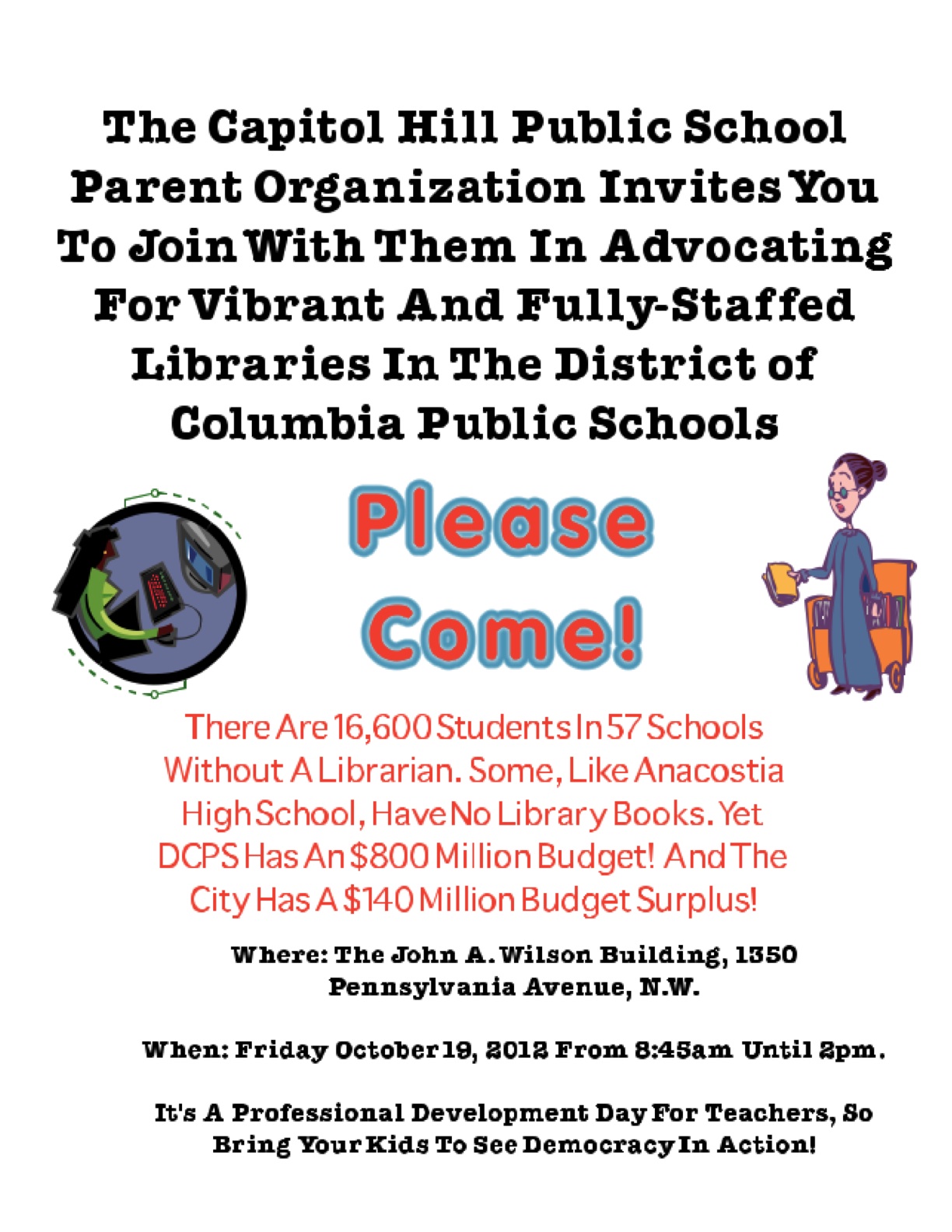
  • Protest/rally on Friday, October 19 at the Wilson Building – 8:45 AM – 2:00 PM

5) Learn about IB Middle Years Programme (Joe Weedon)

  • October 23, 6PM at Atlas Performing Arts Center, including principals from Eliot-Hine, Jefferson and Eastern. More here.
  • Need volunteers to set up and help sign participants in – contact Joe Weedon (joeweedon@verizon.net)


6) Eliot-Hine Living Room Chats – Suzanne Wells

– Looking for 2nd 3rd 4th and 5th grade parents to participate, co-host. Contact Suzanne (m.godec@att.net)

– NOTE: Eliot-Hine set to get bicycle racks!


Next CHPSPO Meeting: November 20, 2012

Upcoming events:

  • Oct 19:  Support School Libraries Rally/Protest, 8:45 AM-2 PM @ Wilson Building. More here.
  • Oct 21: Brent’s Ward 6 Fall Safety Festival, 11 AM- 4 PM (all donations to support the Meslin Family). More here.
  • Oct 23: Learn about International Baccalaureate Middle Years Programme, 6PM @ Atlas Performing Arts Center. More here.
  • Oct 27: Tyler Fall Harvest. 11 AM- 3 PM. More here.
  • Oct 27: Maury Fall Festival. More here.
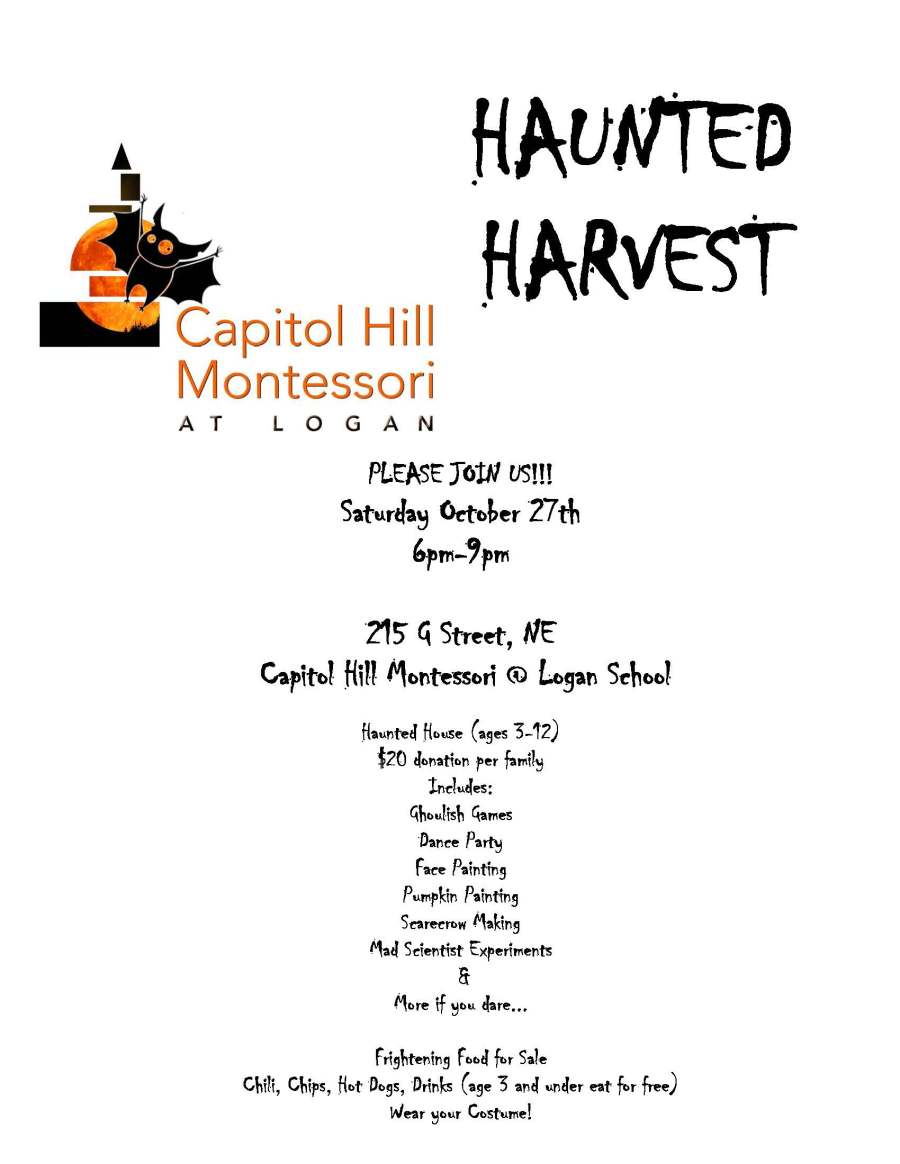
  • Oct 27: Capitol Hill Montessori @ Logan Haunted Harvest, 6-9PM. More here.
  • Nov 8: Cluster Family Game Night & Wine Raffle. More here.
  • Nov 10: Amidon-Bowen Fun Day.  11 AM-2PM


Capitol Hill Montessori at Logan’s Haunted Harvest is Sat, Oct 27,6-9PM


More details: http://capitolhillmontessorischool.org/

Tyler’s Harvest Festival is Saturday, Oct 27, 11AM-3PM


More info at: http://tylerelementary.net/headline/harvest-festival-2012/


Ward 6 Fall Safety Festival at Brent ES is on Sunday, Oct 21!

Save School Libraries Protest on Friday, October 19 – Wilson Building


Can’t make the Rally? What else can you do to help Save School Libraries?

  • Read this fact sheet –> Library Facts Handout 9-19 and reach out to the Mayor Gray, your Councilmember and Chancellor Henderson.
  • Support Council Member Jack Evans’ bill to restore DCPS funding for librarians, art and music teachers.
  • Encourage local leaders to support this effort, like ANC6B’s Resolution.
  • Sign the online petition.
  • Tell the world you support our DC Public School Librarians. ‘Like’ CHPSPO on Facebook, follow @CHPSPO on Twitter, tweet #SaveSchoolLibraries. Keep up with updates via http://chpspo.org