Mark Simon Testimony – Public Oversight Roundtable on the Future of School Reform – March 19, 2018

This hearing asks exactly the right question. Deep reflection is in order about the past and future of DC education reform. That has not occurred for 11 years. Even when the PERAA report came out in 2015 it didn’t really happen. Those who now say we’ve just had bad actors or big bumps in the road need to open their eyes a bit wider. As an Education Next article last week pointed out, the DC “high school graduation fraud is a feature, not a flaw, of a system that incentivizes doing what looks good, not what is good,” for students. From 2007 to today, the focus has been on producing metrics on a narrow set of indicators, by any means. Arbitrary goals were set. Teachers and principals were rewarded or punished. And now we can see that strategy – aim high, crack the whip, no excuses – has not improved outcomes for low income students of color in DCPS or charter schools. The achievement gap has widened. School staff have become cynical. Why? I would submit that we should have been listening to teachers, to principals, to parents and students, especially when students vote with their feet. The warning signs were there all along.

· We have seen since 2007 a system that promised and enforced unreasonable numerical score gains without coherent underlying educational strategies for getting there, just pressure to produce the results.

· IMPACT has never had the confidence of teachers, and sure enough, it looks like the pressures principals were able to exert through powerful rewards and punishments got teachers to pass and graduate students who shouldn’t have been. IMPACT, a system of ranking and rating teachers rather than a way to nurture and support good teaching, needs a thorough external review. Many feel it is the source of other problems. Who’s listening to the teachers?

· Teacher and principal turnover is a clear indicator that something is amiss in the professional culture of our schools in both DCPS and charters. In Chicago, the nation’s fastest improving school district[1], principal retention is 85%. In DC it is around 75%. Teacher turnover in our highest poverty schools is around 33% each year. It’s even higher in charters. Who’s paying attention before teachers and principals vote with their feet?

· Instability is one of the most disturbing features of high poverty students’ lives, and we have managed in the era of DC education reform to make the public education experience for students to find a decent school more unstable than ever. And the Cross-Sector Taskforce not only failed to grapple with the problem but came up with a plan for greater instability and more mid-year transfers. Why did the DME seem to listen more to the business concerns of privately run charters than the pain of families who want a system of good neighborhood schools?

· Michelle Rhee, Kaya Henderson, and Antwan Wilson never actually produced overall step-by-step education plans for how to improve the quality of teaching and learning, a strategy based on research for organizing schools for improvement[2], how to engage parents, or improve the learning culture in each school. What they produced were checklists for teachers, and brochures that announced initiatives or proclaimed numerical goals. Those are very different things.

· OSSE is in charge of data, but their school and system data is designed assiduously to be impenetrable. Data is almost never broken out by race and income. It doesn’t evaluate programs or track results except to be able to proclaim success. We need independent research, funded by the council, but not accountable to the same mayor who is motivated to be able to always declare success. Why is Mary Levy’s volunteer work still the main source of independent research that tracks what’s really going on in schools so that problems can be identified? At least put her on the payroll.The DC Council has funded ($506 Million) and relied on OSSE for information. And yet you keep getting blind-sided with data scandals uncovered by the press. Past scandals like the 2009 test cheating, uncovered by USA Today, were never investigated.

· Parents and teachers attended hearing after hearing in the fall of 2016 on new ESSA evaluation criteria, and clamored for schools to be evaluated more broadly, not just based on standardized test scores that mainly track students’ socio-economic background. But based on OSSE’s plan, next year my great neighborhood school (according to parents), Bancroft ES, will still get rated as just above failing because of low test scores. Next year, if OSSE has its way, my neighborhood will be embarrassed by a new star rating system giving Bancroft just one or two-stars. Who’s listening to parents?

· It is not time to “stay the course” as some have suggested. Quite the opposite. Its time for serious introspection and mid-course corrections. The new DME must be someone open to honest, bottom-up analysis and engagement of parents and teachers in developing operational plans for each school and systems overall, as must the new chancellor. Many good things are going on in the margins. There are some good early childhood programs. Many schools are well run. Curriculum coaches do good work with many teachers. Exciting initiatives are taking place to engage parents and teachers, but these are one-off efforts and cannot be said to be part of an overall reform strategy. They are filling huge gaps.

· Teachers in both DCPS and charter schools have recently energized a new organization called EmpowerEd to elevate the voice of teachers in each school and system-wide. This is a direct response to 11 years of attempts to “teacher proof” and marginalize the good ideas, creativity and initiative of teachers. It is a response to the failed strategy that seems to view teachers as the problem, not the solution. It is being well received among teachers in both sectors.

· Principals continue to live in fear, with one-year contracts, high turnover, and in many cases unreasonable expectations to meet, on penalty of getting fired.

· Mayoral Control creates a single hierarchy and not enough opportunities for the public to have a say. The 2015 PERAA report said that theoretically it could work, but as implemented in DC it has not produced a coherent strategy for improvement and is not working. They’re right. We either need a new elected school board for the city, or the State Board needs real authority, or the DC Council needs its own research arm and ability to hold the mayor and agencies accountable. The past 11 years have witnessed the politicizing of reform, shutting out of parents and teachers, not better accountability.

I would suggest the following broad approaches to a re-thought Education Reform era.

1. Invite a conversation in each school about how best to implement a Community School approach. To work, Community Schooling must be owned by parents, teachers and the community at large. It has four components.

· Wraparound services

· Extended day and extended year offerings

· Parent and family engagement

· Teacher empowerment to stimulate innovation, teamwork and creativity

Education results cannot improve if we don’t begin with the real and pressing needs students face that are getting in the way of focusing on learning. We need to begin with an honest conversation in each school with the people who know best – teachers, principals, parents, and the students themselves.

2. Broaden the evaluation criteria for what makes a good school. Engage parents, teachers, and principals in developing the criteria. Do not double down on the same narrow test-based criteria that OSSE has chosen. And do not implement the five-star report card envisioned for next fall. Each school might be invited to engage in a stakeholder assessment of school strengths and weaknesses and to develop a plan for school improvement to be displayed on the school website. A school isn’t a set of numbers. It’s a community of people.

3. Undertake qualitative investigation of the evaluation systems of both teachers and principals. Develop a newly designed system aimed at nurturing good teaching and empowering the profession to innovate with the particular students in each school in ways that will work.

4. Continue to invest in curriculum development and teacher and principal training. For much of the Rhee and Henderson era the standardized test, over-emphasis on reading and math, and tricks to get students to score higher was the emphasis. It is only more recently that an investment has been made in the breadth of subjects like social studies. There is much still be to be done to provide teachers with the appropriate content and support in the full breadth of subject matter that shows respect for subject matter expertise. Learning a love of reading, how to do research, how to work in groups, and learning to love the subject matter being studied should be the goal, not the content to be covered on the PARCC test.

5. Acknowledge the mistakes of the past. Most of all, I think we have a credibility gap. If the agencies in charge of public education continue to say we’re doing great but just have a few bumps in the road – stay the course – you will lose the strong base in the public who believe in public education and want to make our schools work for all our students. DC has created a powerful spin machine that has to be reoriented to look for honest analysis and solutions. As a start, authorize and fund an independent research arm that can begin to look into some of the questions above.

6. Consider reorganizing systems and budgets. Funds are being spent inefficiently with duplicative bureaucracies so that they are not getting to the students who need them. Agencies, like OSSE, have become huge with little accountability to anyone. Parents, teachers, and community allies and advocates have been marginalized. While rearranging governance may not be a solution, we should consider reinstating a real Board of Education, or a State Board with authority, to institutionalize greater responsiveness to the public. The DC Council cannot continue to be the only recourse for school based and other concerns to which the system should have been more responsive. The Council, try as you may, is not staffed to play that role. It needs access to independent research and data analysis. It is time for a mid-course correction to Mayoral Control of everything. We need a better plan for improving the quality of education in the District of Columbia. The process of hiring a new DME and chancellor will certainly provide an opportunity to begin a fresh approach leading to better reform strategies as long as the mayor can be convinced to treat it as an opportunity to turn a corner rather than continue to demand fealty to discredited strategies and reform orthodoxy.

[1] Badger and Quealy, Dec.5, 2017 New York Times, “How Effective Is Your School District?” A New Measure Shows Where Students Learn the Most. — Based on new research by Sean Reardon at Stanford University rating district efforts to narrow achievement gaps.

[2] Bryk, Sebring, Allensworth, Luppescu and Easton, the Consortium on Chicago School Research, Organizing Schools for Improvement

CHPSPO Meets Tuesday, March 20, at Capitol Hill Montessori@Logan

Dear Capitol Hill Public Schools Parent Organization Members,

CHPSPO will hold its monthly meeting on March 20, 2018, at the Capitol Hill Montessori@Logan building (215 G St., NE). At this month’s meeting:

– Dan Davis with the Office of the Student Advocate will share information about an April 9 special education workshop (flyer attached);

– Erin Roth and Samantha Batel with the Center for American Progress will discuss an article they’ve written on PTA funding inequities; and

– Council Chair Phil Mendelson will join us for an informal discussion on education issues.

Hope to see you on Tuesday.

Suzanne Wells

Analysis: PTA Purchasing Power Leaves Low-Income Schools Even Further Behind

From state budget cuts to federal tax reform, school funding faces real constraints from all sides. But school b…

Ward 6 Special Education Workshop Flyer (Temp).pdf

032018 CHPSPO Agenda.docx

DC Council Hearing on Gun Violence is March 22 – Student Testimony Encouraged

On Thursday, March 22, Councilmember Allen’s Committee on the Judiciary and Public Safety will hold a public hearing on gun violence in the District of Columbia and a number of associated bills on gun safety. Students are particularly invited to testify about school safety and how gun violence has affected them. Council welcomes school groups and student witnesses – please let Laura Marks know if you require help with signing up witnesses, making copies of testimony, or anything else.

Please help get the word out. Full details are below (as well as on CM Allen’s website) and a shareable Facebook event can be found here.

CHPSPO Hosts Education Discussions with DC Council Chair Candidates 3/12 and 3/20

The Capitol Hill Public Schools Parent Organization (CHPSPO) https://chpspo.org/ will be hosting education discussions with DC Council Chair Candidates this month.

Both will take place at Capitol Hill Montessori at Logan (215 G St NE).

Tonight, March 12, 7-8 PMEd Lazere, the former executive director of the DC Fiscal Policy Institute and candidate for DC Council Chair.  The meeting will take place at the Annex/Middle School which is just as you enter the parking lot off of 2nd Street.  If you are walking, you can enter the parking lot to walk to the Annex through the G Street or 2nd Street gates. If you are driving, cars have to enter at the 2nd Street gate to park in the lot.

Tuesday, March 20, 7-8 PM: Phil Mendelson, current DC Council Chair.

Please pass this on to your school communities.

Ward 6 Special Education Workshop – April 9, 2018

Ward 6 Special Education Workshop Flyer

The Office of the Student Advocate is committed to making the public education more accessible by boosting parent engagement and increasing access to resources and supports for families.

Join us for our Special Education Workshop series in Ward 6 cohosted by DC Councilmember Charles Allen, Joe Weedon, Ward 6 State Board of Education Representative and Capitol Hill Public School Parent Organization.

Whether you feel your student needs special education services or you have questions/concerns about existing services, come learn what supports are available. This session will answer your questions about navigating special education at a public charter or traditional public school and provide additional information about you and your student’s rights. Not only will you be able to gather information and resources, but you will also have the opportunity to connect with special education experts throughout the District regarding your student’s specific needs.

PLEASE RSVP for this session at http://bit.ly/2G4BeJU.

If you need more information, call us at 202-741-4692 or email the Office of the Student Advocate at student.advocate@dc.gov

Please share within your schools and communities – parents, caregivers, educators from ALL Wards are welcome! Download the Ward 6 Special Education Workshop Flyer and distribute.

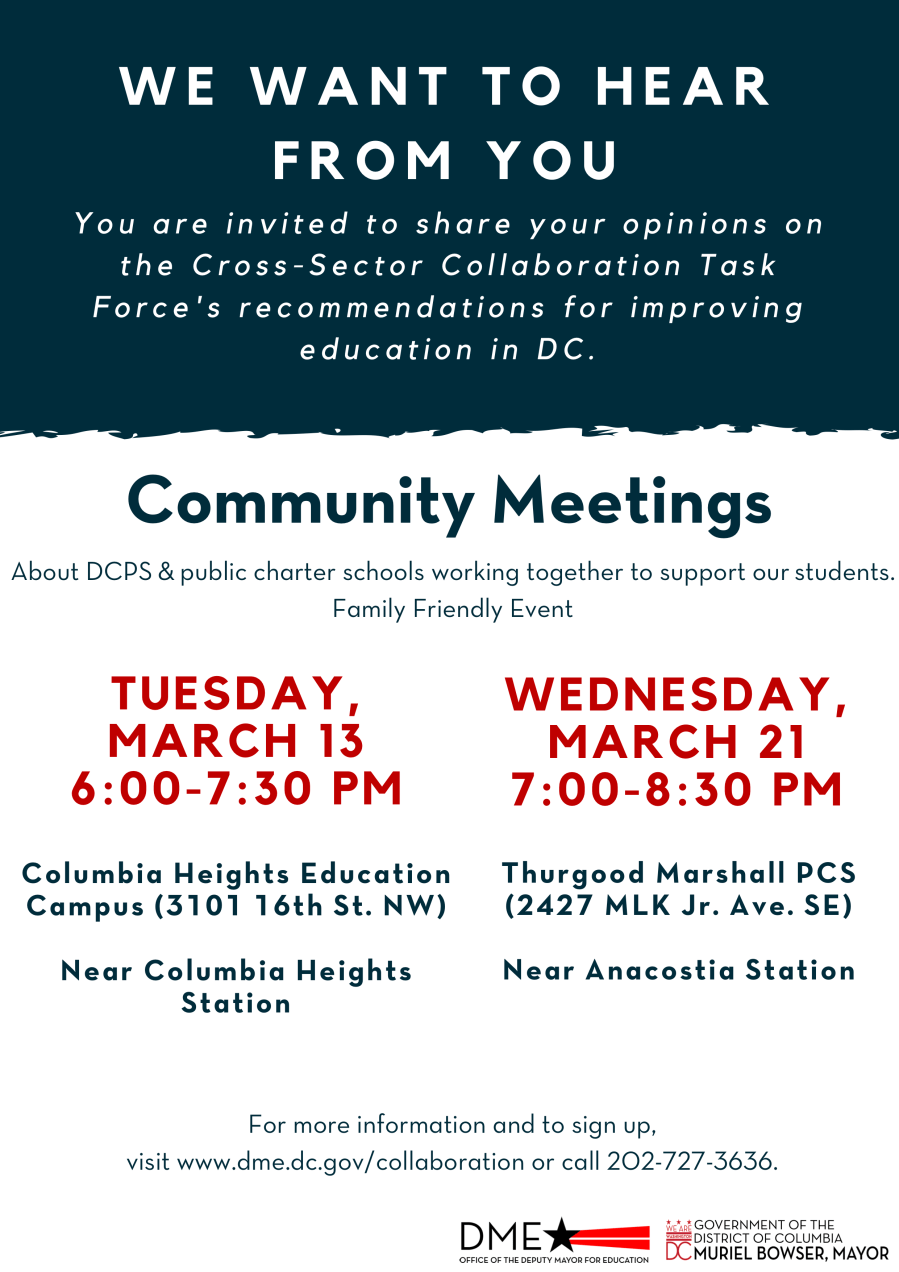
Community Meetings for Cross-Sector Collaboration Task Force (DME)

Cross Sector Community Meeting Flyer

Bike to School Day is May 9 – Save the Date!

BTSD_2inch_Color

How to plan a fantastic party on wheels with all your school friends….

  • Step 1: Mark your Calendar –> May 9, 7:30-8:30 AM @ Lincoln Park.
  • Step 2: Register your school‘s event (or your participation in the Lincoln Park event)!!
  • Step 3: Tell all your friends about Steps 1 and 2!

CHPSPO Meeting Notes– February 20, 2018

Stuart Hobson Middle School, 410 E St., NE
February 20, 2018, 6:30 p.m. – 8 p.m.

Mission Statement – To promote cooperation among the parent organizations of the public schools [in Ward 6] in order to improve the education received by all children attending our schools.

Overview of the DC Council Performance Oversight and Budget Hearings –

Laura Marks, Chief of Staff, Councilmember Allen and Anne Phelps Budget Counsel at Office of Budget Director shared a presentation with key budget facts, timeline, and key advocacy opportunities/dates. Please review the FY19 Education Budget Process – CHPSPO Presentation for details.

About the budget: Important to note, the budget is a finite amount. Operating budget (recurring costs like payroll, goods, services) is planned for 4 years (must be sustained for 4 years). Capital budget (one-time, more limited spending like facilities) is allocated annually.

About education budget: Enrollment projections have huge impact on school level budgets

  • Really important to get these #s right, but they are often off
  • Per Pupil Funding applies to DCPS and charter; also takes into account special needs

Education is underfunded. For example, for FY18’s budget OSSE recommended 3.5% increase for FY18. The Mayor’s budget office proposed 1.5%, Council passed 3%. ***If PPF increase this year is <3%, will be tough to fund operating budget; keep programming***

It’s important to engage in Budget forums and hearings not only to bring visibility to specific issues, but to learn about other priorities. When testifying, bring written copies: Councilmembers and staff write notes/qs on testimony.

Ward 6 School Facilities Tour – Joe Weedon, State Board of Education

Joe Weedon to organize on behalf of PTAs a tour of schools to identify potential problems and critical things that need to be implemented between now and when schools are slated to be renovated.

CHPSPO Strategic Planning Meeting – Danica Petroshius and Suzy Glucksman

To enhance our efforts to develop common goals, facilitate collaboration, and drive real change among public schools in Ward 6, to improve the education received by all children, the Capitol Hill Public Schools Parent Organization (CHPSPO) is engaging the DC education community in a strategic planning process.

All CHPSPO members, as well as families, principals, and engaged community members are invited to participate in this strategic planning (working) meeting where we plan to develop long-term and short-term priorities for our work supporting Ward 6 schools.

https://chpspo.org/2018/02/13/join-chpspos-strategic-planning-feb-24/

Bike-to-School Day Planning – Sandra Moscoso-Mills

Bike to School Day is Weds, May 9. CHPSPO organizes a ‘party’ at Lincoln Park, where families from all nearby schools meetup, socialize, grab a snack, engage in activities, and join bike trains and walking groups to get to school ON TIME! Learn about the national efforts at http://www.walkbiketoschool.org/.

Please reach out to Sandra to if you’re interested in helping identify local and national speakers, organize activities, invite city partners (DC Water, DCPS, WABA, bike shops, etc), and help get the word out at your school.

  • JO Wilson Cheerleaders to perform

Chancellor’s Parent Cabinet – Heather Schoell

Meet periodically and have broken out into issue-based groups of Middle School, Budget, College and Career. DCPS central offers a lot of programming, but not doing a good job communicating to families.

Find background and meeting notes, here: https://dcps.dc.gov/page/chancellor%E2%80%99s-parent-cabinet-sy-2017-2018-cabinet-priorities-and-updates

Other advisory committees shared by the group include

  • Global education advisory group (both Heather Schoell (Eliot-Hine and Eastern parent) and Stefany Thangavelu (Maury parent) serve on Global Ed Advisory Group)
  • Public Spaces advisory group

More on Boards and Commissions: https://mota.dc.gov/page/boards-commissions-and-task-forces-district-government

New Chancellor – Group Discussion

Ideas for engaging raised: engage in process for finding replacement; relay shortcomings from last experience; Are there changes we should push for vis a vis governance, particularly regarding the role of the State Board of Education.

ACTION: Draft letter to Mayor articulating issues raised during meeting.

——

Next CHPSPO Meeting: March 20, 2018

Upcoming Events

DC Council Performance Oversight and Budget Hearings

  • Wednesday, February 21, DCPS Performance Oversight Hearing, public witnesses, 10 am (Wilson Building)
  • Wednesday, March 28, DCPS Budget Hearing, public witnesses, 10 am (Wilson Building)
  • Thursday, April 19, DCPS Budget Hearing, public witnesses (Wilson Building)

Cross Sector Collaboration Task Force Focus Groups

  • Tuesday, March 13, 6 – 7:30 pm, Columbia Heights Educational Campus (3101 16th St., NW)
  • Wednesday, March 21, 7 – 8:30 pm, Thurgood Marshall PCS (2427 Martin Luther King Ave., SE)

CHPSPO Strategic Planning Meeting – Saturday, February 24, 9:30 am – 1 pm, Northeast Library (7th & Maryland Avenue, NE)

Kenyon Weaver Testimony – DCPS Performance Oversight Hearing – February 21, 2018

Good Morning. I’m Kenyon Weaver, a parent at Maury Elementary and member of the Maury PTA, as well as the Maury SIT, or School Improvement Team.

Last week, I provided testimony on how, while Maury is blessed with a strong community and high trust within our school, including our excellent Principal, administration and faculty, that DCPS Central Office was failing to meaningfully engage with the community with regard to the Maury modernization process. Today, I’m here to provide suggested solutions for the way forward.

A lot has certainly happened in the past 9 days to further erode trust. The DCPS Central Office leadership needs to restore that trust. These are District-wide proposals that will help to restore that trust:

· First: Transparency. Here we are with a crisis of transparency and fair process at the very top, but it is similarly a crisis in the lower interactions between the DCPS Central Office and the individual school communities. Transparency in the SIT process means:

o Identify community priorities and needs before design;

o Hold regular meetings;

o Provide the community with actual deadlines, real budget numbers – do not deflect or avoid or “run out the clock”;

o Be honest in those responses. The community does not expect every wish and desire will be fulfilled but we expect a candid conversation.

· Second: DCPS leadership, DGS leadership, and DDOT leadership should support Councilmember Allen’s Daytime School Parking Zone Amendment Act, providing teachers a mechanism for permits for on-street parking. Otherwise, the District will not be putting Kids First. At least, not all kids.

· Third: DCPS should adopt minimums for play space in its Educational Specifications. Under the DC Code, we could have a school with a mandatory 30 parking spaces, and zero outdoor play space. That’s because there’s no requirement that a school have play space. Again, without these, in my view the District cannot claim to be putting Kids First.

As I noted last time, because of DCPS Central Office’s intransigence, Maury Elementary’s new building simply will have not the facility it needs to support the expected 500+ students. Yes, it will have classrooms. Like every school. But, no, it will no longer have a usable garden or sufficient playground space. And it never will, because of the poor decisions being made now.

But we can still salvage something, with Transparency that restores trust, and with legislation and policies that puts all Kids First. Daytime School Parking Zone Amendment Act, and with outdoor playspace in Ed Specs. And we can make steps back to restoring trust. Parents are willing.

Dr. Jalan Washington Burton – DCPS Performance Oversight Hearing – February 21, 2018

Good afternoon. My name is Dr. Jalan Washington Burton and I am a wife, mother, Ward 7 resident, physician consultant for one of the DC Medicaid programs, and a Pediatrician who practices in Ward 8 in Southeast DC. I have a background in pediatrics, public health, health disparities, and quality improvement. I am the Co-secretary of the Tyler PTA and a member of the newly formed Advocacy Subcommittee. I am here to speak briefly about issues that are very important to me – the health and education of DC children. As the mother to a Tyler first grader we lovingly refer to as Zo and a baby due today, you can tell these issues are very important to me.

First I would like to talk about HEALTH AND WELLNESS:

As our PTA President Patrick has shared, there are pressing health and safety issues related to facilities that must be prioritized. Our country, and especially urban areas such as Washington, DC, are experiencing a rise in childhood overweight and obesity. Study after study shows that children need less time sitting on their butts and need more time spent outside playing and having fun and they need easy access to fresh water. One of my son Zo’s favorite places to be is outside at the playground, but when I see caution tape on the playground bridge month after month, it is dangerous and unacceptable. I know work orders have been submitted but why isn’t a safe and fully working playground more of a priority? When will it truly be fixed? I see beautiful updated playgrounds at schools such as Van Ness and I wonder – when will Tyler’s upgrades be a priority? Tyler has a long outdated track, several areas with underutilized concrete space, and I again wonder when will Tyler and the children who attend our school be the priority?

Along with time outside, children need easy access to water. The outdated and often broken water fountains found here at Tyler are something that parents and teachers alike know need to be fixed. While I applaud the school administration for working quickly to report them and have them fixed, the repeated repairs show that it is time to just upgrade them. Upgraded models with spots for water bottles and easy cup filling will help teachers and parents offer water more easily to all children. When our son forgets his water bottle at home he often reports he didn’t drink anything all day because we do not allow him to drink juice and he cannot drink the dairy milk offered in the cafeteria.

Another facilities concern that has very real health implications is exposure to peeling paints and rodents. It is no secret that mice and rats plague many old DC buildings. When children are exposed to these conditions at home and then also at school it is a very dangerous mix. Asthma is one of the leading causes of preventable death in children. I see poorly controlled asthma every day in my practice. I can do pretty well with education and treatment when there are no housing or school issues but when there are I know there are virtually no good solutions and I go home frustrated and saddened. When we were notified of the rat issue at Tyler it was very concerning. I again applaud the administration for working to prioritize this issue and hope to see continued collaboration with DCPS.

Next, I would like to talk about the TRADITIONAL PROGRAM, previously known as the Creative Arts program.

When my son first joined the Tyler family last year my husband and I thought he was enrolling into a Creative Arts Curriculum as it is commonly referred to. We value the arts and see it as an integral part of developing creativity and critical thinking. We loved Zo’s first grade teacher Mrs. Ughiovhe because she daily included music, singing and dancing into our son’s education and he thrived. As I became more and more involved with the PTA I learned that the Creative Arts curriculum has not been funded for at least the last 2 years. My husband and I were saddened to learn that this had occurred and we were also concerned that its funding was not a priority with the city and that the opportunity to fundraise to continue the program had not been offered. We continue to get mixed messages from parents and the administration alike about the program – we are told that teachers no longer have formal creative arts training at Tyler but at other schools they do. We are also told that some parents want a school-wide dual language program, others want school-wide traditional education, and others want creative arts. My fellow parent Elsa discussed these issues in more detail, but as a second year parent here at Tyler it is exceedingly confusing and frustrating that a unified vision for the school does not exist. Either way a decision has to be made and as parents we need transparency. I need to know what programs are truly being offered so that I can make the best decisions for my child and advocate for other children. And I also need to know where my help fundraising is needed.

In closing, I thank you for the opportunity to share my perspectives as a parent and Pediatrician who lives and works in Southeast DC. Our children mean the world to us and the world depends on us providing them with the tools and resources they need. One of my favorite quotes by Frederick Douglas says “it is far easier to build strong children than to repair broken men.” I implore us all to prioritize these children and do a better job each day to provide them with the resources they need to be the strongest children they can be.