Danica Petroshius Testimony – DC Public Schools Budget Hearing – April 14 2016

TESTIMONY OF DANICA PETROSHIUS

PARENT, CAPITOL HILL MONTESSORI AT LOGAN

deptroshius@yahoo.com

April 14, 2016

Thank you for the opportunity to testify. I am Danica Petroshius, a Ward 6 resident and a parent of two at Capitol Hill Montessori at Logan. Our school is PK through 6th in one building and a middle school in a trailer, and our families come from every Ward. We love this school – the teachers, the principal, the parent community and the Montessori approach.

But once you look beyond the school community, we don’t like what we see. We see a city that has punted our modernization from 2014 to 2017 to 2019 – and now indefinitely. We see a city that cannot provide accurate, full data about our school. We see a city willing to leave schools untouched for too many years.

Enough is enough. We have been told by a few senior members of the government that there is a chance of retribution from the system when parents speak out. That’s wrong. Fear is no way to run a city. We look all our city leaders in the eye and say: hear us and work with us. We have an opportunity now to change the dialogue from one of fear and behind-closed-doors decision-making to one of transparency, accurate data and full investment.

Chairman Grosso, we applaud your call last year to bring a data-driven approach to modernization. We were thrilled to hear that the Mayor would have a transparent modernization process and use data to make the decisions. On approach, we are all aligned.

But the approach breaks down when you look at process and data. There is no record of the data collection used for the building assessments. If it was DGS data, their data shows that our school has never been assessed. It was suggested to us that the Mayor got her own data instead by touring schools. But we’ve never seen that data and we have no idea if it’s accurate. Were modernization experts with her? Were principals who know their buildings best asked to help identify the school’s needs? Was our school included?

In addition, DGS found lead in our water last year without notifying us. We found out from a blog article. Now, DGS cannot provide the data showing that our school is 100% remediated of lead. Whether it’s the building or lead in the water, if we can’t get comprehensive and accurate data, then the entire process fails.

The approach further breaks down when even the metrics to rank schools are faulty and inconsistent. For example, our middle school did not receive a priority like other middle schools. But in deciding our capacity rating, it appears our trailer that houses the middle school was counted which means that they do know that we are a middle school. Some have argued that we are an education campus not a middle school. This bureaucratic distinction between an education campus and a middle school doesn’t change the fact that we have kids who are in middle school in a separate trailer. Do you want to tell our 7th and 8th graders that they are not in middle school?

We’ve given you the charts that show the data is faulty and missing. The process and data systems used to create this proposed modernization plan are broken.

Finally, the system fails on investment. Parents and many on council fought hard to take us from cuts in school modernization last year to increases this year. But it’s not yet a job well done. We can find money for every school and modernize them over the next 5 years. No one believes we have an economic crisis in DC. We are leading other cities in economic growth at 3-4% a year. We have a cash reserve of over $700 million. You can’t throw a stone in this city without hitting a crane that is building more condominiums and more restaurants. And we now are spending $50 million on a practice stadium for a professional basketball team whose owner is worth billions. The city should reprioritize and fund the must-have’s–safe strong schools –first. Only then should they fund the “nice-to-have’s.”

Today, I ask each Councilmember to stand with us and stop the budget process from moving forward until three tests are met:

  1. There is full, accurate and fully transparent data for every school.
  2. The metrics for ranking school modernization include that data and priorities are applied consistently across every school.
  3. There is funding over the next 5 years to fund every school’s modernization needs.

We have attached a letter from over 230 parents in our school calling for a better solution. We welcome parents from other schools to join us. We welcome the ability to work with the Council and city agencies on a solution. The city has set very high learning standards for our children – standards that we as parents help our kids and teachers meet every day. It’s time for the city leadership to set their standards high too.

Thank you.

Suzanne Wells Testimony – DC Public Schools Budget Hearing – April 14 2016

Updated 4/15/2016 with final version.

DC Public Schools Budget Hearing

April 14, 2016

Suzanne Wells


Thank you for the opportunity to testify this evening on the DC Public Schools SY2017 budget.  The focus of my testimony this evening will be on middle schools.  My daughter is currently a 5th grader in the Tyler Elementary Spanish Immersion program, and she will be attending Eliot-Hine Middle School, our in-bound middle school, next year.

I want to thank DCPS and the Eliot-Hine principal, Tynika Young, for the efforts over the past several years to work towards Eliot-Hine becoming an International Baccalaureate Middle Years Programme.  These efforts resulted in the school becoming an authorized IB programme this past November.  It is my hope the IB programme will provide an engaging and challenging curriculum for all students attending the school.

There is much talk about the middle schools being a weak link for DCPS, and Mayor Bowser even campaigned on the slogan “Alice Deal for All.” While there is much talk about supporting the middle schools, one area that is seriously lacking is the modernization of the middle school buildings.  The recently released Capital Improvement Plan does seem to have budgeted what are believed to be more realistic numbers for the costs of renovations, yet it is not clear how these higher numbers were determined.  In Ward 6, the middle schools are far back in the renovation queue.  Eliot-Hine Middle School is not scheduled to be renovated until 2019, Jefferson Middle School is not scheduled to be renovated until 2021, and Capitol Hill Montessori@Logan which contains a middle school was not even included in the 2017 – 2022 Capital Improvement Plan.  All students starting at Eliot-Hine and Jefferson next year will be in high school before the buildings are renovated, and it will be even longer for the Capitol Hill Montessori@Logan students.  This doesn’t seem like an Alice Deal for All.

These middle schools are struggling, often through no fault of their own.  They face intense marketing from charter schools that often start at 5th grade, and draw away families who are concerned about their middle school opportunities.  The condition of the buildings also doesn’t help to attract families.  When windows have to be opened in the winter because the classrooms get overheated, or the air conditioners in the warmer months are so loud the students can’t hear the teacher, or the lighting is poor, families often look elsewhere for middle school.

Yet these middle schools present tremendous opportunities for DCPS.  For example, the Eliot-Hine building sits on 6.4 acres of land on the edge of Capitol Hill.  It’s not hard to imagine families choosing to send their children to an authorized IB Middle Years programme in a renovated building that meets the criteria for a Green Ribbon School and sits on a 6.4 acre campus that they can walk to each day.

I encourage the Education Council and the Mayor to find a way to move these middle schools up in the renovation queue in the current Capital Improvement Plan.  Respected organizations like the 21st Century School Fund have repeatedly identified the need for greater cost accountability and oversight in the DCPS modernizations.  There should be savings on the modernizations projects since the city will no longer be doing summer renovation blitzes.  There may be opportunities to reduce some of the modernization estimates if we have a better understanding of the estimated square foot costs for the individual school modernizations, and find some can be reduced while still providing high-quality renovations. Savings achieved from greater accountability and oversight, moving away from summer blitzes, and any possible reduced square foot cost estimates could be put toward our middle schools.  Our city’s middle school students are too important to have their modernizations delayed any longer.

Jablow testimony, DME Budget Hearing 4/13/16

I am Valerie Jablow, testifying about the ineffective public education stewardship of the DME’s office that I have experienced as a Ward 6 public school parent. This lack of effectiveness comes at the expense of by right schools and their students, who are the majority of children in DC.


Here are some examples:


Renovation of DCPS’s Eliot-Hine Middle School has been delayed again, despite mold, rodents, and persistent HVAC issues. Since Eliot was built 85 years ago, its upkeep and improvement have been minimal[1]—as has city investment in most other Ward 6, by right school facilities[2].


In the meantime, with charter middle schools starting in 5th grade and actively marketing themselves to Ward 6 by right elementaries,[3] Eliot-Hine’s feeder system has been decimated, and it has lost enrollment for years running.


The DME’s office has not addressed these crises.


In 2014, then-DME Abigail Smith offered a nearby closed school to charters, presenting data showing hundreds of empty seats at DCPS schools around and including Eliot-Hine.[4] When asked why create another public school in an area where her own data showed a glut of seats, the DME had no answer.


Then, during her performance oversight hearing last month, the current DME noted how the city created the misalignment of middle school grades between charters and DCPS[5]—leading to the depopulation of many DCPS elementary and middle schools. The DME testified that she has no idea how to solve this problem.


Another example:


In March, the DME rolled out data on programmatic capacities of public schools.[6] Charter schools estimated their own capacities, according to current and future uses, curricula, and staffing. Capacities of DCPS schools were estimated by DGS mainly according to square footage.


My daughter’s DCPS school, Watkins Elementary, as a result appears to be slightly underenrolled even though it has been fully enrolled—and not meeting ed specs–for decades.


And yet, on the basis of this data, the DME analyzed DCPS school utilizations and outlined plans for schools thusly considered underenrolled.[7]


But the DME did not outline charter school utilizations–not even for the 44 charters currently in former DCPS spaces.[8] Nor did the DME’s data account for the high closure rate of charter schools,[9] despite both pieces of information being vital to any comprehensive public education planning in DC.[10]


The mayor and her deputy supposedly oversee all public education in DC. The buck stops with them for misalignment of middle school grades; poor conditions at schools like Eliot-Hine; and underenrolled schools.


And the buck stops with them for equitable planning that would prevent these problems in the first place. Saying “I don’t know how”; pretending no one has oversight of charter schools or enrollment; or shifting the burden to a temporary, volunteer group (the cross sector task force) are excuses that hurt kids.


Here is how things could be better—tomorrow, if you and the mayor wanted:


–All charter and DCPS middle school grades aligned starting SY17.

–No school created or closed before the poor conditions at Eliot-Hine and other unrenovated schools are completely remedied.

–No school created until empty seats at existing schools are filled.

–School capacities and uses equitably analyzed across sectors—and, until they are, no school openings, closures, or new uses.


Our kids deserve education leaders who work for all DC public education students. Thank you.

—————-

Footnotes

[1] See http://greatergreaterwashington.org/post/30291/eliot-hine-a-dc-middle-school-is-falling-apart/ and DGS data used to prioritize FY16 capital spending.


[2] In a March 2016 presentation, the 21st Century School Fund presented data on DCPS capital expenditures from 1998 through 2015 by ward. Expenditures for Ward 6 were the lowest in the city, both as measured in costs per square foot as well as per attending student:


Ward 1: $44,076/student; $169/sf

Ward 2: $48,038/student; $214/sf

Ward 3: $54,373/student; $323/sf

Ward 4: $36,078/student; $149/sf

Ward 5: $59,244/student; $254/sf

Ward 6: $29,426/student; $126/sf

Ward 7: $33,362/student; $165/sf

Ward 8: $44,541/student; $148/sf

[3] This is obvious to anyone who lives on Capitol Hill and has children in its public schools, but it was recently documented in a story on March 2, 2016 on WAMU (see http://wamu.org/news/16/03/02/5th_grade_dropoff) and also on the blog educationdc.net (https://educationdc.net/2015/09/08/where-have-all-the-4th-graders-gone/).

[4] This was the offer of the closed DCPS elementary Gibbs. Besides the glut of seats, the community around Gibbs objected to its reopening as a school and the process by which that was undertaken. See http://anc6a.org/wp-content/uploads/GibbsProcessConcernsDGS.pdf


[5] This was on March 2, 2016, at the performance oversight hearing before the council’s education committee. The exchange on the DME’s recognition of misalignment of middle school grades between charters and DCPS began at the 4:17 mark. At 4:21, Charles Allen asked, “Is this something on the table for the cross sector task force?” The DME responded that the task force would be “truly collaborative,” but warned that “decision rights” are not on the table and she would not enact a “fiat.” She then stated, “I don’t know how we are going to solve it.” The charter school board, she noted, would have to choose to have schools to start at certain grades—and then said that it is not in her power to make them do that. See here: https://educationdc.net/2016/03/24/performance-oversight-tidbits-deputy-mayor-for-education/

[6] Some of this data was used for facts sheets for the cross sector task force, but most appears to have been part of the master facilities plan supplement.

[7] See page 6ff of the MFP supplement, available here: http://dme.dc.gov/sites/default/files/dc/sites/dme/publication/attachments/SY15%20MFP%20Annual%20Supplement3%207%2016.pdf

[8] It is not clear if the city still has the public information about square footage and programmatic capacities for these buildings—but it should, given that many are still owned by the city and leased.

[9] Depending on how one calculates this, the charter closure rate goes from a low of 33% to a high of 40%. The NRC report on mayoral control of schools (http://sites.nationalacademies.org/cs/groups/dbassesite/documents/webpage/dbasse_165783.pdf) noted that 102 charters have been granted in DC since 1996, with 38 since closed and 8 never opened, making for a charter closure rate approaching 40%. A report from the Progressive Policy Institute (http://www.progressivepolicy.org/slider/tale-of-two-systems-education-reform-in-washington-d-c/) notes that a third of all charters have closed between 1998 and 2015, making a closure rate of 33%. See https://educationdc.net/2015/10/07/predicting-the-education-future-in-dc/


Adding in DCPS closures makes the school closure rates even more stark. Using 21st Century School Fund data, I counted all DCPS schools closed since 1996, when charters started here. I got 65 schools closed. If you add to this the NRC number of closed charter schools since 1996, you get a total of 103 public schools closed (65 + 38) since 1996, for a closure rate of 51 public schools per decade–or 5 entire public schools closed every year on average in the last 20 years.


That is a huge number to sustain for both communities and resources in our city. Add to that the fact that the head of MySchoolDC, the DC public school lottery, testified in March before the council that the most important factor for parents choosing schools is proximity to their home.


Our high rates of school closures simply prevent parents from enacting school choice, all the while decimating communities that depend on those schools.


[10] Let us not forget another piece vital to education planning: the growth of the student population and the growth of the number of schools. In DC, we do the latter far more than the former. In 1999-2000, DC had 185 public schools serving 74,800 students. In 2014-15, DC had 223 public schools serving 85,400 students (data from the 21st Century School Fund).


Thus, over a decade and a half, with a gain of 10,600 public school students (14% growth), we have 38 more public schools (20% growth). Each school created requires infrastructure and staffing, raising costs overall. The mismeasure between those numbers adds to those costs.


And adding to all those costs is the high rate of school closures, as detailed in footnote 9 above.


Simply put, if we want to plan well for our public school students and save money while doing so, we need to stop creating and closing so many schools.


I have found nothing among the materials the DME cites or creates that mentions this.

FY17 School Budget Tool: DCPS school budgets comparable and transparent

The Coalition for Public Schools & Communities (C4DC) and Code for DC released a School Budget Tool with all schools’ FY17 budget data (and comparisons to FY16 and FY15).

In the post, “C4DC Budget Tool & the FY17 DC School Budget Data in Context,” C4DC analysis on the tool shows that despite FY17 increases, some schools have reduced buying power for 3 reasons: costs of positions went up; some costs were shifted to school budgets; and an unfunded mandate added responsibilities to schools but not funding.

This comparative data and context will be important in the upcoming budget oversight hearings and in holding our city accountable for the high quality education for all of our students.

CHPSPO Meeting Notes – March 15 2016

Capitol Hill Public Schools Parent Organization
Capitol Hill Montessori @ Logan, 215 G St., NE

March 15, 2016 – 6:30 p.m. – 8 p.m.

 1) Report out on meeting with DME, Marty Welles and Suzanne Wells

  • Issues raised:
    • Funding/support for Ward 6 middle school Eliot-Hine & Jefferson renovations
    • Task Force; grade misalignment
  • DME suggested issues raised should be heard by charter school leaders/board
  • DME will be responsible for drafting Mayor’s capital improvement plan
  • DCPS now in charge of renovations, but DGS in charge for implementation

2) Discussion of school security procedures, Caroline Kopek-Pezzarossi

  • Are schools locked all the time? Including drop off and pick up?
  • Reports from Miner, Maury, Van Ness, Amidon-Bowen, Tyler, CHM@L, SWS, Watkins, Stuart-Hobson, JO Wilson, Eliot-Hine
  • Variances on front doors being open all day vs locked all day vs locked between 9-3 and after 3:30,
  • DCPS Security Tips Hotline here: http://dcps.dc.gov/page/school-safe

3) Bike to School Day, Sandra Moscoso-Mills

  • Wednesday, May 4 @ Lincoln Park
  • Partnership with National Center for Safe Routes to School
  • Connect with DCPS Cornerstone
  • Reach out to DDOT
  • Follow up planning w/ George, Beth, Danica, Suzanne & Sandra

4) Budget Oversight Hearings – Who is testifying on what – Everyone


Next CHPSPO Meeting:  April 19, 2016

UPCOMING EVENTS

Cross Sector Collaboration Task Force

March 21, Education Counsel, 101 Constitution Ave. NW, Suite 900), 6 pm 

Council Performance Budget Oversight Hearings Register at http://bit.ly/EdOversight16

Tuesday, April 12:  PCSB and State Board of Education

Wednesday, April 13: DME

Thursday, April 14 (10 a.m. and 5 p.m.): DCPS (public witnesses)

Monday, April 18: OSSE

Ward 6 Budget Town Hall

April 21st, 6:30-8:30PM Ward 6 CM Allen to host budget town hall, DHS H St Service Center (645 H St. NE) http://www.charlesallenward6.com/fy17budget

Eliot-Hine Enrollment Nights

Tuesday, April 5th and Wed, April 13th (overlap with PTO mtng at 6pm), from 4:30pm – 6:30pm – 1830 Constitution Ave NE

School Auctions

March 19, Maury at the Market, Eastern Market North Hall

April 30, Brent’s Taste of the Hill, Capitol Skyline Hotel

Bike to School Day – May 4 at Lincoln Park. Save the date!

Lion King – May 20 – 21 at Stuart Hobson.  Save the date!


Eliot-Hine hosts Enrollment Nights in April!

Enrollment for the 2016 – 2017 School Year Begins Friday, April 1. Register Early!

Enrollment Nights for Eliot-Hine feeder and current families are:

  • Tuesday, April 5, from 4:30pm – 6:30pm and
  • Wednesday, April 13, from 4:30pm – 6:30pm.

Bring residency verification (gas or electric bill + gov’t photo ID).

Health forms are not required at this time.

enroll.2016

CHPSPO Meets March 15 at CH Montessori@Logan

Dear Capitol Hill Public Schools Parent Organization members,

CHPSPO will meet on Tuesday, March 15, at 6:30 p.m. at Capitol Hill Montessori@Logan (215 G St., NE) – IN THE ANNEX BUILIDING (enter via the parking lot on 2nd St. NE).

We will discuss last Friday’s CHPSPO visit with the Deputy Mayor for Education, the upcoming Education Council budget oversight hearings, Bike to School Day, school security procedures, and CHPSPO’s 2016 priorities.

Hope to see you on Tuesday!

Suzanne Wells

031516 CHPSPO Agenda.docx

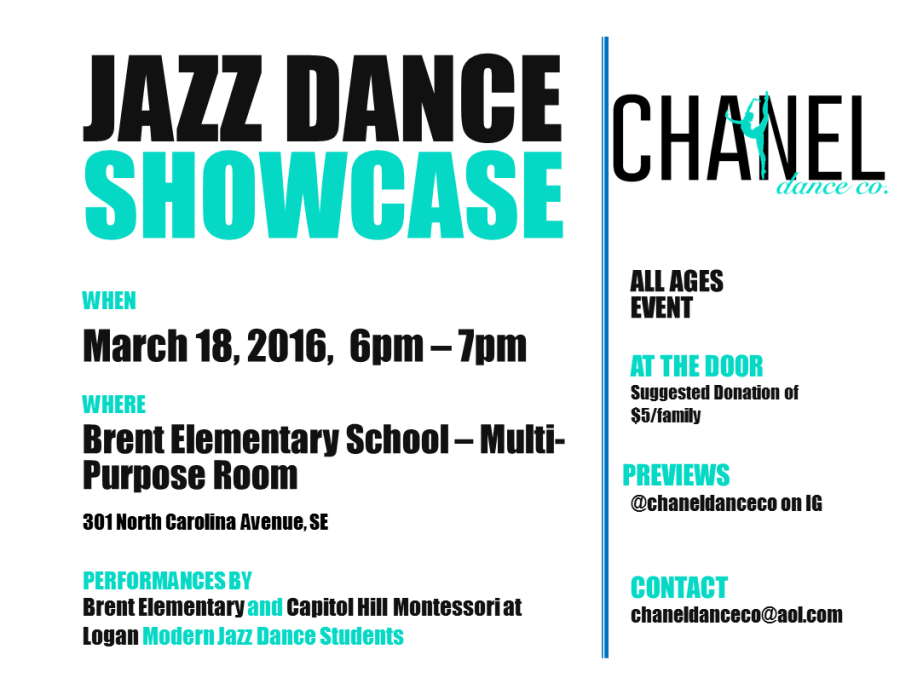
Dance with the stars! Brent and CHM@L students put on joint dance expo – Friday March 18

Don’t be jealous of their boogie!

Join Brent and Capitol Hill Montessori at Logan modern jazz students for a showcase performance!

When: Friday, March 18, 6-7 PM

Where: Brent Elementary School’s Multi-Purpose Room (301 North Carolina Ave., SE)

What: Performances by students enrolled in Chanel Dance Co after school programs.

*Suggested donation of $5/per family to help the students raise funds for costumes/materials for the big show they are planning (and practicing) for in June.

chanel dance poster

Questions? Contact Chanel Colbert: chaneldanceco@aol.com or @chaneldanceo on Instagram.

Cross Sector Collaboration Task Force Upcoming Focus Group February 23, 2016

Dear CHPSPO Members,
Please forward this information to your school communities.
The Mayor’s Cross Sector Collaboration Task Force had its first meeting this evening.  The Task Force will focus its efforts on identifying key aspects of public education that would benefit from cross-sector efforts between DCPS and public charter schools,
I strongly encourage anyone who is interested in giving input on key coordination issues and how they impact access to quality education to attend the upcoming Focus Group meeting on Tuesday, February 23rd at Eastern High School from 6 to 7:30 pm.  To register for the focus group go to : http://dme.dc.gov/node/1130326.
The Task Force needs your input on issues such as the process for siting, opening and closing schools, how to improve enrollment stability and finding ways to share information and replicate success across sectors.  These focus group sessions are currently the best opportunity for interested parents, teachers and community members to give input on what issues the Task Force should be addressing.
At tonight’s meeting the DME’s office presented data on public education enrollment, achievement levels, attendance across sectors and other data important to understanding current trends in DC’s public education system.  This data will be uploaded to the DME’s website in the next few days. They are supposed to be making both the charts and the raw data available to the public. I encourage you to check it out.  If you have questions about the data contact the DME’s Office at DME@dc.gov.
If you have questions about the Task Force or comments you would like to share, you can contact me at Caryn.ernst@gmail.com.

Caryn Ernst