Andrea Tucker Testimony – DCPS Budget Hearing – April 14 2016

Testimony of Andrea Tucker

PTA President, J.O. Wilson Elementary

to the DC Council Committee on Education

April 14, 2016

For more information: andreatuckerhomes (at) gmail (dot) com

Good evening, Chairman Grosso and members of the Education Committee, and thank you for holding this budget hearing and inviting public testimony. We appreciate the opportunity to be here to represent our school at JO Wilson Elementary. We are Title I school that serves kids from Preschool through Fifth grade and we located in the heart of the NoMa/H Street community.

My name is Andrea Tucker and I am proud parent of three children at J.O. Wilson. I am also the President of the school’s PTA,  a native Washingtonian and a proud Alumni of J.O. Wilson. J.O. Wilson holds a special place in my heart. I have watched the school grow over the years as I have lived in the community right behind the school growing up.

My early education at J.O. provided me with the tools and opportunities I needed to succeed and I’m confident that it’s going to provide that same excellent education and opportunities for my children.

J.O. Wilson’s enrollment has grown tremendously in the five years since my children have been in attendance there and this year we have more than 500 children that attend our school.  Our numbers are continuously increasing yearly and we are maxing out capacity. According to the Deputy Mayor’s annual facilities review, we are currently at 96.4% capacity – one of the highest among Ward 6 elementary schools. Based on our enrollment projections for the 2016-2017 school year, we will be at almost 99% utilization come this time next year.

J.O. Wilson services children from all over the city and most of them are there all day. We have 77% of our children that participate in aftercare, which is one of the highest rates in the city.  Our Early Childhood program starts kids off on the right foot with a 94% attendance rate, which also is one of the highest rates in the city.  Most of our students stay at J.O. Wilson through the 5th grade.  We have 3 classes on every grade level which is unusual for an elementary school and an important first step to fixing our city’s difficult middle school challenges.

Our successes could quickly be set back if our facilities continue to languish and do not meet the high expectations that we expect from our scholars. Our children should be proud to come into a school that is warm and inviting and they feel comfortable learning in. Despite the challenges we face at our school, some of which are an inaccessible and non ADA compliant facility, a building that is literally falling apart in places, a lack of gym space and an outdated and inefficient cafeteria, we’ve succeeded.

The city has done a wonderful job with the High Schools, it’s now time to focus on our  Elementary Schools to create strong pathways. Elementary School is the beginning of our children’s education and without a firm foundation and adequate facilities our children cannot even advance and be prepared for the next level of education. Our students at J.O. Wilson have lots of challenges already. Many of our families are impacted by poverty, homelessness or other unconventional living situations, as well as language barriers.  In fact, for the upcoming school year it is projected that almost half our students will be considered “at risk” of academic failure.  Let’s not let the conditions of their school building be a challenge as well. Thank you.

Ivan Frishberg Testimony – DCPS Budget Hearing – April 14 2016

Council of the District of Columbia

Education Committee Budget Oversight Hearing

Testimony by Ivan Frishberg

Thursday, April 14, 2016

Chairman Grosso and members of the Committee, thank you for the opportunity to testify today.

My name is Ivan Frishberg and I am a parent of two children at Brent Elementary. Our plan is to send those children to Jefferson Academy.

Last year you wisely responded to the city track record of wasteful spending, broken promises, and no clear plan or rationale to the CIP with a different approach.

You presented an approach for transparently assessing and prioritizing what we do with limited capital dollars. It wasn’t perfect, but it was a very big step forward.

The current budget proposal clearly responded to the need to focus on modernization as a priority and within that to focus on middle schools.

There are signs of progress, and I am happy for Eliot Hine. But I am even more disheartened about this administration’s ability to meet the objectives the committee laid out and DCPS said they agreed with. While you were taking a step forward, they largely executed business as usual.

  • The chart you produced to identify priorities has not become more sophisticated as it has emerged from DCPS, and the data behind it seems even less transparent. Not the latest available enrollment data. No measures of school success to indicate a school’s ability to grow and serve. No apparent progress on the data quality for population or building condition.
  • In Ward 6, Logan has a higher score than Jefferson and Eliot but disappears all together. Some schools win or lose by years based on statistically insignificant amounts on top of questionable data.
  • Jefferson was top of your list last year and got pushed off for two years. Then, Jefferson then does better on enrollment and test scores and some how drops down the list and gets pushed back two more years.
  • The planning money appropriated by this committee is not spent. Then DCPS says it is only for architects, not community planning. And the stabilization projects you appropriated funds for haven’t happened.

Jefferson has a wait list for 6th grade right now, is 4th ranked on PARCC across District Middle Schools. Each grade scores higher than the one before and the number of students at proficiency doubles from 6th to 8th grade. Jefferson does this with 23% Special Education and 99% Free and Reduced Lunch populations.

And now DCPS’ response to this success is to deprioritize the school and say wait until 2021 to fix the infrastructure.

And we are supposed to put our confidence in this budget and its priorities?

Absolutely not.

They should not have presented, and you should not approve, a budget that doesn’t answer these issues with data, rigor, transparency and a commitment to being straight with parents.

You have a choice:

Pass along the Mayor’s priorities with a few tweaks here and there. Or do what was promised last year by DCPS but which they have failed to. Set priorities and a CIP plan that is based on real data, real transparency and engagement, and real planning.

This Committee set that bar last year. Your budget is the law. You followed up with rigorous oversight. Asked the right questions. But if the administration can’t build what you provide funds for and they can’t meet the standard of budgeting and planning we had all agreed to, maybe you should start from scratch.

Max Kieba Testimony – DCPS Budget Hearing – April 14 2016

Testimony for Max Kieba, Maury Elementary School

DC Council Committee on Education Budget Oversight Hearing

District of Columbia Public Schools

Thursday, 4/14/2016


Thank you for the opportunity to testify today.  My name is Max Kieba, also known as Wyatt (Kindergarten) and Hadley’s (PreK-3) dad.   I’m a member of the PTA, serve as Maury’s School Improvement Team (SIT) Co-Chair and speaking on behalf of Maury’s LSAT.   I’m here to give perspective on the SIT process, modernization funding through the Capital Improvement Plan (CIP), and operational budget issues as they relate to at-risk funding.


Proposed Maury funds in CIP

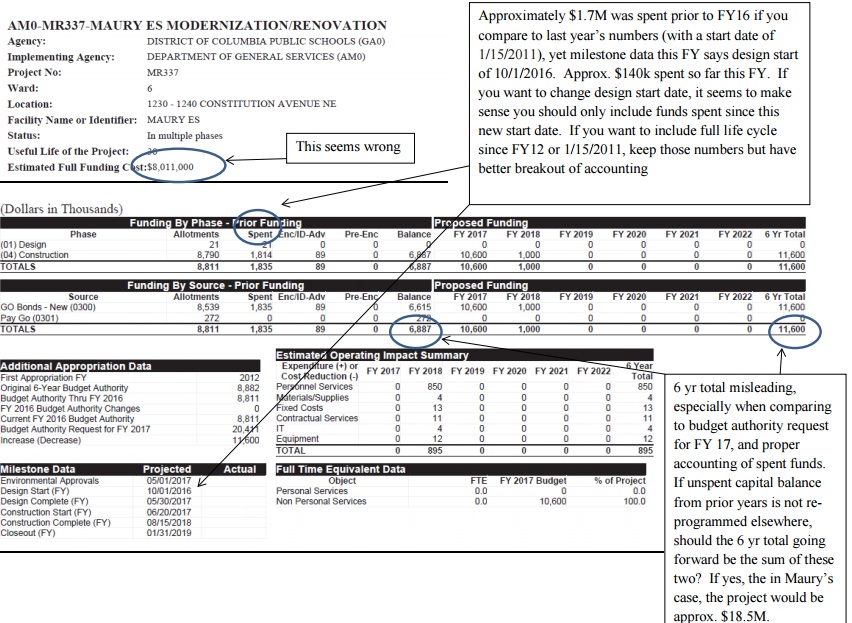
Maury is thankful that additional funds were proposed for our project, with a start of construction scheduled for summer 2017.  We can’t confidently say yet if we feel that is the right number as we’re still in the feasibility study review stage with DCPS and DGS, with a number of issues with the 2 scenarios presented to the SIT and 2 other scenarios that were done by the feasibility architect and submitted to DCPS that DCPS is not yet comfortable sharing for discussion.  At a minimum we hope the number proposed in this budget sticks, but it may possibly need to be more.   We also understand budgets are tight, so if that’s the best we can get, we’ll make it work.  We are committed to continue to work with DCPS and DGS to try to come up with a reasonable project that’s acceptable to all.

Confusion on available modernization funds

There continues to be confusion on the exact project numbers being proposed, total life cycle appropriation, and if/how prior spent and balance funds are calculated.  Maury’s example is below, but some clean-up of how budgets are presented in the future could help address a lot of issues people have with understanding the numbers.

kriebatestimony

Overall SIT Process

There are some improvements being seen in the overall SIT process, including the thought process of sequencing schools and managing swing space effectively, particularly some schools close to each other geographically.   For instance, while it hasn’t been decided if Maury will need to go to swing space and where, t it’s very likely Maury will need to swing with Eliot-Hine (E-H) seeming to be the logical choice.  If Watkins is done on time, it makes sense for Maury to swing to E-H and when Maury is done, modernize E-H.  Some could certainly argue E-H should move up and Maury delayed or at least swing somewhere else.  Maury being delayed further is not a popular or even practical choice without more help addressing space issues such as bring additional trailers on site to an already tight footprint.    Such discussions would need to be done properly with the community, but if it ends up being a choice of waiting with some additional trailers and swinging to E-H vs. Maury staying on schedule but swinging somewhere else further away with more transportation issues into the equation, the pros/cons get more interesting.

Modernization fund big picture 

Looking at the big picture, it’s great we have more modernization funds this year but the numbers and timing are all over the map.  Some schools got a bunch of funds, some a little (or not at all) and some in between.  It’s good we’re throwing money at the problem, but are we addressing the problem appropriately, in a fair, equitable, transparent, etc. way?  And are the numbers the right ones, particularly for many schools that haven’t even started a SIT or even completed feasibility study

Individual school snubs

This committee came up with a great idea last year of at least providing some seed funds for schools to start the SIT process even if we didn’t have funds to start construction right away.  Unfortunately, those SIT processes started way too late or didn’t happen at all.  It was great they finally got the SIT process going for E-H, but was disappointed to see that Jefferson never got theirs and now has that $1.5M taken away or at least pushed off further down the road.  Other schools like Capitol Hill Montessori at Logan (CHML) keep getting pushed off but in desperate need to happen.  If we can’t move up CHML completed, can we at least figure out a way to get some seed funds to start a SIT?  The excuse we’ve heard from DCPS and even DME Niles is we just don’t have the funds to do the project now.    Per DCPS’s own SIT guidelines, the feasibility study/design phase takes a good 12-18 months before construction.  Also, budgets shouldn’t even come into play that early.  I thought the intent of the feasibility study is to get input on the needs of the community and develop some high level blocking of resources given the ed spec and school’s overall footprint.   Budgets should not really come into play until further down the road.

Funding for at-risk students

Our LSAT has discussed the large drop-off in “Title” funding that happens when a school loses Title I eligibility and the challenges this creates in meeting the needs of the remaining at-risk students.

A DCPS school is eligible for a Title I Schoolwide Program if 40% or more of the students qualify for free or reduced lunch, or a Title I Targeted Assistance Program if between 35-40% of the students qualify for free or reduced lunch.

Schools with less than 35% of students eligible for free or reduced lunch are considered Non-Title I. Non-Title I schools receive Title II, Part A funding which is used to support professional development for teachers and principals.

Since Title I is implemented as a threshold program, there is a large reduction in Title funding when a school dips below the 35% threshold. For example, another Ward 6 school with a similar total enrollment has a Title allocation of $166,000 (primarily from Title I) for FY17, while Maury has a Title allocation of only $9,600 (from Title II).

Even though Maury is no longer a Title I school, we still had 38% of students who were classified as economically disadvantaged in the PARCC testing grades 3 through 5 last year. These students still have needs, but we don’t get Title I resources to help address their individual needs.

Maury’s Title allocation + “at-risk payment” line item works out to only $171 per at-risk student. For the other Ward 6 school mentioned before, the Title allocation + at-risk payment line item provides $1,031 per at-risk student. Certainly schools with higher at-risk populations should get more funding overall, however non-Title I schools like Maury are getting substantially less for each individual at-risk student. This makes it more difficult to provide targeted interventions like after-school programs or coaching for math and reading. The individual kids are still at-risk, even if the school as a whole has passed below a percentage threshold.

It would be helpful if the Title I funds could follow the individual students and be provided on a more equitable per student basis. Alternatively, the “at-risk payment” line item of the DCPS school funding model could be used to provide more equitable levels of funding for every economically disadvantaged student.

A comparison of Maury and Miner is below.  This is not intended to try to compete with or complain about another school in our feeder pattern.    If anything, Miner is doing great and should continue to get any funding it can to improve an already great community.  If anything though, it might make sense for schools to be more consistent with one another, particularly within a given feeder.  Wouldn’t it be great if we somehow figured this out on a feeder pattern by feeder pattern basis, maybe get Maury, Miner and Payne, and even E-H and Eastern all together in a discussion with DCPS to talk about per at-risk student funding so regardless of where they start in the feeder, students get the help they need and hopefully get consistent funding as they stay within the feeder.  In general too at-risk funds should supplement, not replace other funding mechanisms.  This is now just an issue at these schools, but Eastern as well.

*******************************************************************************************************

Calculations, Based on FY17 initial budget allocations

Maury ES proj. enrollment = 400, 14% at-risk or 56 students.

Title funding = $9,575.

At-risk payment line item = $0

($9,575 + $0)/56 = $171 per at-risk student


Miner ES proj. enrollment = 398, 70% at-risk or 279 students.

Title funding = $165,830.

At-risk payment line item = $121,928

($165,830 + $121,928)/279 = $1,031 per at-risk student

Bike to School Day is May (the) 4th – save the date!

BTSD_2inch_Color

What: Bike to School Day

When: WEDNESDAY, MAY (the) 4th, 7:30 AM – 8:20 AM
(Star Wars jokes, compliments of our very own Laura Marks!)

Where: Lincoln Park (East Capitol St between 11th and 13th Streets)

Who: All our neighborhood students + friends from the National Center for Safe Routes to Schools + local and national celebrities!

Look out for details about the special activities planned!

Sandra Moscoso Testimony – DCPS Budget Hearing – April 14 2016

Testimony by Sandra Moscoso

Education Committee DCPS Budget Oversight Hearing,

April 14, 2016


Thank you for the opportunity to testify.

I am a member of the Capitol Hill Public Schools Parent Organization (CHPSPO), a DCPS Parent at Capitol Hill Montessori at Logan and a DC Charter School Parent at BASISDC PCS.

My ask of Council given your influence over education budget are:

  • Be transparent in how decisions are made.
  • Be consistent in your support of and honor commitments made to student, families, and educators.
  • Get the most out of limited funds by supporting TRUE coordination between DC public and DC charter schools.

On transparency, while city education agencies have made great strides over the past few years around making data and policy more accessible, there is still a long way to go for the lay (or even savvy) parent to understand the rationale behind how decisions are made.

This is due to the lack of transparency and lack of consistency around how funding decisions are made. Capital funding decisions in particular.

In the absence of transparent inputs, processes, and evidence-based decision-making, there is plenty of room for lack of trust. Sadly, this is where many (if not most) of parents like me sit today.

On consistency, honor commitments our students depend on.

I think back to my daughter’s school, Capitol Hill Montessori at Logan. On April 6, 2011, I sat in the school’s multi-purpose room, along with about 100 parents, teachers, and students, as we learned about our school’s future home. The then Office of Public Education Facilities Modernization of DC Public Schools delivered a presentation of plans for the building we would be moving into August of that year. Those plans included basic repairs to get the school ready to safely accommodate our students, with plans for Phase 1 modernization in 2014.

While disappointed that we would wait 3 years for modernization, we trusted in the system and patiently waited our turn. 2014 has come and gone, and now our students (most of who will have aged out) will have to wait over a decade for a modernized building?

We ask a lot of our students (and their teachers). We ask them to sit through long days, 10-20 minutes to scarf down their lunch, and dwindling recess. We ask them to tolerate hours of skill and drill, and assessments every 6 weeks (if not more). We ask them to adjust to bouncing around schools, yo-yo access to resources, and initiatives du jour. On top of this, our students live with the pressure that if they do not perform well on standardized tests, their teachers or principal could get fired. This is the type of responsibility we put onto 3rd graders, 9 year olds.

In turn, can we really not accept the responsibility for ensuring their learning environments are adequate? We owe them modern, beautiful spaces to learn.

Finally, I recognize that resources are limited and funding is scarce. I believe that funding two public education sectors without strategic coordination between them exacerbates the issue of scarcity.

I have children in both sectors, and the problems I witness in both are quite similar. Aging facilities in need up updating, scarce resources for programming. I cannot understand how it is possible that the city is willing to open a school in the same neighborhood where a similar, up and coming but highly under-resourced school exists. I have seen first-hand how this reckless practice has hurt my children’s DCPS and Charter middle schools, as well as all of my neighborhood middle schools like Eliot-Hine, Stuart-Hobson, and Jefferson Academy.

Fund the schools here today adequately (DCPS and Charter) give them a chance to succeed, and put a hold on opening new ones or we’ll never find our way out of this cycle.

Ensuring there is true coordination between the two sectors should be at the top of EVERY councilmember’s agenda. Doing this well will mean better use of resources, and equity around how those resources are distributed.

Back to trust, if we cannot count on our elected officials to find a way to get the most out of our education sectors, I wonder whether we have the right officials in place. I am very sorry to put it this way, but the argument of “Congress gonna Congress” cannot possibly be tolerated when it comes to addressing our city’s education challenges.

I have faith in this Council, I hope that I can continue to say you have my trust.

Thank you for your time and attention.

Danica Petroshius Testimony – DC Public Schools Budget Hearing – April 14 2016

TESTIMONY OF DANICA PETROSHIUS

PARENT, CAPITOL HILL MONTESSORI AT LOGAN

deptroshius@yahoo.com

April 14, 2016

Thank you for the opportunity to testify. I am Danica Petroshius, a Ward 6 resident and a parent of two at Capitol Hill Montessori at Logan. Our school is PK through 6th in one building and a middle school in a trailer, and our families come from every Ward. We love this school – the teachers, the principal, the parent community and the Montessori approach.

But once you look beyond the school community, we don’t like what we see. We see a city that has punted our modernization from 2014 to 2017 to 2019 – and now indefinitely. We see a city that cannot provide accurate, full data about our school. We see a city willing to leave schools untouched for too many years.

Enough is enough. We have been told by a few senior members of the government that there is a chance of retribution from the system when parents speak out. That’s wrong. Fear is no way to run a city. We look all our city leaders in the eye and say: hear us and work with us. We have an opportunity now to change the dialogue from one of fear and behind-closed-doors decision-making to one of transparency, accurate data and full investment.

Chairman Grosso, we applaud your call last year to bring a data-driven approach to modernization. We were thrilled to hear that the Mayor would have a transparent modernization process and use data to make the decisions. On approach, we are all aligned.

But the approach breaks down when you look at process and data. There is no record of the data collection used for the building assessments. If it was DGS data, their data shows that our school has never been assessed. It was suggested to us that the Mayor got her own data instead by touring schools. But we’ve never seen that data and we have no idea if it’s accurate. Were modernization experts with her? Were principals who know their buildings best asked to help identify the school’s needs? Was our school included?

In addition, DGS found lead in our water last year without notifying us. We found out from a blog article. Now, DGS cannot provide the data showing that our school is 100% remediated of lead. Whether it’s the building or lead in the water, if we can’t get comprehensive and accurate data, then the entire process fails.

The approach further breaks down when even the metrics to rank schools are faulty and inconsistent. For example, our middle school did not receive a priority like other middle schools. But in deciding our capacity rating, it appears our trailer that houses the middle school was counted which means that they do know that we are a middle school. Some have argued that we are an education campus not a middle school. This bureaucratic distinction between an education campus and a middle school doesn’t change the fact that we have kids who are in middle school in a separate trailer. Do you want to tell our 7th and 8th graders that they are not in middle school?

We’ve given you the charts that show the data is faulty and missing. The process and data systems used to create this proposed modernization plan are broken.

Finally, the system fails on investment. Parents and many on council fought hard to take us from cuts in school modernization last year to increases this year. But it’s not yet a job well done. We can find money for every school and modernize them over the next 5 years. No one believes we have an economic crisis in DC. We are leading other cities in economic growth at 3-4% a year. We have a cash reserve of over $700 million. You can’t throw a stone in this city without hitting a crane that is building more condominiums and more restaurants. And we now are spending $50 million on a practice stadium for a professional basketball team whose owner is worth billions. The city should reprioritize and fund the must-have’s–safe strong schools –first. Only then should they fund the “nice-to-have’s.”

Today, I ask each Councilmember to stand with us and stop the budget process from moving forward until three tests are met:

  1. There is full, accurate and fully transparent data for every school.
  2. The metrics for ranking school modernization include that data and priorities are applied consistently across every school.
  3. There is funding over the next 5 years to fund every school’s modernization needs.

We have attached a letter from over 230 parents in our school calling for a better solution. We welcome parents from other schools to join us. We welcome the ability to work with the Council and city agencies on a solution. The city has set very high learning standards for our children – standards that we as parents help our kids and teachers meet every day. It’s time for the city leadership to set their standards high too.

Thank you.

Suzanne Wells Testimony – DC Public Schools Budget Hearing – April 14 2016

Updated 4/15/2016 with final version.

DC Public Schools Budget Hearing

April 14, 2016

Suzanne Wells


Thank you for the opportunity to testify this evening on the DC Public Schools SY2017 budget.  The focus of my testimony this evening will be on middle schools.  My daughter is currently a 5th grader in the Tyler Elementary Spanish Immersion program, and she will be attending Eliot-Hine Middle School, our in-bound middle school, next year.

I want to thank DCPS and the Eliot-Hine principal, Tynika Young, for the efforts over the past several years to work towards Eliot-Hine becoming an International Baccalaureate Middle Years Programme.  These efforts resulted in the school becoming an authorized IB programme this past November.  It is my hope the IB programme will provide an engaging and challenging curriculum for all students attending the school.

There is much talk about the middle schools being a weak link for DCPS, and Mayor Bowser even campaigned on the slogan “Alice Deal for All.” While there is much talk about supporting the middle schools, one area that is seriously lacking is the modernization of the middle school buildings.  The recently released Capital Improvement Plan does seem to have budgeted what are believed to be more realistic numbers for the costs of renovations, yet it is not clear how these higher numbers were determined.  In Ward 6, the middle schools are far back in the renovation queue.  Eliot-Hine Middle School is not scheduled to be renovated until 2019, Jefferson Middle School is not scheduled to be renovated until 2021, and Capitol Hill Montessori@Logan which contains a middle school was not even included in the 2017 – 2022 Capital Improvement Plan.  All students starting at Eliot-Hine and Jefferson next year will be in high school before the buildings are renovated, and it will be even longer for the Capitol Hill Montessori@Logan students.  This doesn’t seem like an Alice Deal for All.

These middle schools are struggling, often through no fault of their own.  They face intense marketing from charter schools that often start at 5th grade, and draw away families who are concerned about their middle school opportunities.  The condition of the buildings also doesn’t help to attract families.  When windows have to be opened in the winter because the classrooms get overheated, or the air conditioners in the warmer months are so loud the students can’t hear the teacher, or the lighting is poor, families often look elsewhere for middle school.

Yet these middle schools present tremendous opportunities for DCPS.  For example, the Eliot-Hine building sits on 6.4 acres of land on the edge of Capitol Hill.  It’s not hard to imagine families choosing to send their children to an authorized IB Middle Years programme in a renovated building that meets the criteria for a Green Ribbon School and sits on a 6.4 acre campus that they can walk to each day.

I encourage the Education Council and the Mayor to find a way to move these middle schools up in the renovation queue in the current Capital Improvement Plan.  Respected organizations like the 21st Century School Fund have repeatedly identified the need for greater cost accountability and oversight in the DCPS modernizations.  There should be savings on the modernizations projects since the city will no longer be doing summer renovation blitzes.  There may be opportunities to reduce some of the modernization estimates if we have a better understanding of the estimated square foot costs for the individual school modernizations, and find some can be reduced while still providing high-quality renovations. Savings achieved from greater accountability and oversight, moving away from summer blitzes, and any possible reduced square foot cost estimates could be put toward our middle schools.  Our city’s middle school students are too important to have their modernizations delayed any longer.

Jablow testimony, DME Budget Hearing 4/13/16

I am Valerie Jablow, testifying about the ineffective public education stewardship of the DME’s office that I have experienced as a Ward 6 public school parent. This lack of effectiveness comes at the expense of by right schools and their students, who are the majority of children in DC.


Here are some examples:


Renovation of DCPS’s Eliot-Hine Middle School has been delayed again, despite mold, rodents, and persistent HVAC issues. Since Eliot was built 85 years ago, its upkeep and improvement have been minimal[1]—as has city investment in most other Ward 6, by right school facilities[2].


In the meantime, with charter middle schools starting in 5th grade and actively marketing themselves to Ward 6 by right elementaries,[3] Eliot-Hine’s feeder system has been decimated, and it has lost enrollment for years running.


The DME’s office has not addressed these crises.


In 2014, then-DME Abigail Smith offered a nearby closed school to charters, presenting data showing hundreds of empty seats at DCPS schools around and including Eliot-Hine.[4] When asked why create another public school in an area where her own data showed a glut of seats, the DME had no answer.


Then, during her performance oversight hearing last month, the current DME noted how the city created the misalignment of middle school grades between charters and DCPS[5]—leading to the depopulation of many DCPS elementary and middle schools. The DME testified that she has no idea how to solve this problem.


Another example:


In March, the DME rolled out data on programmatic capacities of public schools.[6] Charter schools estimated their own capacities, according to current and future uses, curricula, and staffing. Capacities of DCPS schools were estimated by DGS mainly according to square footage.


My daughter’s DCPS school, Watkins Elementary, as a result appears to be slightly underenrolled even though it has been fully enrolled—and not meeting ed specs–for decades.


And yet, on the basis of this data, the DME analyzed DCPS school utilizations and outlined plans for schools thusly considered underenrolled.[7]


But the DME did not outline charter school utilizations–not even for the 44 charters currently in former DCPS spaces.[8] Nor did the DME’s data account for the high closure rate of charter schools,[9] despite both pieces of information being vital to any comprehensive public education planning in DC.[10]


The mayor and her deputy supposedly oversee all public education in DC. The buck stops with them for misalignment of middle school grades; poor conditions at schools like Eliot-Hine; and underenrolled schools.


And the buck stops with them for equitable planning that would prevent these problems in the first place. Saying “I don’t know how”; pretending no one has oversight of charter schools or enrollment; or shifting the burden to a temporary, volunteer group (the cross sector task force) are excuses that hurt kids.


Here is how things could be better—tomorrow, if you and the mayor wanted:


–All charter and DCPS middle school grades aligned starting SY17.

–No school created or closed before the poor conditions at Eliot-Hine and other unrenovated schools are completely remedied.

–No school created until empty seats at existing schools are filled.

–School capacities and uses equitably analyzed across sectors—and, until they are, no school openings, closures, or new uses.


Our kids deserve education leaders who work for all DC public education students. Thank you.

—————-

Footnotes

[1] See http://greatergreaterwashington.org/post/30291/eliot-hine-a-dc-middle-school-is-falling-apart/ and DGS data used to prioritize FY16 capital spending.


[2] In a March 2016 presentation, the 21st Century School Fund presented data on DCPS capital expenditures from 1998 through 2015 by ward. Expenditures for Ward 6 were the lowest in the city, both as measured in costs per square foot as well as per attending student:


Ward 1: $44,076/student; $169/sf

Ward 2: $48,038/student; $214/sf

Ward 3: $54,373/student; $323/sf

Ward 4: $36,078/student; $149/sf

Ward 5: $59,244/student; $254/sf

Ward 6: $29,426/student; $126/sf

Ward 7: $33,362/student; $165/sf

Ward 8: $44,541/student; $148/sf

[3] This is obvious to anyone who lives on Capitol Hill and has children in its public schools, but it was recently documented in a story on March 2, 2016 on WAMU (see http://wamu.org/news/16/03/02/5th_grade_dropoff) and also on the blog educationdc.net (https://educationdc.net/2015/09/08/where-have-all-the-4th-graders-gone/).

[4] This was the offer of the closed DCPS elementary Gibbs. Besides the glut of seats, the community around Gibbs objected to its reopening as a school and the process by which that was undertaken. See http://anc6a.org/wp-content/uploads/GibbsProcessConcernsDGS.pdf


[5] This was on March 2, 2016, at the performance oversight hearing before the council’s education committee. The exchange on the DME’s recognition of misalignment of middle school grades between charters and DCPS began at the 4:17 mark. At 4:21, Charles Allen asked, “Is this something on the table for the cross sector task force?” The DME responded that the task force would be “truly collaborative,” but warned that “decision rights” are not on the table and she would not enact a “fiat.” She then stated, “I don’t know how we are going to solve it.” The charter school board, she noted, would have to choose to have schools to start at certain grades—and then said that it is not in her power to make them do that. See here: https://educationdc.net/2016/03/24/performance-oversight-tidbits-deputy-mayor-for-education/

[6] Some of this data was used for facts sheets for the cross sector task force, but most appears to have been part of the master facilities plan supplement.

[7] See page 6ff of the MFP supplement, available here: http://dme.dc.gov/sites/default/files/dc/sites/dme/publication/attachments/SY15%20MFP%20Annual%20Supplement3%207%2016.pdf

[8] It is not clear if the city still has the public information about square footage and programmatic capacities for these buildings—but it should, given that many are still owned by the city and leased.

[9] Depending on how one calculates this, the charter closure rate goes from a low of 33% to a high of 40%. The NRC report on mayoral control of schools (http://sites.nationalacademies.org/cs/groups/dbassesite/documents/webpage/dbasse_165783.pdf) noted that 102 charters have been granted in DC since 1996, with 38 since closed and 8 never opened, making for a charter closure rate approaching 40%. A report from the Progressive Policy Institute (http://www.progressivepolicy.org/slider/tale-of-two-systems-education-reform-in-washington-d-c/) notes that a third of all charters have closed between 1998 and 2015, making a closure rate of 33%. See https://educationdc.net/2015/10/07/predicting-the-education-future-in-dc/


Adding in DCPS closures makes the school closure rates even more stark. Using 21st Century School Fund data, I counted all DCPS schools closed since 1996, when charters started here. I got 65 schools closed. If you add to this the NRC number of closed charter schools since 1996, you get a total of 103 public schools closed (65 + 38) since 1996, for a closure rate of 51 public schools per decade–or 5 entire public schools closed every year on average in the last 20 years.


That is a huge number to sustain for both communities and resources in our city. Add to that the fact that the head of MySchoolDC, the DC public school lottery, testified in March before the council that the most important factor for parents choosing schools is proximity to their home.


Our high rates of school closures simply prevent parents from enacting school choice, all the while decimating communities that depend on those schools.


[10] Let us not forget another piece vital to education planning: the growth of the student population and the growth of the number of schools. In DC, we do the latter far more than the former. In 1999-2000, DC had 185 public schools serving 74,800 students. In 2014-15, DC had 223 public schools serving 85,400 students (data from the 21st Century School Fund).


Thus, over a decade and a half, with a gain of 10,600 public school students (14% growth), we have 38 more public schools (20% growth). Each school created requires infrastructure and staffing, raising costs overall. The mismeasure between those numbers adds to those costs.


And adding to all those costs is the high rate of school closures, as detailed in footnote 9 above.


Simply put, if we want to plan well for our public school students and save money while doing so, we need to stop creating and closing so many schools.


I have found nothing among the materials the DME cites or creates that mentions this.

FY17 School Budget Tool: DCPS school budgets comparable and transparent

The Coalition for Public Schools & Communities (C4DC) and Code for DC released a School Budget Tool with all schools’ FY17 budget data (and comparisons to FY16 and FY15).

In the post, “C4DC Budget Tool & the FY17 DC School Budget Data in Context,” C4DC analysis on the tool shows that despite FY17 increases, some schools have reduced buying power for 3 reasons: costs of positions went up; some costs were shifted to school budgets; and an unfunded mandate added responsibilities to schools but not funding.

This comparative data and context will be important in the upcoming budget oversight hearings and in holding our city accountable for the high quality education for all of our students.