CHM@L Hosts High School Information Night – Thursday, October 22, 5:30-7PM

Capitol Hill Montessori at Logan invites 7th and 8th grade parents and students to meet representatives from exciting DCPS high schools.  Get information about DCPS academic offerings and extra curricular programs.

When: Thursday October 22,5:30pm – 7pm

Where: CHM@L – 215 G St. NE (in the multipurpose room)

See you there!

TONIGHT: German Youth Band: (Tues Oct 20) 6:30pm at Stuart-Hobson

The Youth Big Band and Choir from Flensburg, Germany (approximately 40 members ranging from ages 14-18) will be performing a free concert Tuesday night October 20 at Stuart-Hobson Middle School (410 E St NE) as part of a United States tour.  The performance will begin at 6:30pm and last about an hour.

The enthusiasm of young people for jazz music was the impulse for creating the Youth Big Band at the Altes Gymnasium in Flensburg, which lies on the border between Germany and Denmark.  Since its foundation the Big Band has given numerous concerts throughout Germany and has toured to Denmark, Great Britain, Russia, the Ukraine, Japan, and the United States. The repertoire is traditional and modern jazz, but also pop and funk music.

Thanks to parent Max Kieba for passing this along!

CHPSPO Meeting – October 20 @ Maury Elementary

Dear Capitol Hill Public Schools Parent Organization Members,
CHPSPO will meet on Tuesday, October 20 from 6:30 pm – 8 pm at Maury Elementary (1250 Constitution Ave., NE).  We will be joined by representatives from DCPS who will be discussing the upcoming food services contract, and from the Deputy Mayor for Education’s office who will be discussing the Partnership for Assessment of Readiness for College and Careers (PARCC) test results that are scheduled to be released this fall, and the Cross Sector Collaboration Task Force.  Attached is our agenda.  Hope to see you on Tuesday.
Suzanne Wells

Upcoming Fall School Events & October 20th CHPSPO Meeting

Dear CHPSPO members,

Since I missed so many events when I sent a message out yesterday, I wanted to send a follow-up message with all the events! Lots of events and meetings coming up in the next couple of weeks! Suzanne Wells

Friday, October 16 from 3 – 7 pm, J.O. Wilson (7th & K Streets, NE) will host a Pumpkin Festival in front of the school.

Saturday, October 17 from 10 am – 4 pm, the Capitol Hill Cluster School Renovators’ House Tour that will include a stop at the renovated Stuart-Hobson Middle School along with renovated houses. Tickets are $25 in advance, and $30 the day of the tour. Tickets are available at a number of local venues before Saturday and at the houses on the day of the tour. http://renovatorshousetour.org

Sunday, October 18 from 11 am -3 pm, Brent Family Picnic & Fall Festival at Providence Park (X Park) and Brent playground.

Saturday, October 24 from 10 am – 2 pm, Maury Fall Festival. All funds support the 5th grade trip to Space Camp, and if you go in the morning you can dunk Joe Weedon in the Dunk Tank!

Saturday, October 24 from 11 am – 3 pm, Tyler Elementary (10th and G Streets, SE) will host its Harvest Festival.

Saturday, October 24 from 6 – 9 pm, Capitol Hill Montessori will host its Haunted Harvest ($20 donation per family).

Sunday, November 8, 6 – 10 pm, J.O. Wilson will host the 4th annual Taste of H. Tickets can be purchased at Taste of H.

CHPSPO will meet on Tuesday, October 20, from 6 – 8:00 pm at Maury Elementary. We will have guest speakers from DCPS discussing the upcoming food services contract, and from the Deputy Mayor for Education’s office discussing the PARCC and the Cross-Sector Collaboration Task Force.

SHAPPE/DC Fiscal Policy Institute Forum on DC Public Schools’ Budget Priorities, October 28 from 7 – 9 pm, Luke Moore Academy, 1001 Monroe St., NE.

Testimony by Sandra Moscoso at the Education Committee public hearing on B21-0115, Public Charter School Fiscal Transparency Amendment Act of 2015 Wednesday, October 14, 2015

Thank you for the opportunity to testify today. I am submitting this testimony as a DC Charter School Parent, a DC Public Schools Parent, and a member of the Capitol Hill Public Schools Parent Organization (CHPSPO). My message to Council and your influence over transparency of DC public charter school fiscal transparency is simple:

  • Ensure transparency in how funding decisions are made and allocated, particularly by the private management companies responsible for school and student services.
  • Ensure the most out of limited funds by supporting TRUE coordination between DC public and DC Charter schools.

On transparency, I don’t just mean canned, pre-cooked reports. I also mean open data. The city has made great strides over the past few years around making data and policy more accessible. The parent community has also made great strides in engaging around available data.

This sharing of data by education agencies has enabled education consumers to not just ask our city what it wants from schools and learning opportunities, but has also enabled communities to collaborate with governments in designing the future of education.

Any Councilmember who has attended a local civic hacking event can confirm that data analysis takes place not only in the Wilson building, in DCPS headquarters, at OSSE, but in libraries, community hubs, and living rooms.

The case for transparency are straightforward. As a parent, I want to be able to access how my son’s charter school is being funded, and whether this funding is comparable to my daughter’s DCPS.

I want to know that my son’s charter school isn’t at risk of losing a large population of the faculty when the school’s private management company decides to invest in opening in a new school nearby, with potentially competitive teacher salaries.

Recognizing that key decisions about my son’s education are made by what is in effect, a private company, I worry that my opportunity for holding the school accountable is really just one – that of moving him to another school.

If there is not transparency over how the public funds allocated to my son’s school are managed, I don’t see how the school’s parent body, the school’s board of trustees, the Public Charter School Board, or DC Council are able to exercise rigor in oversight.

I want to highlight here that closing schools is not something to celebrate, nor is it a sign of rigorous oversight. When a school closes, this means that we adults have failed the children in that school. We need to recognize that we are not only failing those children, but we are then also forcing them and all their friends to be displaced to other schools. This is not oversight, this is failure.

Where there is transparency, engaged communities can help to identify blind spots, and effectively collaborate with the DCPCSB, council, the DME and the city to strengthen schools.

On coordination, I recognize that resources are limited and funding is scarce. I believe that funding two public education sectors without strategic coordination between them exacerbates the issue of scarcity.

I have children in both sectors, and the problems I witness in both are quite similar. Aging facilities in need up updating, scarce resources for programming, and lack of stability around student mobility. These issues will require close coordination among the sectors (including understanding the impact of each other’s decisions).

Fund the schools here today adequately (DCPS and Charter), require transparency, hold them accountable, and give them a chance to succeed.

Thank you for your time and attention.

Testimony of Suzanne Wells before the Council of the District of Columbia Education Committee Public Charter School Fiscal Transparency Amendment of 2015, B21-0115 October 14, 2015

Thank you for the opportunity to testify on the Public Charter School Fiscal Transparency Amendment of 2015. My name is Suzanne Wells. I am the founder of the Capitol Hill Public Schools Parent Organization, and my daughter is a fifth grader in the Tyler Elementary Spanish Immersion program.

It is important to strengthen the transparency surrounding the DC public charter schools, and this bill is a modest step in the right direction. As the Council considers comments on the bill, I strongly urge the Council to consider the recommendations included in the Transparency, Accountability, and Fiscal Responsibility for Publicly Funded Charter Schools in DC paper that was developed with input from a broad range of education stakeholders across the city.

My testimony today focuses on the lack of transparency in the siting of new public charter schools. Public charter schools generally locate their facilities in DC public schools that are determined to be surplus or in commercially-owned buildings. There is a minimal opportunity for the public to be involved when charter schools locate in surplus DC public schools. However, there is no transparency or opportunity for public input when public charter schools locate in commercially-owned buildings. There are many different reasons that a community may want or not want a school in their community, and that is why transparency on the siting of new public charter schools is so important both for the schools and for the communities.

The recent opening of Washington Global Middle School in Ward 6 provides important insights into the need for greater transparency in the siting of new public charter schools. In May 2014, the Public Charter School Board approved Washington Global’s application which said it was looking to site its new facility in Wards 4, 5, 7 or 8. Washington Global initially sought to locate in the former Gibbs School, along with Monument Academy and Community College Prep. For reasons that have never been made public, Washington Global was not included in the group of schools that were awarded the former Gibbs School. In December 2014, Washington Global Middle School announced it had leased a commercial building in Ward 6 for its new location. Because this commercial building is privately owned, there was no process for the public to provide input.

The Advisory Neighborhood Commission 6D was not consulted or informed before Washington Global leased its new facility. The Public Charter School Board approved the Ward 6 location for Washington Global even though its original application said it was planning to locate in Wards 4, 5, 7 or 8. The public was never given the opportunity to provide input on the opening of Washington Global which is now located less than 1,700 feet from Jefferson Middle School, a DC public school that has a program substantially similar to Washington Global. There is no defined process for the siting of new public charter schools.

There is no opportunity for the public to provide input when public charter schools locate in commercial buildings. I encourage the Council to consider strengthening the Public Charter School Fiscal Transparency Amendment by adding provisions that would increase public involvement and transparency when new public charter schools are sited or when existing public charter schools are expanded. Without increased transparency, we will continue to make less than optimal decisions about where our tax dollars go to support our public schools, and will do a disservice to the students attending schools in Washington, DC.

Another area where much greater transparency is needed is in regards to what happens to the facilities that once housed closed public charter schools. Approximately 40 public charter schools have closed since their charters were first approved. The facilities of these closed public charter schools were paid for with taxpayer dollars while the schools were open. The taxpayers have a right to know what happened to the facilities that formerly housed these public charter schools. If the buildings were sold, where did the proceeds from the sale go? If the facilities were being financed through revenue bond programs, who is paying the bond debt now?

In closing, there are many areas where greater public charter school transparency is needed. I strongly encourage the Council to strengthen this fiscal transparency amendment. Thank you for the opportunity to testify

Testimony of Elizabeth Bacon at the Education Committee Public Hearing on B21-0115, Public Charter School Fiscal Transparency Amendment Act of 2015

Councilmember Grosso and the Committee on Education: Thank you for holding this hearing today as a public discussion of transparency and fiscal responsibility for our public schools. This is an important, although sometimes difficult, issue that we must address to be better stewards of the $1.4 million we spend in public money on our education system annually.

In my view – as a parent with two children in DCPS schools and as a former LSAT member with experience deciphering school budgets – there is room, and need, to strengthen this bill. After seeing how tight (and often short) the capital and operating budgets are at my children’s DCPS schools, I believe we must be better stewards of our public education dollars.

As well, as a member of the education council in Ward 6 and as a member of the Coalition for DC Public Schools and Communities, I would point councilmembers to the proposals to strengthen this bill in the Coalition’s recent paper, “Transparency, Accountability, and Fiscal Responsibility for Publicly Funded Charter Schools in DC,” which contends that all of our public schools, no matter the sector, should be held to the same standards of accountability and transparency.

As I understand it, the current version of the Act, as introduced, only applies to a handful of charter schools. Examples of charters diverting millions to private contractors – as in the cases of Options and Community Academy – should speak to an imperative for greater transparency for all public charter schools, both those open now, and those that will open in the future.

As a DCPS parent, I hear how charters are supposed to spur innovation and best practices for traditional schools, but if it’s not clear how money is being spent to implement these best practices, how is it possible to authentically replicate these models and practices?

Mine is a parent’s perspective, but two particular recommendations from a recent report from the Annenberg Institute, “Public Accountability for Public Charter Schools, Standards and Policy Recommendations for Effective Oversight,” on effective oversight of public charter schools echo the conversation here today:

  • School governance should be representative and transparent.
  • Monitoring and oversight of charter schools are critical to protect the public interest.

A data warehouse – as outlined in the School Reform Act (and called for by fall 2016) – would serve to create common data points across the charter and DCPS sectors to provide intelligible and useful comparisons. This would be important to the sectors being able to learn from each other (which is in line with the goals of the cross-sector collaboration task force being formed now by the Deputy Mayor for Education); important to Council for oversight purposes; and important to LEAs and citizens in assessing how money is being spent to achieve specific results.

In the interest of stewardship of public dollars and building the strongest public education system in our city we can, I urge the Committee to use this legislation and future opportunities to strengthen fiscal transparency and accountability for our city’s education spending.

Testimony of Becky Levin – DCPS Food and Nutrition Services Program – September 30 2015

Testimony of Becky Levin, parent of Capitol Hill Montessori at Logan Student

DCPS Food and Nutrition Services Program

Council of the District of Columbia, Education Committee

September 30, 2015


Members of the DC Council, thank you for the opportunity to speak with you about food and nutrition services in D.C. Public Schools and what you can do to promote good nutrition in our school system, how to maximize the effectiveness of tax payer dollars funding school meals, and strategies to consider as DCPS moves forward to select either new vendors or a new system for producing meals in subsequent school years.


My name is Becky Levin, I am the mother of a third grader at Capitol Hill Montessori at Logan, a coordinator of the school’s Health and Wellness Club, and a Commissioner on the D.C. Healthy Youth and Schools Commission.  At Logan, we are working hard to teach our students and their families about nutrition and to promote healthy eating and living throughout our school’s activities. I’m also an advocate working on Child Nutrition Reauthorization currently pending in Congress.  I talk to a lot of school food service professionals, nutritionists, and other advocates working very hard to make school meals healthier, delicious, and appealing.  There are fantastic examples across the country that can help the District of Columbia Public Schools (DCPS) greatly improve our school meals. DCPS has had some promising initial successes. I am confident that with thoughtful consideration, such as convening hearings like today’s, and the proper oversight DCPS can once again be a leader in providing excellent and student-embraced school meals.

We all know that children, like adults, require good nutrition to power their brains so that their minds are well-fueled and they aren’t distracted by a rumbling belly.  Excellent nutrition is particularly critical for young children, as their brains are still developing. We also know that proper nutrition and exercise are essential to combat childhood obesity, adult obesity, preventable health complications and sky- rocketing health care costs. Thank you for recognizing that supporting healthy school meals efficiently addresses both public health and education issues and is a prudent and cost-effective investment. Providing the highest-quality nutrition for the districts nearly 46,000 students- about 8 million meals a year – should be a priority, especially since twenty-six percent of D.C. children are living in poverty.


School meals are a lifeline for poor students to access better health, a better learning experience, and a better future.  I want to emphasize this. Nutrition in schools should be a core focus of the public school system, and- yes- I fully recognize that there are many challenges facing DCPS.  Already, DCPS makes decisions about whether or not to open schools in bad weather, recognizing some children may not eat all day if schools are not open.  Every day that school is open is an opportunity for students to not only learn but to become healthier.

Thank you Councilman Allen- you and your staff have been very open to exploring solutions and are always willing to engage on this important subject. I’d also like to thank Councilwoman Mary Cheh and her staff for spearheading the innovative Healthy Schools Act, which is a critical first step in improving quality and standards in DCPS school meals. I’m very interested in your proposal to create a Food Policy Council and Director for D.C.  Thank you also Councilmembers Elissa Silverman and Brianne Nadeau for joining Councilmembers Allen and Cheh in the vote of disapproval for DCPS to continue the Chartwell’s contract.

I encourage Council to build on this new beginning for DCPS school food to improve student health and school meals by taking a serious look at the next critical step, selecting a responsible vendor or vendors, preferably local vendors that will provide scratch cooking, rather than the large, multi-state vendors, many of whom have proven that they are simply out to maximize profit with little regard for either quality or transparency. Ultimately, the best step would be to bring meal production and food procurement back within the public sector instead of contracting with private, for- profit vendors.  I recognize this is a very significant step, but there is clear evidence to support this transition.

School food service privatization has failed to economically manage food service and promote and maintain high quality- not just in DC but in New Jersey, New York, Pennsylvania, Connecticut, Michigan, Wisconsin and across the country. The stories are the same.  These large, multi-state food service management companies have increased deficits, decreased quality, hidden rebates, and profited at the expense of inferior nutrition for children. Despicable.

The recent $19.4 million settlement with Chartwells, regardless of whether the contractor admits fault, is a clear sign that the privatization, accountability, and procurement in D.C. government specifically is a problem. Despite repeated and continuous opportunities to hold this vendor accountable, it took a whistleblower lawsuit from outside of DCPS to begin to clean this mess up.

In order for the Healthy Schools Act to achieve its potential, the DCPS food services team needs to have experienced, professional and stable leadership.  If meal service is not produced in-house, then DCPS needs to very carefully select a trustworthy partner or partners as vendors and carefully manage the contract.  It’s also essential that there be transparency, accountability, and sustained high quality in all meals and snacks.  Oversight from Council is needed here. Problems with food services procurement, contract review, cost overruns, and quality has been a problem for too long.  Council should also require and direct DCPS to improve outreach to and coordinate with parents, students and teachers to improve satisfaction, reduce waste, and increase participation.  It’s my understanding that participation rates have dropped significantly, but the data is not readily available or transparent.  Ambitions new goals should be set to increase participation.  Participation data should be publically available and reported to Council in a standardized format broken out by individual school and with a comparison to participation numbers when they were at a peak.

Food waste is a problem, because many students do not like the food being served, a big change from a few years ago.  I encourage DCPS to work together with students, parents and DCPS faculty to make meals more engaging and appealing.  A few suggestions include forming an advisory board of students and faculty, holding a contest for new meal entries similar to what the First Lady Michelle Obama has successfully accomplished with Let’s Move, holding townhall meetings for input, and having food services representatives attend PTSO meetings to provide updates on changes and field questions.  A survey is a fine beginning, but it’s important to create and sustain a dialogue rather than quickly disseminating a one-time gauge of satisfaction.

Food waste, however, is a byproduct of meals, even with high meal satisfaction. But there’s a better way to handle it than just pitching out food.  Composting was supposed to be provided, but it’s no longer happening at our school. This should be a requirement throughout the school system.  There are also some very simple, common sense approaches to reducing plate waste.  Give students more time to eat lunch.  An extra 10 minutes would be helpful.  Schedule lunch before recess instead of afterward.  Studies indicate that students eat more after recess.  And I know that noise is an enormous issue in our school and many others.  Noise abatement is important, so that the environment is conducive to eating.

Schools around the country are crafting more innovative and economical ways to produce healthy meals and increase meal participation.  Successes are popping up in Boulder, CO, in Memphis, TN and locally in Baltimore, MD.  Let’s learn from their successes. Overall, 87 percent of large school districts across the country run food services in-house and schools systems are successfully moving away from food service management companies, and looking at innovative ways to cook from scratch, centralize meal production, purchase local fruits and vegetables, and introduce children to healthier foods that taste great.

Our bottom line should be what is best for kids. Clearly that’s high quality food that is fresh, minimally processed, seasonal and local, free of antibiotics and additives, lower in sugar, with lots of fruits, vegetables, and whole grains. If we don’t invest in this now, then we will be paying for it later in increased healthcare costs.  I look forward to hearing about Council’s plans to further improve school meals and hopefully seeing changes for the better.

I’d also like to add that children will eat healthy foods, including vegetables.  Our school’s Health and Wellness Club has introduced children to many foods they may have never have eaten before- fruit smoothies, Brussels sprouts, butternut squash, persimmons, pecans, black beans, plain yogurt, salsa, baked chips, and homemade hot chocolate with much less sugar than in mixes.  I’ve watched the same students make gagging faces at the sight of a squash and then stand in line with twenty other kids for seconds on butternut squash soup.  And we ran out of roasted Brussels sprouts, because the children were eating them like candy.  Many of these kids- and parents, too- had never eaten these foods or thought they didn’t like them. But when parents and kids tried these foods- which were local, seasonal, fresh, and cooked properly- they loved them!


Tasty school meals can achieve the same success. Healthy school meals serve an essential role to promote health, wellness, and to introduce new and tasty, healthy foods.  Ideally, the DCPS school breakfast, lunch, supper and snack menus can serve as a guide for parents to model and create healthy meals.  But we need a willing, responsible partner, effective leadership, and strong oversight that places high quality food service and health as the top priorities.  I urge you to reject empty promises from large, for-profit vendors; provide consistent oversight and accountability; ensure that DCPS is prepared to greatly improve oversight and accountability; and engage parents and students in the process in order to do what’s best for the children and taxpayers of the District of Columbia.

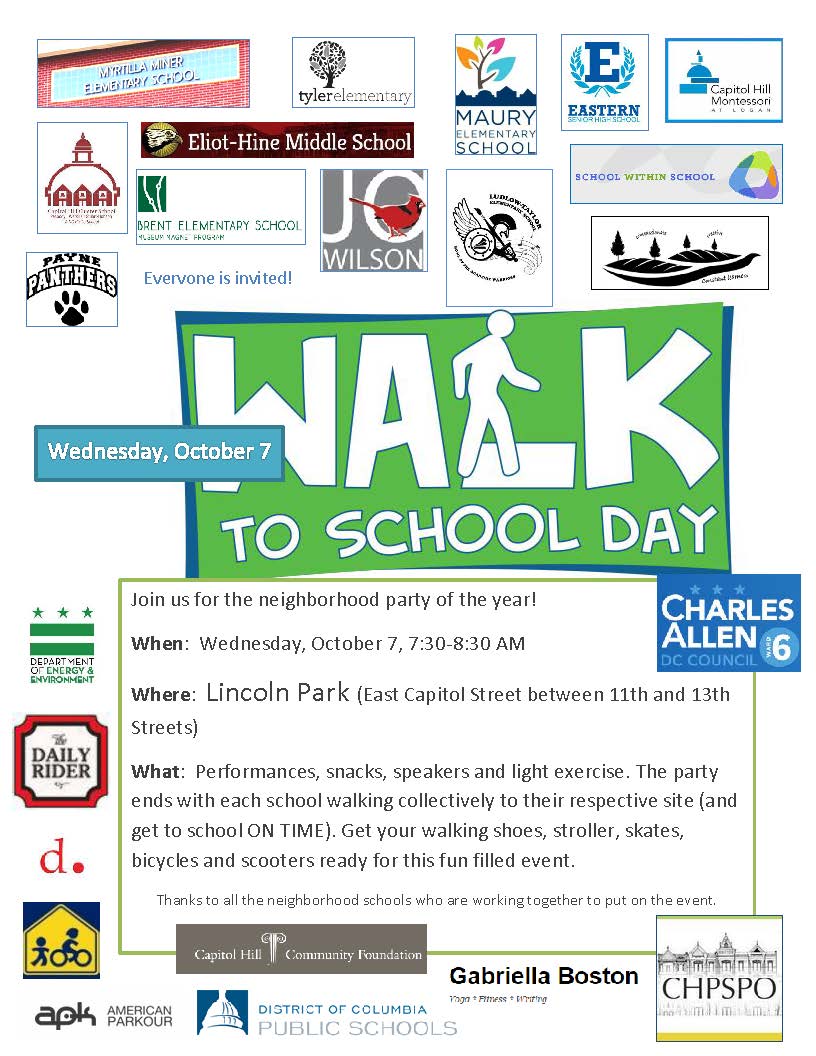
Walk to School Day is Wednesday, October 7 – register your school and join us!

Walk to School Day is Wednesday, October 7!

Join us at Lincoln Park, 7:30-8:30 AM for our annual early morning party with snacks, school performances, active transportation and education supporters, and this year – parkour and yoga!

Register your school here, to get swag for your school from DDoT’s safe routes program (and to show your support for keeping our routes to school safe for our families).

WalkToSchoolDay2015_Poster

CHPSPO Meeting Notes – September 15, 2015

Capitol Hill Public Schools Parent Organization
Stuart Hobson Middle School

September 15, 2015

1) Discussion about CHPSPO’s nomination to the Cross-Sector Task Force

  • Issues we think are important for the Task Force to address
    • Planning: # of seats, site selection, curriculum
    • Grade alignment (consistency around at grades are included in middle school)
    • Financial transparency
    • Long-term à amend the existing laws
    • Ways to foster stability throughout the school system
    • Ways to foster collaboration not competition
  • Discussion with people interested in serving on Task Force
    • Caryn Ernst (Capitol Hill Cluster School parent and former PTA president) and Sandra Moscoso (Capitol Hill Montessori at Logan & former LSAT Chair/BASISDC parent)
  • Voting on CHPSPO’s nomination
    • Caryn Ernst was selected to receive the CHPSPO nomination.

2) Discussion about educationdc.net blog, Valerie Jablow; http://educationdc.net/

  • Follow the blog via email, disseminate it into your communities and reach out to Valerie to contribute posts

3) Upcoming DC Council Education Committee hearings and events. Laura Marks

  • Visit here for calendar of Education Committee hearing dates in September and October 2015 and instructions for submitting testimony
  • Public School Food and Nutrition Services Programs and School Food and Nutrition Services Contract Requirement Act of 2015 – public roundtable. Wednesday, September 30, 2015, 10:00 a.m., Hearing Room 412 http://bit.ly/1KrvZx0
  • Early Learning Quality Improvement Network Amendment Act of 2015 and Higher Education Licensure Commission Amendment Act of 2015. Thursday, October 1, 2015, 10:00 a.m., Hearing Room 412 http://bit.ly/1WyW0nw
  • Public Charter School Fiscal Transparency Amendment Act of 2015. Wednesday, October 14, 2015, 1:00 p.m., Hearing Room 120 http://bit.ly/1NATvuJ

4) CHPSPO visits to Wilson Building, Ivan Frishberg.

In process of scheduling group visits with councilmembers on education committee.

5) DCPS Library Resourcing. Peter MacPherson.

  • Proposal to advocate for adequately resourcing DCPS libraries (recommended is 20 volumes/student, which is not currently the case at many schools). Idea is to apply the $13.7 million settlement from Chartwells towards funding volumes in schools without adequate collections.
  • Surveys were distributed to CHPSPO librarians to collect information about individual school collections. Please return completed surveys to Suzanne Wells.

6) Walk-to-School Day Planning, George Blackmon

  • Wednesday, October 7, 7:30-8:30 AM @ Lincoln Park
  • Schools are encouraged to hold their own events, if the distance to/from Lincoln Park is inconvenient.
  • Speakers; draft agenda:
    • 7:30: Arrival/Snacks and American Parkour Academy demos
    • 7:45: Ward 6 CM Charles Allen welcomes everyone
      • NOTE: Charles give a shout out to Mark Toorock and Matt Caraballo from American Parkour Academy (they won’t speak, but will be leading demos on the park).
    • 7:48: Maury ES Cheerleaders perform
    • 7:53 Miriam Kenyon, director of health and physical education at District of Columbia Public Schools (DCPS)
    • 7:56: Tommy Wells, Director of the District Department of the Environment
    • 7:59: JO Wilson ES Cheerleaders perform
    • 8:04: Fitness celebrity Gabriella Boston leads yoga stretch
    • 8:10: Charles Allen sends everyone off to school

7) American Parkour, Mark Toorock and Matt Caraballo info@americanparkour.com

Next CHPSPO Meeting:  October 20, 2015

Upcoming Events

September 30 Education Committee hearing on DCPS Food & Nutrition Services Program, 10AM

September 30  DCPS State of Schools with Chancellor Henderson, Dunbar HS, 7-9 PM

October 4        Brent Fall Festival

October 7        Walk-to-School Day (register your school at www.walkbiketoschool.org)

October 8        Jefferson Academy vs Stuart Hobson (6-8 PM @ Coolidge HS)

October 10      Capitol Hill Cluster School PTA Renovators Tour Fundraiser

October 17      Capitol Hill Community Foundation’s A Literary Feast (http://www.aliteraryfeast.org/)

October 21      Education Committee hearing on issues facing youth

October 24      Capitol Hill Montessori at Logan’s Haunted Harvest, 6-9PM

October 24      Maury Elementary’s Fall Festival

October 24      Tyler Elementary’s Harvest Festival, 11AM-3PM

November 8    JO Wilson’s Taste of H (http://www.tasteofh.org/)