Update on Librarians – Still need your support. By Peter MacPherson

Dear Friends:

For the past 14 months we’ve been involved in a long and difficult battle with DCPS over school libraries and librarians. Thanks to your efforts we’ve made real progress in getting librarians back in the schools. Unfortunately we have to fight about a longer. The chancellor has said there will be a librarian in every school this fall. That promise, however, comes with a significant caveat. Schools with under 400 enrollment will only receive a part-time librarian, which is 61.4 percent of DCPS campuses. There is no money currently in the FY14 DCPS budget to buy books and other materials for the libraries. There is no plan in place to deal with the fact that Anacostia High School has no library book. That H.D. Woodson has only 400. That Dunbar and the new middle school at McKinley Tech will open with no new books. What the chancellor has offered relative to a spectacular degree of advocacy is pretty paltry.

Almost every school community is in a fight with DCPS over some aspect of the budget. But the library issue effects us all, either in staffing terms, the absence of resources or both. This effort desperately needs you to raise your voice yet again and tell our city’s elected leadership how critical you view school libraries to be.

Best,

Peter MacPherson

—Every school, regardless of size, should have a full-time librarian.

—Funds need to be allocated so that schools get a yearly per-pupil allotment to buy books and other library materials. We recommend $25.

—All school libraries that are going through modernization must have an opening day library collection purchase for them. The size should be 20 volumes per student enrolled. That needs to begin immediately.

—All remaining high schools and middle schools should have their collections brought to that size as well.

—All schools, regardless of size should receive 30 magazine subscriptions.

—DCPS should buy 1,400 e-readers and assemble a 40,000 volume e-book collection.

—DCPS students should have access to at least 10 databases for research.

—And all schools should have at least 10 computers bought and available for student use in the library.

—All these things should be in place by the beginning of the 2013-14 academic year.

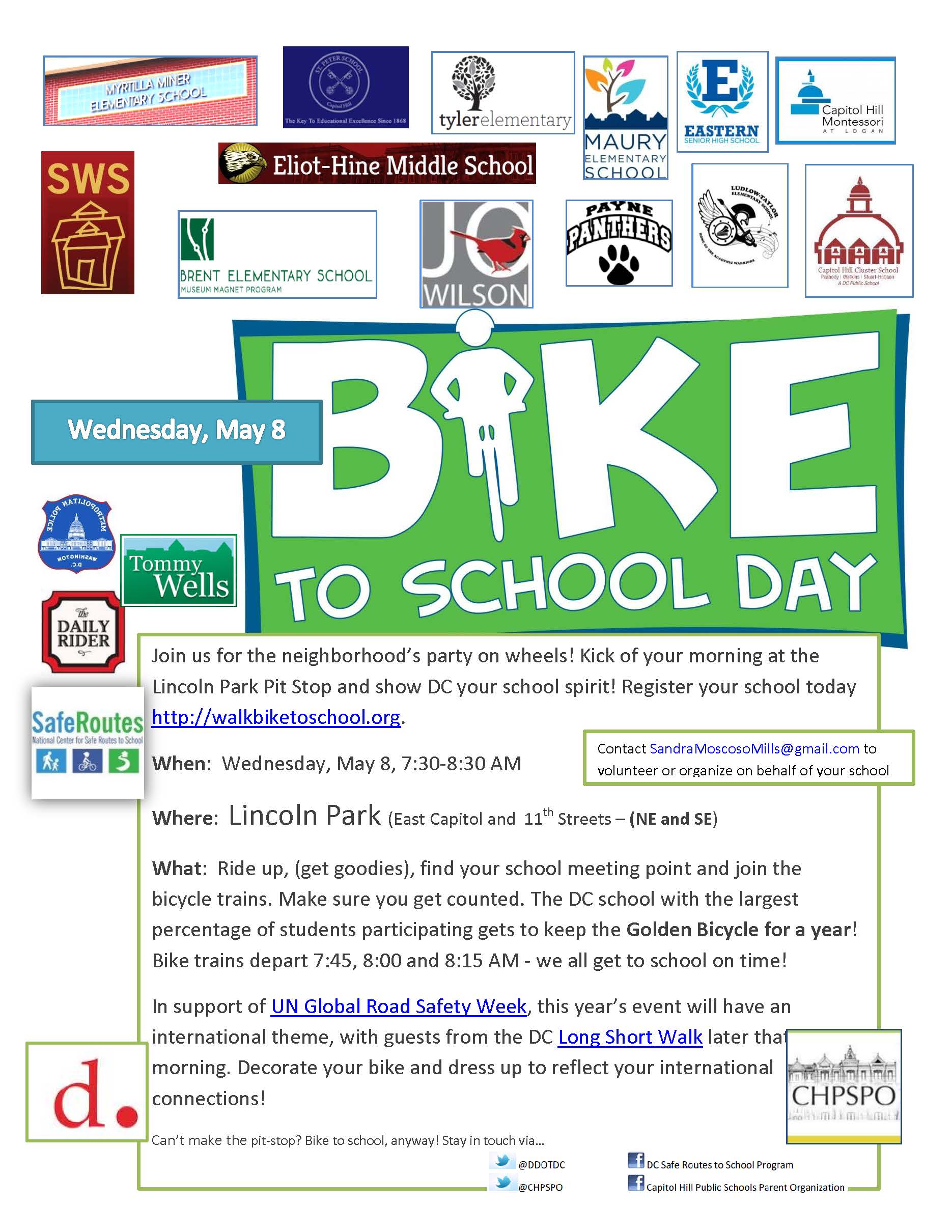
Bike to School Day is May 8, 7:30-8:30AM @ Lincoln Park! Get Ready!

Bike2SchoolDay2013_PosterRegister your school here (see who has registered so far).

Learn more about UN Global Road Safety Week and the Long Short Walk organized by National Organizations for Youth Safety.

Post the flier at your school!!

Testimony For Apr 17, 2013 Council Hearing On School Budget By Committee On Education – By Joe Weedon

COMMITTEE ON EDUCATION


OVERSIGHT HEARING

The Proposed Fiscal Year 2014 Budget of the District of Columbia Public Schools


Wednesday, April 17, 2013

10:00 am


Hearing Room 500, John A. Wilson Building

1350 Pennsylvania Avenue, NW

Washington, D.C. 20004

Testimony of

Joe Weedon, Parent

Maury Elementary School

Thank you, Chairman Catania and members of the Council.

My name is Joe Weedon. I’m here today as a member of the Maury Elementary School Parent-Teachers Association (PTA). I am the father of two children at Maury Elementary School. I serve as the PTA’s Middle School Committee Chair and as Maury ES representative on DCPS’s Eliot-Hine Collaboration Team. I am also a member of the District’s State Title I Committee of Practitioners administered at the Office of the State Superintendent of Education (OSSE).

About Maury ES

Maury Elementary, a DCPS school located in Ward 6, is a school with extensive parental and community involvement committed to the education of the whole person. Our educational program fosters intellectual, emotional, social and physical development, thereby enabling each child to compete successfully in a global society. Students are provided with a multi-dimensional, student-centered environment providing a challenge to all students and also promoting maximum achievement.

Maury Elementary has undergone a remarkable transformation over the past few years. Just eight years ago, the school was under-enrolled and then DCPS Superintendent Clifford Janey hosted a meeting at the school where it was stated that Maury was in danger of being closed due to under-enrollment.

Today, the school is thriving. We expect to be home to 330 students next year and we have over 475 students on the waitlist for admission to school. We have an active PTA with approximately 170 members. We have a strong principal in Carolyne Albert-Garvey and, last October, ten Maury staff members were recognized by DCPS as highly effective educators (Asonja Dorsey, grade 1; Beverly Overby, retired counselor; Janine Levin, preschool; Kate Sweeney, librarian; Lauren Bomba, art teacher; Natalie Hanni, grade 2; Norah Rabiah, Instructional Coach; Scott Harding, preschool; Shirley Battle, Kindergarten; and Vanessa Ford, Think Tank/Science Coordinator). Maury is also home to a winner of the Rubenstein Award for Highly Effective Teaching, Mr. Scott Harding (preschool).

FY2014 Budget

The Maury ES community received from DCPS its FY2014, School Year 2013-14, budget proposal on Friday, March 8, 2013. The school budget provided Maury an allocation of $3.2 million for 330 students or $9,761 per student.


SY 2012-13

(FY2013)

Projected SY2013-14

(FY2014)

Increase / Loss

Total Budget

$3,174,115

$3,221,203

+ $47,087

Enrollment

312

330

+18

Per-Student Spending

$10,173

$9,761

– $412

The initial budget proposal submitted to Maury Elementary School showed a limited understanding of our school community and the factors that have allowed our school to grow and thrive over the past 5 years. The budget proposal included funding for an additional kindergarten classroom which would have upset years of planning that have resulted in manageable classroom sizes in the upper grades. Additionally, the budget included substantive changes to staffing levels that threaten the on-going success of our academic programs and the support of our parent community. Despite these significant changes, the school administration was expected to return to DCPS a final budget by Thursday, March 14, providing the school’s leadership less than one week to obtain parent and community input.

The Maury leadership has worked in partnership with DCPS to make changes within our budget that will allow for the majority of our current programming to continue. We have accomplished this without asking for or receiving any additional funding to support our staffing or classroom activities.

Despite our school community’s success in obtaining waivers to ensure our academic programs can continue, we still have several unanswered questions about this year’s budget and budget process. Most alarming for many Maury parents are DCPS’s decisions to (1) change the “small school” threshold from 300 to 400 students and (2) strip budget autonomy from members of the DC Collaborative for Change (DC3), of which Maury ES is a member. Additionally, we have significant concerns about how DCPS funds afterschool programming and with the lack of transparency and autocratic decision-making of DCPS.

(1) The “Small School” Threshold

There is no clear threshold for “small schools” in last year’s (FY 2013) DCPS Budget Guidelines. However, last year elementary schools with enrollments over 300 students received funding for full-time librarians, art, music and physical education teachers as well as office staff and other support staff, including social workers and psychologists. This is the same threshold that Maury has repeatedly been told we needed to exceed in order to ensure we’d receive budget allocations for full-time librarian as well as full-time art, music and PE teachers.

Over the past year, during discussion on the plan to consolidate and reorganize schools, Chancellor Henderson often cited 350 students as the threshold for “small” schools at the elementary level:

When schools reach a certain threshold, 350-ish at the elementary school level, 450 at middle, 600 at high school, you actually have the ability to do more flexible grouping. You have teachers who are able to work together because they’re on a team and are not isolated teaching one grade.

DCPS’ Consolidation & Reorganization proposal also clearly lists 350 students as a threshold: “Schools with fewer than 350 students require additional per-pupil funding to offer a full range of services. Sixty-four percent of DCPS elementary schools have fewer than 350 students.”

Despite the threshold being 300 in last year’s (FY2013) budget and rhetoric from DCPS indicating a 350 threshold was possible in the future, in next year’s budget, elementary schools with under 400 students are classified as “small schools.” This decision was made with little to no public input or notice.

The Impact of being a “small school”

Maury Elementary School is a growing community and is projected to reach 330 students in SY2013-14, dramatically exceeding our building’s capacity.

While Maury ES currently has approximately 475 students on its waitlist, our facility, though renovated in 2011, is rated for fewer than 300 students and without a long-promised expansion of the school we will not be able to meet the new 400 student threshold for full-time librarians, art, music and language teachers or for a full-time mental health team. The change in ‘small school’ status means that Maury faced the following staffing reductions:


SY 2012-13

(FY2013)

Projected SY2013-14

(FY2014)

Budgeted Loss

Instructional Positions
Librarian

1

.5

. 5 Librarian

Music

1

.5 music or art

. 5 Music or Art

Art

1

.5 music or art

. 5 Music or Art

Classroom aides

8

6

2

Administrative Positions
Business manager

1

.5

. 5

Support Positions
Social Worker

1

.5

. 5

Psychologist

1

.5

. 5


The value of full-time staff.

The parents and students at Maury Elementary school place a great value on having our teachers in our school throughout the day. We believe that relying upon part-time staff at our school will impact the quality of staff and of instruction, reduce our academic offerings, and impact the school’s culture.

The reliance on part-time staff will result in significant hiring and retention issues at Maury ES and other “small” schools. We strongly believe that teachers, when given a choice, will select to be in a single school rather than splitting their time between two buildings. We believe that the impact of this decision will be that Maury ES will not be able to retain our high-preforming teachers and that we will struggle to attract high-quality applicants for part-time positions in the future.

Second, without the teachers in our building full-time, our academic programs will suffer in the following ways:

Collaboration with classroom teachers will be limited. At Maury ES, there is a culture of collaboration between classroom teachers and the special teachers (Library, Art, Music, and PE which could all become part-time positions in “small schools”), in which all specials teachers work together to help students thrive. If teachers are in the building ½ time, the amount of time for special teachers to collaborate with classroom teachers will be limited and academic progress will suffer.

Reading interventions will be limited. Specials teachers (Library, Art, Music and PE) at Maury ES do much to support the literacy of our students.  The Maury librarian, Ms. Kate Sweeney leads a ‘Reading Lunch’ for 4th and 5th grade students and ‘Open Library’ during recess for students in grades 3-5. This provides students with the opportunity to improve their reading skills and secure additional support in both reading and math. Other ‘specials’ teachers at Maury lead reading interventions during their free and planning periods and support the literacy of our school in multiple ways.

Additional instruction opportunities will not be possible.  Many of the Maury specials teachers (Library, Art, Music and PE) participate in after-school programming and offer special programs for students during lunch or recess periods. Additionally, the Maury PTA has implemented a fundraising initiative to buy computers for a technology class for grades 1-5 next year. This class would teach students both basic computer skills and also the skills necessary to become creators of digital content and to thrive in a Web 2.0 world. This class will not be possible with part-time staffing.

In addition to the retention and academic concerns that DCPS’s decision to staff Maury ES with more part-time position, we also believe that the school’s culture will suffer dramatically. Students have a strong bond with our ‘specials’ teachers that is only possible because of the amount of time the teachers spend at our school. At our recent school fundraiser, the auction items featuring the ‘special’ teachers were among the most in-demand items at the auction, raising thousands of dollars to support our school.

The change to ‘small school’ status will also impact the provision of mental health services across the city, including at Maury ES. Most ‘small schools,’ including Maury ES, will now only have a 1/2 time social worker and a 1/2 time psychologist. Given requirements that these two individuals both be present for certain evaluations and meetings, there will be substantial periods of time when small schools will not have a mental health professional in the building. These staff do remarkable work in helping those with needs, in helping to prevent and solve disruptions in the classrooms and in ensuring that schools can have a positive, inclusive culture.


‘Small School’ conclusions:

Over the past several years, DCPS officials have made it clear to the Maury community that we needed to increase enrollment to be guaranteed a fully staffed building. We were continually informed that we needed to be home to more than 300 students. We have met this challenge. Our student population has grown from just 263 students in 2009-2010 to over 300 and our projected enrollment for SY2013-14 is 330. DCPS’s decision to change the “small school” threshold to 400 students, placing our continued success in jeopardy.

By changing the “small school” threshold to 400 students, Maury ES – which was renovated in 2011 and has a rated capacity of less than 300 students – is subject to significant reductions to our staffing and support personnel that will prevent us from retaining and attracting the best teachers, will weaken our academic programs and hinder student growth, and undermine our school’s culture.

DCPS cannot be allowed to arbitrarily change the goal, without notice or providing fully enrolled schools the opportunity to meet the new enrollment thresholds. We also believe that DCPS needs to fully staff all fully enrolled schools to ensure that we have strong staff, strong academic programs and interventions and a strong school culture.

(2) DC Collaborative for Change

The DC Collaborative for Change (DC3) is a group of nine District of Columbia public schools that are united by a shared vision, common values and purpose, and a commitment to realizing the infinite potential for learning among all our stakeholders. As a member of the DC3, Maury ES has long received a degree of budget autonomy that has allowed our school’s leadership to ensure that our budget priorities could be achieved. However, in the proposed FY2014 budget, Maury ES no longer had any degree of budget autonomy.  This change was made without notice or without public input.

While I would like to take this opportunity to Thank DCPS’ leadership for granting Maury ES a number of waivers to allow us to shift resources within our budget to meet the needs of our school community, the Maury ES community does not believe that the process of requesting and securing annual waivers to ensure our school is adequately staffed in a manner that meets our school’s unique priorities is a viable solution. In years past, the school leadership – the principal with the support of the Local School Advisory Team (LSAT) – had the authority to make many of the changes to our budget DCPS has authorized this year.

While we are appreciative of DCPS’ willingness to work with us, the added layer of bureaucracy and the fact that we cannot be guaranteed to receive the same types of waivers in the future are concerning. The fact that our school’s capacity and enrollment likely mean we will continue to beholden to the “small school” funding level makes the lack of budget autonomy more critical.

We believe that DCPS should restore the budget autonomy of DC3 schools to allow the members of the collaborative the budgetary flexibility to provide our children with a well-rounded education with our limited resources. Additionally, DCPS needs to empower instructional superintendents to work with principals to ensure that all schools receive initial budget allocations that meet their unique school needs.

Additional Issue: After School Programming

Afterschool programs provide a variety of unique programming options to students, furthering their academic attainment and cultivating new interests among the students. Participation in high-quality afterschool programs has been proven to improve school attendance, academic achievement, graduation rates and attitudes toward learning. Students attending three hours of afterschool programming each day gain the equivalent of nearly four months of learning time.

Afterschool programs are an integral part of the learning environment and they play a vital role, especially at the elementary level, for working parents. Maury ES has long utilized DCPS afterschool to care for many of our students and the program has seen remarkable growth – both in enrollment and in programming. However, next year, Maury ES will join the growing number of District schools that do not qualifying for DCPS afterschool programming, impacting approximately 70 Maury students who are currently enrolled in the program.

At Maury ES, we recognize that the loss of our DCPS afterschool program is due to the changing demographics of our school community and that it is a long-standing DCPS decision to not provide aftercare at schools that do not qualify for Title I status. However, the Maury community believes that this decision is creating a dual system of “haves” and “have nots” across the District and that it threatens our goal of being an inclusive and diverse – socially, culturally, and economically – school.

Maury Elementary School, through a non-profit after-care provider, has a strong plan in place to ensure that all students will continue to receive strong aftercare programming, including an academic power hour, snacks, and enrichment programs during the next academic year. However, some families – especially those who have to pay increased prices under new system but whom would receive free or reduced cost after-care at schools which receive DCPS aftercare programming – will choose their school based on whether or not a school has ‘free’ aftercare programming. This will lead to a growing economic divide within our school communities.

We believe that it is in DCPS’ as well as the city’s best interest to ensure that all elementary students have access to high-quality aftercare programming to ensure that all schools are economically diverse and that all schools are inclusive. We believe that funds for afterschool programming should follow students in need regardless of the percentage of low-income students in a school.

Additional Issue:  Lack of Transparency and Autocratic Decision-Making

Many in the Maury community – as well as DCPS parents across the city – are concerned with DCPS’ limited communication, lack of opportunity for parental involvement and unilateral decision-making.

First, throughout the FY2014 budget process, DCPS Chancellor Henderson has provided little insight into how the changes in budgeting and ‘small school’ size align with DCPS’ vision to attract students (outlined in the Better School for All Students consolidation and reorganization plan) and improve academic attainment (outlined in A Capital Commitment as well as in RAISE DC). This is especially problematic when the proposed budget for a school such as Maury ES – a school that has seen dramatic enrollment growth and improving test scores – includes significant cuts to staffing and support personnel and limits our ability to allocate resources in a manner that best meets the needs of our school community.

Second, many parents are concerned that DCPS has misled them during the debate about school closings. During testimony to the Council last year, as well as at numerous public events over the past year, DCPS Chancellor Kaya Henderson stated that the recent round of school closures would save DCPS approximately $8.5 million, which would be put back into schools to improve programming including into support services, libraries and the arts (all slated for cuts at Maury ES). Additionally, in mid-February, Mayor Gray announced that DCPS would receive a 2 percent increase in per-student funding. Yet, Maury ES and many other schools across the city are slated for significant cuts in staffing for the 2013-14 School Year (SY). These cuts are occurring despite enrollment growth at Maury ES.

And, finally, parents are concerned with the limited transparency and lack of parental involvement and notice of decisions that dramatically impact our school environments. This concern relates to DCPS’ unilateral decisions to change the threshold for ‘small schools’ from 300 to 400 and to strip budget autonomy from DC3 schools without any public discussion or notice.

Conclusions

The Council of the District of Columbia has an obligation to ensure that DCPS’ budget is clear and transparent. The Council also has a responsibility to ensure that all students in the District of Columbia are receiving a high-quality educational experience. I’d also argue that the Council also has an obligation to ensure that DCPS is meeting the goals that that have been laid out relating to student achievement and student enrollment.

The Maury community stands ready to work with you – and with DCPS – to ensure that our school can continue to thrive.  Our school community has met every challenge that we have faced – we have increased enrollment and we have improved DC CAS scores. We are working to build strong middle school options across Ward 6 and there are a growing number of families who are committed to seeing our children graduate – together – from Eastern HS.

Yet, we cannot allow DCPS to continually change the goals, including the 300 student threshold for small schools, that they have set out for us. We believe that DCPS needs to fully staff fully enrolled schools. We believe that DCPS needs to restore autonomy to members of the DC3 collaborative and ensure that instructional superintendents are empowered to work with principals to ensure that all schools are adequately staffed and supported.  Additionally, we believe the city needs to reexamine how afterschool programs are funded and ensure that all students in need receive funding regardless of where they attend school. And, we believe that the Council needs to ensure that DCPS operates in a transparent and good-faith relationship with parents and community members to build a system of schools that serve all students in the District.

Thank you for this opportunity to speak here today.

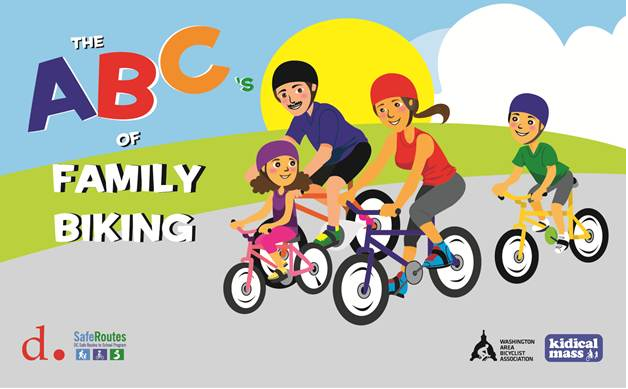
ABCs of Family Biking coming to CHM@L on Sunday, Apr 28!

ABCs

Kidical Mass DC, the Washington Area Bicyclist Association (WABA) and the District Department of Transportation (DDOT) Safe Routes to School Program are pleased to announce the return of “The ABC’s of Family Biking.” This free event, which builds on the popularity of last year’s successful debut, will celebrate the joy of biking with children and introduce local parents to the tools, skills and equipment that can help them start biking with their kids.
Held on Sunday, April 28th from 11:00am – 1:00 pm at Capitol Hill Montessori School at Logan, “The ABC’s of Family Biking” will offer:
  • An open forum to talk to area parents who bike with children of all ages
  • Bicycles and equipment available at local bike shops to help parents bike safely with their children
  • Free classes with WABA instructors to teach basic riding skills to children, including a special class on group riding skills for families that are interested in forming “biketrains” for children to ride to and from school in groups
  • A performance of “Squirrels on Bikes,” a new bike-themed puppet show by the Flying Fox Puppet Theater
  • The opportunity for parents to “Swap or Sell” their gently used family biking equipment
  • Free bike repair clinics from The Bike House
The event will also provide a chance for families to practice their bicycling skills in advance of National Bike to School Day on May, 8, 2013.”
What:             The ABC’s of Family Biking
Where:            The parking lot behind Capitol Hill Montessori School at Logan 215 G Street NE
The location is easily accessible from the Union Station Metro and Capital Bikeshare stations.
When:             Sunday, April 28th from 11 am-1 pm,
Puppet show begins at 11:30am
Biketrain class begins at 12:00pm
For more information, visit KidicalMassDC.blogspot.com and click on “ABC’s of Family Biking,” or contact Megan Odett, Kidical Mass DC’s organizer, at KidicalMassDC at gmail dot com or 443-254-2188

Testimony For Apr 17, 2013 Council Hearing On School Budget By Committee On Education – By Valerie Jablow

I am Valerie Jablow, and my two children attend the Capitol Hill Cluster School, which has 1,200 students from preK through grade 8.

Like many in DC, our school’s budget has been cut, resulting in numerous teacher layoffs.

Our PTA now projects spending a majority of its money this coming school year to pay for needed staff.

Our layoffs include all foreign language staff at our middle school, Stuart-Hobson, as well as Stuart-Hobson’s technology teacher, leaving a multimillion dollar computer lab unstaffed. At the new staffing level, there will be 35 kids per class.

Our layoffs also mean that our middle school will not have a full-time librarian, and our elementary no guidance counselor or reading resource teachers. All are basic to a healthy school.

All this because of 30 double-enrolled students at Stuart-Hobson! Let me explain.

In summer 2012, our principal turned waitlisted students away from Stuart-Hobson. Our historically fully enrolled school otherwise would have been overenrolled—and DCPS told her that was bad.

But in the first week of school this year, parents of 30 kids pulled them out of Stuart-Hobson to attend charters. All were double-enrolled. And so our numbers at Stuart-Hobson dropped below DCPS’s new, arbitrary 400 student level, causing especially steep budget cuts for 2014. Adding foreign language teachers at the elementary level, a new DCPS mandate, means that keeping the per pupil funding to a fixed number, also a DCPS mandate, results in cuts everywhere.

At the same time that our school is being defunded, DCPS is expanding a school just blocks from Stuart-Hobson into middle school grades and creating another new public school another few blocks away—all the while at least nine new charter schools are applying to open in DC AND our mayor says that school enrollment is projected to decline!

The take-home message: absolutely no support for existing DCPS schools. It’s the Hunger Games, public school edition, ensuring a slow, resource-starved death for most schools. Those of us at the Cluster know this all too well: we have been fighting for almost three years now just to get full funding for Stuart-Hobson’s renovation–its ONLY renovation in 86 years.

To address our cuts, our staff is working extra hours to ensure that all parents enroll their children so we might gain one lost teacher. Our principal has also marketed our school to everyone with a child in neighborhood schools. And since the budget came out, our staff have scrambled to figure out how to offer the same quality education with fewer resources.

In the meantime, our kids need to learn–but how can anyone teach when they are trying just to ensure their school will survive?

Our city has created these problems and all DCPS kids are paying for them! Double enrollments can be stopped tomorrow. New schools do NOT have to be created. And school budgets should reflect the best use of existing resources, not saying that each child gets X dollars for funding, end of story—and by the way, take an extra budget hit if you don’t meet a new, arbitrary enrollment cutoff, when there are no common enrollment dates and processes for all schools receiving public money!

All of this is in YOUR power to fix. Tomorrow, if you want. Our school cannot do this alone, and expecting parents or PTAs or heroic staff or prayer to make up the difference is cynical and not respectful of the idea of public education. Our city must invest in our existing public schools—otherwise, what is the point of public education? Thank you.

Testimony For Apr 17, 2013 Council Hearing On School Budget By Committee On Education – By Martin Welles

DC Council Hearing on DCPS SY14 Budget

April 17, 2013

Testimony by Martin Welles

Capitol Hill Public Schools Parent Organization

Thank you for the opportunity to testify today.  I am testifying on behalf of the Capitol Hill Public Schools Parent Organization about concerns we have with the DCPS SY14 budget.  Our testimony today focuses on 1) the impact most schools will see next year because of lower budgets, 2) specific concerns with librarians, foreign language instructors, and mental health professionals, and 3) suggested solutions for ensuring the DCPS budget includes a plan for stabilizing and strengthening schools.

Many schools across the city are projected to see fewer dollars in their school budgets next year and the reason stems from two factors:  1) projected drops in enrollment, and 2) raising the size of small schools from 300 to 400 students.  The DC Fiscal Policy Institute’s analysis of the initial local school allocations found $8 million less will be going to the individual schools in SY14 in spite of a 2% increase in the per student funding formula.  Less funding is going to the schools because there is a projected enrollment drop of about 1,100 students.  In addition, many schools will see their budgets decreased because DCPS arbitrarily raised the size of what is considered a small school from 300 to 400 students, and important positions like librarians, art teachers, social workers and psychologists are only budgeted for ½ time positions at small schools. It is important to note that in some cases schools with under 400 students are fully enrolled and some have waitlists, but are being hurt in the budget process because they have a building capacity for fewer than 400 students.

The impact of these lower budgets will be felt. Many schools will have larger class sizes and fewer staff in the school.  Libraries often won’t be staffed.  Middle school students won’t have foreign language instruction.  Evaluations and meetings requiring the presence of mental health professionals will be delayed.  Principals and teachers will be asked to do more with less.  You will also hear concerns from others today about the growing number of schools that do not qualify for DCPS aftercare, and the impact this has on working families.

The library programs will be impacted.  Based on the submitted budgets, of the thirteen elementary and middle schools in Ward 6, only five will have full-time librarians, all three middle schools will only have ½ time librarians, two elementary schools will have ½ time librarians, and three will have full-time library aides.  The lack of library media specialists will result in students being short-changed by not having access to quality library programming, and missed opportunities for collaboration between librarians and classroom teachers.

While DCPS is putting a new emphasis on foreign language instruction, we feel the emphasis is misguided.  Many elementary schools will be hiring foreign language instructors and the foreign language will be taught as a specials subject where students will get instruction 45 minutes a week or less.  Yet, a middle school like Stuart Hobson will no longer be able to offer foreign language as it has in previous years because its enrollment is projected to fall below 400 students, and the school is being reclassified as a “small school.”  (Historically, this school has always had enrollment between 350 and 450 students.)  At this school, where Spanish has been offered for many years as a core subject, the PTA finds itself having to step in to offer a before and/or after-school Spanish class for a portion of the school’s students.  As you may know, in order to be accepted into competitive high schools in DC, middle school students have to fulfill the foreign language requirement.

These school-level cuts are shortsighted because they will exacerbate the enrollment problems by driving away frustrated parents and lead to further destabilization of our neighborhood schools.  One parent told us the decision not to offer foreign language at Stuart Hobson was a “deal breaker” for her family, and they will likely choose another school to send their children. When parents choose another school, they will likely choose a charter school that offers foreign language instruction. When families cannot depend on programs being offered from one year to the next they start to look elsewhere.  This is destabilizing to our neighborhood schools because it further decreases enrollment  and thus more schools will fall under the 400 student threshold to qualify for certain budget items, such as full-time librarian and foreign language instruction.  It turns into a “vicious cycle” of perpetuating low enrollment.

So what should be done?  If the DC public schools are to be successful in this time of school choice and competition, we believe investments must be made to provide the types of programming that will retain and attract families.  We strongly recommend:

  • the recommendations of the DCPS Library Task Force be followed in regards to library staffing, and that DCPS fund full-time librarian positions regardless of school size.
  • DCPS rethink the staffing planned for foreign language instruction in the coming year.  We believe there should be a greater emphasis on ensuring foreign language is provided equitably across all of the city’s middle schools, and that the educational value of providing very limited foreign language instruction at the elementary schools be reexamined.  At the elementary level, foreign language instruction can only be viewed as ineffective, unless it is taught more than once a week.
  • targeted investments be made in the local schools where DCPS sees schools losing quality programming they have previously offered due to the SY14 budget cuts.

Testimony For Apr 17, 2013 Council Hearing On School Budget By Committee On Education – By Sandra Moscoso

DC Council Hearing on Education Budget

Wednesday, April 17, 2013

Testimony by Sandra Moscoso, Capitol Hill Montessori at Logan Parent

Council Members Catania, Grosso, Wells, Alexander and Barry, thank you for the opportunity to testify. As a parent in DC Public Schools, I continue to value the work of this committee and would like to commend what I perceive to be a push for transparency by the council. I believe this is in line with what families are looking for, in order to make decisions about and advocate for schools, transportation, safety, and beyond.

I recently described my community’s engagement with the city and schools to a group of international visitors. I talked about how in DCPS, parents are invited to be part of the budget process; that we review how the school is staffed, look at allocation for non staff costs like toilet paper and do our best to compare our school’s staffing to other schools and across years. As I described this, it occured to me how odd this might seem and the visitors confirmed that it’s not something they would expect from their own schools or governments.

While I am not sure that this type of city-with-citizen engagement is intentional or deliberate, it’s clear to me that it is crucial to the success of our schools. Every successful school I have seen in action is a product of a strong partnership between its families and educators.

Families build gardens, design playgrounds, develop enrichment opportunities, host staff appreciation weeks, organize community discussions, support school communications, work to improve our children’s lunches, write grants and raise funds. In turn, we entrust our children’s and their peers’ academic (and to some degree social) development to educators. We expect that the quality of the academic programming in our schools will not only be stable from year to year, but will hopefully improve and be adequately resourced.

Unfortunately, over the past years, it seems that the support for schools seems to be slipping. Schools are being asked to meet enrollment minimums in order to get resources like librarians, music, language and art teachers. Of course, in order to attract families, schools need to offer resources. What is disturbing, is that schools that have worked hard to meet these enrollment requirements are now losing existing resources when the enrollment bar is raised. Without any warning, as there was no transparency around the process by which these enrollment decisions were made.

I do not know whether this situation is coming from overall school budget needing to be supplemented by the city, or whether DCPS is not distributing resources in a way that best supports schools. I do not necessarily want to be in the position of having to figure this out, but here I am, wondering why my children’s school and my neighbors’ schools, cannot get a full-time librarian and are at risk of losing our language (and other) teachers. I am also wondering how exactly the funds that were budgeted for my children’s (and other) schools were spent? We (parents and school educators) did our part in making our schools a place where children learn, are enriched and made sure other parents know it, so more families want to enroll. I am wondering whether the city and DCPS are doing their part?

When it comes to resourcing our schools, let me be clear. I send my children to their school because I believe in their teachers, their peers, and the staff who supports them in that building. I do not send them to their school because of DCPS’ teacher evaluation system, or because of the opportunity for my children to test out another version of the DC CAS or Paced Interim Assessment.

I value the collection of data and measurement of results, but it must be purposeful. In the case of my children’s education, when it comes to data, I wonder why I hear so much about testing and teacher evaluation, but not so much about how my children’s school is enriched? I also wonder about whether the data collected about my children’s school and its performance is well-rounded. Finally, given this environment of choice, I wonder why ALL of this data, given its importance, is not yet available for ALL schools (DCPS and charter) in a central place, like the Office of the State Superintendent of Education (OSSE). As families, we don’t really have a choice if we don’t have access to information to make that choice. I see good things happening in way of making this data available by OSSE and hope that the Council and the schools will continue to support this level of transparency and will apply it to school factors beyond standardized testing.

In closing, my requests and expectations of DCPS and the city are simple and hopefully sensible. Families are much more interested in what is happening at their children’s school than in the school system. Resource the schools properly, so they are attractive to families. Be transparent about how resources are budgeted, allocated and spent. Given that we are told we have choices, make all (non-sensitive) data publicly available for all schools.

Thank you for your audience.

Testimony for April 17, 2013 Council Hearing on School Budget by Committee on Education – by Beth Bacon

Written Testimony of
Elizabeth Bacon
418 7th Street, NE
Washington, DC 20002
 
To the Council of the District of Columbia Committee On Education, 
Councilmember David A. Catania, Chairman
 
Oversight Hearing on the Proposed Fiscal Year 2014 Budget of the District of Columbia Public Schools
 
Wednesday, April 17, 2013
10:00 am, Hearing Room 500, John A. Wilson Building, 
1350 Pennsylvania Avenue, NW, Washington, DC 20004
 
Thank you, Chairman Catania, and members of the Education Committee, for convening this important oversight hearing on the DCPS proposed fiscal year 2014 budget for our city’s public schools. I have been a resident of Ward 6 for 14 years. I am a parent of two children; one is a Capitol Hill Cluster School student in second grade at Watkins Elementary. I also live two blocks from Stuart-Hobson Middle School.


I am submitting this testimony today because I am disheartened by the ways DCPS is changing the formula for non-personnel discretionary spending in school budgets. Specifically, I can see the direct impact of the reduced spending and reduced flexibility in non-personnel discretionary spending on my child’s classroom, her classmates, and her elementary school as a whole.


I believe the Council should hold DCPS responsible for the way this change in discretionary spending essentially cuts schools budgets and handicaps them in competing for enrollment.


This new equalization is harmful to DC public schools in three ways:
1.  The “equalization” proposed by DCPS for the 2013-14 school-year budgets does away with much of the flexibility individual schools have had in the past to determine their own spending for support positions and creative programs that are best for that school. At Watkins Elementary, where my daughter attends 2nd grade, losing the flexibility for non-personnel discretionary spending limits the degree to which our teachers can carry out differentiated instruction for the range of learners at our school and therefore meet the needs of all learners.


At Watkins, that spending had been used to support three resource teachers to help with some of our more challenged learners. With the drive to “equalize” school budgets across schools, Watkins will lose these three resource teachers – two reading resource teachers and one math resource teacher.


For Watkins classrooms, that means that the most challenged learners will not have the support of dedicated, trained specialists to help them in reading and math. Instead the burden will fall on the classroom teachers to attend to these children’s intense learning needs, and the social/emotional challenges that as almost always accompany intense learning needs. For my daughter’s teacher, that means he spends less time attending individual student needsof the rest of the class, including my daughter’s higher learning needs.


2.     Equalizing budgets – which essentially removes discretionary spending – is a wolf in sheep’s clothing. DCPS is using equalization to hide cuts to school budgets. DCPS will not admit this, and, in fact, the person appointed by the Chancellor to respond to parent emails protesting the budget cuts, asserts essentially that these are not cuts.


3.     Removing spending flexibility puts public schools at a severe disadvantage in this era where public schools are expected to compete with charter schools for enrollment. Removing flexibility takes away the ability for public schools to build unique programs and differentiate themselves from each other – and charters – at the same time the prevailing wisdom encourages “healthy” competition between schools. DCPS is handicapping the public schools while our public dollars are being used to open and support numerous charters in the city. I find this unconscionable.


I urge the Education Committee to force DCPS to be honest about “equalization.” DCPS should have to be honest about how removing discretionary spending actually reduces schools budgets – and disadvantages public schools next to their neighboring charter schools.


At the Capitol Hill Cluster School, this loss of flexibility in spending flies in the face of all the work we have done to strengthen our academic integrity with a new administrative team, high expectations for student learning, and a strong school community.


Thank you.

Testimony for Apr 17, 2013 Council Hearing on School Budget by Committee on Education‏ – by Caryn Ernst

Written Testimony of 

Caryn Ernst

716 15th Street SE

Washington, DC 20003 

To the Council of the District of Columbia Committee on Education

Oversight Hearing on the Proposed Fiscal Year 2014 Budget of the

District of Columbia Public Schools

Wednesday, April 17, 2013

As the PTA President of the Capitol Hill Cluster School, I am testifying today to oppose the severe cuts to the budgets for both Stuart Hobson Middle School and Watkins Elementary School, two of the three campuses of the Cluster School.

Due to a combination of policy and budget decisions, DCPS’ 2014 budget is resulting in the loss of 8 ½ staff positions at Stuart Hobson and the loss of 4 staff positions at Watkins.  Both campuses have historically had full enrollment and waiting lists, which will be the case again this year.  But we will have substantially fewer staff to support those students.

Our budgets are reduced as a result of:

  1. Parents being allowed to maintain dual enrollment at multiple public and charter schools, which was exacerbated by the opening of a new Middle School last Fall in our feeder area.
  2. DCPS’ decision to change the small school definition from 300 to 400 students, which means that now ½ of DCPS students are enrolled in small schools that are allocated lower staffing levels.
  3. DCPS’ overall disinvestment in Middle Schools in this year’s budget and its inexplicable decision to reduce or eliminate world languages at the Middle School level, while requiring part-time language instruction at the elementary level.
  4. DCPS policy to “normalize” school budgets and the resulting reduction in school’s flexible non-personnel budgets, which the Cluster has used to fund additional staffing in the past.

The combination of these policy and budget changes has resulted in the loss at Stuart Hobson of:

  • 3 Spanish teachers
  • 1 technology teacher, leaving a ¼ million technology lab unstaffed
  • 1 math resource teacher
  • 1 aide
  • 2 Special Education teachers, and
  • ½ time librarian

At Watkins, these changes have led to the loss of:

  • 2 Reading resource teacher
  • 1 Math resource teacher
  • 1 guidance counselor

Allowing Dual Enrollment at Public and Charter Schools

As you know, parents are currently allowed to hold enrollment slots at multiple public and charter schools.  This means that Principals have no way of knowing how many students will actually show up the first day of school, making class and grade level planning challenging and making it impossible to plan for appropriate classroom sizes.

Last August, Stuart Hobson was fully enrolled with a waiting list. Our Principal spent much of the Summer turning away students from our waiting list to avoid the problem we had the previous year of being OVER-ENROLLED and having unreasonably large classroom sizes.  However, a new charter middle school was opening in our feeder area, which had been marketing heavily to local elementary schools.  Unbeknownst to the Principal, 45 students were holding enrollment slots at multiple schools and chose not to send their children to Stuart Hobson the first day of school.

The Cluster has been told that if we reach full enrollment this Spring DCPS will return ONE STAFF POSITION to our budget, which means we will continue to be down 7 ½ staff positions from this year with all of our slots filled.  This is a budgeting bait and switch, and parents know it.  Parents are unwilling to enroll their children in a middle school that they know has been severely under-resourced, creating a self-fulfilling enrollment prophesy.

DCPS needs to guarantee that if we get Stuart Hobson fully enrolled this Spring our budget will be fully restored, which would include all of the staff reductions based on low enrollment projections, as well as all staff reductions that resulted from designating Stuart Hobson as a small school, when they inaccurately projected that we would drop below 400.

The Impact of “Normalizing” Across all DCPS Schools 

I applaud DCPS’ stated goal of equalizing investments across all of its schools so that all students have access to the same quality education.  However, DCPS’ strategy for achieving that goal is to gut the programs at many of the most successful schools in the District, in order to spread those resources across the other schools.  Rather than being a strategy for success, this is a recipe for failure.

We know what success looks like in DC Public Schools.  Schools with a track record of success are in high demand.  Our strategy for created more successful schools should be to replicate successful programs, not decimate them.

Cutting key programs is not a strategy for success.  Parents tell me that the loss of Spanish at Stuart Hobson is a deal breaker. With world languages an entry requirement for the application-only High Schools, a middle school without world language puts a child at a serious disadvantage.  As a result, they are bailing for Charter Schools where world languages, science and other programs continue to be funded.

During a time when the District of Columbia is experiencing growth and prosperity, it is inexcusable that our public schools seem to be running on an austerity budget.  Every elected official in this city ran on a platform of investing in our public schools. Well now is the time to invest in replicating success, not decimating it.

1) The Mayor and City Council should increase funding for public schools.

2) Investments should go directly to schools, not central administration.

3) DCPS should dramatically reduce spending on central administration, put master teachers back in classrooms, return instruction superintendents to Principal positions.  We don’t need more administration, we need more teachers for our students.

Loss of Flexible Spending Budgets for Schools

By “normalizing” school budgets DCPS is dramatically reducing the flexible spending budgets that schools have relied on every year.  Those funds have theoretically been replaced with mandated staff positions, but many of the new mandated staff positions, like language at the elementary school level, aren’t actually being funded at almost half of the schools.  This means that schools are having to give up other staff in order to meet new requirements.  The loss of flexible spending for schools will undermine many schools, particularly the Capitol Hill Cluster School, where flexible funds have paid for additional resource teachers.  Losing these funds will cost four positions at Watkins Elementary– two reading resource teachers, a math resource teacher and a guidance counselor.

Watkins is an incredibly diverse school, both economically and academically and we rely on the resource teachers to help support our students who are struggling. Removing these flexible funds robs our talented Principals of the ability to make the strategic investments needed in their specific circumstances, and to differentiate their school from others.  At a time when DCPS has been investing heavily in its Principals, why would this budget limit their ability to deliver the high-quality education in the most appropriate manner?   The loss of these four resource teachers will not only limit the amount of support those students get, it will also make it impossible for the school to provide adequate staffing to monitor lunch and recess without violating teacher contracts and their right to time during the day for instructional planning.

In the best schools in the District, some of the outstanding Principals that DCPS has hired in recent years have used flexible funds to invest in the staff, programs and materials that they feel are most critical to the success of their students and their school, and to differentiate their school from others.  Their ability to do that is now severely limited.

Transparency in Budgeting 

Perhaps the most disturbing aspect of the reduction in flexible spending, as well as many of the other budget changes, is how these changes are not being implemented in a transparent way.  The changes have been hidden in opaque budgets that make comparisons next to impossible, and that hide what percentage of funds are actually going to central office.  Many costs that were previously in the central administrative budget are now being pushed to individual school budgets, but with no additional funds to cover them.

The official DCPS budget shows Watkins only having a modest budget reduction, yet we’re losing 4 resource teachers.  The math doesn’t add up, which makes it difficult not to conclude that the budget information is being purposefully obfuscated.

I became even more convinced of this at a recent meeting of the Capitol Hill Public Schools Parent Organization, a coalition of PTA’s in Capitol Hill, when at least 4 of the PTAs reported that their Principal had been told to “get their parents under control,” and stop them from advocating on the budget changes.

I would hope that DCPS understands that the parents who don’t advocate on behalf of their schools are the ones who quietly leave DCPS in favor of Charter Schools, and that it’s the parents who take the time and effort to support their school who are committed to working with their teachers, Principals and DCPS to make our school system the best it can be.  I would think they would welcome our involvement, not discourage it.

In summary:

1) DCPS needs to restore flexible funding levels for all schools and give Principals the ability to invest in the staffing and programs most critical to the success of their school.

2) DCPS needs to make school budgets more transparent, which includes making transparent year to year budget comparisons, and making budget changes between central administration and schools clear and upfront.

CHPSPO meeting on April 16, 6:30-8PM, Riverby Books

The Capitol Hill Public Schools Parent Organization will meet on Tuesday, April 16 at Riverby Books, 419 East Capitol St., SE. Attached is the agenda for the meeting.One of the things we will discuss on Tuesday is the testimony CHPSPO is scheduled to deliver at the DC Council hearing pn April 17 on the DCPS SY14 budget.Suzanne Wells

041613 CHPSPO Agenda.docx