ANC4B01 – COW Hearing: DCPS Initial School Level Budgets FY22 – April 2, 2021

Testimony of Evan Yeats on Behalf of ANC4B01

Committee of the Whole Public Roundtable on DCPS Initial School Level Budgets

April 2, 2021, 9:30am

Dear Chair Mendelson and Councilmembers:

Thank you for the opportunity to submit this written testimony. This testimony is largely based Advisory Neighborhood Commission 4B’s Fiscal Year 2022 Budget Priorities, passed unanimously at a properly-noticed meeting by our Commission on March 22, 2021.

Students, families, and schools have faced unprecedented challenges over the previous year. The COVID-19 (coronavirus) public health emergency deepened already existing inequities that have plagued the District’s public education system. The challenges facing schools in DC demand a budget that prioritizes students across the District through an equity framework. Previous attempts to ensure equity have not succeeded — particularly in ensuring funding for at-risk students follows those students to their school and supplements existing funding — and current budgeting practices will only perpetuate those gaps. Advisory Neighborhood Commission 4B supports a budget that not only mitigates the harm caused to students and schools through the COVID-19 (coronavirus) pandemic, but also works to erase longstanding gaps in funding for students of color, low-income students, English-language learners, students with disabilities, and their schools.

In Advisory Neighborhood Commission 4B, District of Columbia Public Schools (DCPS)’s initial proposed budgets include significant cuts at Takoma Education Campus, Whittier Education Campus and Lasalle-Backus Education Campus. Each one of these schools serves student populations with significant need, but that need is not met by the proposed DCPS budgets. While DCPS has testified that the losses of general education teacher positions are caused by the transition of students from the education campus to Ida B. Wells Middle School, the Ida B. Wells middle school budget has not been increased by an equivalent number of general education teaching positions. 

In addition, these schools are losing seven English as a Second Language teacher positions, of the 57 being cut across DCPS. Students learning English are among those supposedly targeted for additional support by DCPS, however, by cutting the teaching staff they rely upon and have built relationships with, DCPS is undermining these students. 

These schools were also negatively impacted by DCPS’s decision to forgo federal Head Start grant funding and lay off 83 staff members working with vulnerable early childhood populations. It means that further staff cuts compound already existing decisions to remove supports in vulnerable school communities. 

Advisory Neighborhood Commission 4B requests the Fiscal Year 2022 budget for the District of Columbia fully fund individual District of Columbia Public Schools (DCPS) school budgets and ensure that no school experiences staff or program cuts of any kind so that federal and local relief funding are in addition to existing staff and resources at schools. In addition, ANC 4B has requested that federal relief funds for DCPS provide school-level support and flexibility instead of being spent centrally and externally by requiring that DCPS issue guidance to principals stating that funds can be used for staffing, can be spent over time, and do not require immediate obligation. 
DCPS has received or will receive shortly $277,517,055.14 in federal relief funding. Instead of using the money to retain highly-trained and experienced staff that our children know and love and that serve students with some of the most need, they are instead hiring temporary tutors and non-teaching staff. The “several hundred” monitor positions that DCPS recently opened to hiring are “long-term temporary” with no benefits and low pay. These budgeting decisions are irresponsible, immoral and do not reflect a commitment to our children and our values or to the success of our children. They are also completely unnecessary.

Ward 7 Education Council – COW Hearing: DCPS Initial School Level Budgets FY22 – April 2, 2021

Dr. Marla M. Dean Testimony on Behalf of Ward 7 Education Council

Committee of the Whole Public Roundtable on DCPS Initial School Level Budgets

April 2, 2021, 9:30am

Good Morning Chairman Mendelson, Councilmembers and Council Staff. Thank you for the opportunity to come before you this morning. I am Dr. Marla M. Dean, ED/CEO of Bright Beginnings, Inc, a DC nonprofit that operates child and family learning centers serving those largely located in Wards 7 & 8 who as the current Mayor has stated “farthest away from opportunity.” But today, I come before you in my current capacity as Legislative Chair of the Ward 7 Education Council (W7EC) but also as the incoming Chair of the Ward 7 Education Council.

The Ward 7 Education Council supports the petition being currently circulated through the Action Network that calls for more funding to schools and no cuts. I am positive in this era of recovery, after suffering the worst moments of the COVID-19 pandemic, we can all coalesce around the idea of “no cuts to schools”. But the important question is — will schools receive increased funding to support the whole child, and the impact on families and communities?

This question is the one I hope to elucidate this morning.

  1. Last night, the W7EC met, and we learned about our schools receiving reduced initial budgets. Many LSATs and principals have successfully petitioned the District to recoup some of their funding cuts but no school has escaped impact.
    • Schools have had to cut FTEs; reduce some staff to part time; or plan to dismantle important programming in order to balance their budgets.
    • No schools are in a place to bring on innovative programming to help mitigate the experience of the last year.
    • One school has a new principal and thought that it was vital to have a vice principal to support the new leadership. To make this happen, this school reduced some staff to part time.
    • For some schools to retain staff, they were left with the reality that they could do nothing else.
    • While other schools are simply losing FTEs.
    • Vital programs like before and after care have been impacted.
    • Schools are at risks of not having librarians, music, art or PE instructors.
    • Schools have had to eliminate funding for digital learning software and student licenses, funds for college tours, funds for experiential learning off campus, funds for computer devices for teachers and students, and funds for student and teacher celebrations and recognition.

After the experience of COVID-19 and the unknown traumas that will most certainly reveal itself over time, losing staff or cutting programming that ensures that every child is healthy, safe, engaged, supported and challenged cannot be our way forward. We must employ a whole child approach.

2. We must also plan for the future and the inevitable. Special education supports were already a concern before the pandemic and the need will undoubtedly increase as schools fully come online and students return to the building.

  • We can anticipate that more students will need to be referred for services. We already have an indicator for this emerging need as violent crime has increased among youth.
  • Before the pandemic many schools did not have Special Education Coordinators who did not have teaching loads. Special Education Coordinators do exactly what their title indicates, coordinate vital services. But they also are serve as crisis intervenors, liaisons with parents, and advocates for students. Every school should have a Special Education Coordinator who is duty free from any and all teaching responsibilities. This is a minimum requirement to meet this need that is mandated by law for our students.

3. We must not over rely on community-based organizations and contractors to fill the gaps that we know many of our children will have when they return to their schools. This new term “high dosage tutoring” is one that gives me great pause. If we employ a deficit lens to addressing this issue, we will surely disenfranchise our most vulnerable and marginalized students.

  • The way forward must be investing in high expertise teaching. Staff that is in schools daily have the best opportunity to build respect and rapport between staff and students. There can be no supplanting of full-time staff to meet this need.
  • We have heard that schools have been told they should not increase staffing because of the cliffing effect. This is reference to the anticipated federal funding that is scheduled to arrive in the near future.
  • The reality is that community-based organizations or contractors will experience that same cliffing effect because overtime their funding will sunset. So, we cannot use community-based organizations to supplant the needed staffing of our schools. I am a leader of a community-based organization. They play a vital role. But their role is to supplement not supplant staffing.
  • Again, staff that are with our students, day in and day out and for the full day, are our best hope for recovery from this devastating experience our children have endured.

4. Finally, there is a movement afoot to convert to a student-based budgeting staffing model. I am a proponent for student-based budgeting. But not in DC where schools are small and there are over 60 LEAs and where no economies of scale can be employed. We need a strong comprehensive staffing model that ensures all schools have a baseline of staff and programming or we will see more and more students disengage from learning. This is a topic for a future day but it is one to watch for and ask questions about before it is implemented.

Thank you for your time and consideration.

Mary Levy Testimony – COW Hearing: DCPS Initial School Level Budgets FY22 – April 2, 2021

Mary Levy Testimony

Committee of the Whole Public Roundtable on DCPS Initial School Level Budgets

April 2, 2021, 9:30am

As an education finance lawyer, a budget and policy analyst, and a DCPS parent, I have studied DCPS local school and overall budgets for 40 years.  When DCPS posted proposed local school budgets for next year, a small group of us downloaded and converted them to spreadsheet.  I recently completed systemwide analysis of these budgets.  Preliminary results (numbers may change for a few schools) are that 49 of 115 schools will lose dollar funding and 38 will lose allocated positions. One quarter of the former have very small or no enrollment loss. As in previous years, school buying power is down, by 2.2% for FY 2022. The average increase in dollars is 1.2% while the average teacher cost is rising 1.5%, administrators over 2%, aides 12%, office staff over 13%.  

Changes in some crucial categories:

The effects of all this differ among schools. 

  • Forty-nine schools are actually losing money compared with their last year’s final budgets, while 66 are gaining, though most are gaining little.  Thirty-eight schools are losing allocated positions.  Because additional positions are funded through undesignated funds, such as Chancellor’s Assistance, Per Pupil Funding Minimum, Stabilization, and Title I, the first three of which vary by school from year to year, the total number of staff losses may be higher.
  • When DCPS diverts 40% of at-risk money into basic services, it does not take it evenly even among schools with similar demographics, or from the same school from year to year.
  • On top of Comprehensive Staffing Model basic program and at-risk funds, DCPS awards  separate amounts of money to selected schools for special programs and undesignated purposes.  The basis on which these are selected is not explained and can vary from year to year.  [See Preliminary Analysis, pdf DetailxSch]
  • CSM cutoffs of 300 or 400 for staff allocations create contrasts between schools with projected enrollments close to the cutoffs.  For example, a school of 295 has higher pupil staff ratios than one of 305.

Due to all of the above factors, per pupil funding for general education varies greatly among schools.  “General education” is the remainder when at-risk, special education, ELL and federal funding are filtered out.  One would expect general education per pupil funding among schools with the same grade levels to be similar except for adjustments for size, since small schools have higher costs.  Yet some schools of similar size have general education per pupil funding differing by many hundreds of dollars.  [See Preliminary Analysis, pdf DetailxSch] In considering remedial measures, these factors mean that schools do not all start in the same place.  Some have less money per pupil than others for the same services due to arbitrary cutoffs and allocation practices that at least appear to be random. 

Three significant factors drive the overall budget situation this year:

  1. Schools are, as usual, losing buying power because costs for almost all staff are up, as is inflation for non-staff costs.  Every school has lost buying power, with small variations depending on their mix of staff positions and non-personnel funding.  Overall, school buying power is down by 2.2%.  [See Preliminary Analysis, FY22 at FY21 Cost]
  • Enrollment projections for next year are down compared to those on which this year’s budgets were based.  This is a hangover from a decrease in actual enrollment this year, at least actual enrollment as of October 5.  No information is available on how many returned or transferred in after that date.  Projections are disproportionately down for at-risk students, which means that their schools are losing money disproportionately. [See Preliminary Analysis, FY21&FY22 web]
  • As happens every year DCPS diverts about 40% of the money designated by law for services to at-risk students to pay for basic program services available to all students.  This is particularly unfair because schools with low numbers of at-risk students have little at-risk money to divert, while schools with many at-risk students have a lot syphoned off, leaving at-risk students without the kinds of services to which they are legally entitled.  [See Preliminary Analysis, pdf DetailxSch]

Whereas this year’s budgets are pre-pandemic budgets, next year’s are non-pandemic budgets.  Although federal Covid funding will be available, DCPS does not permit it to be used to save staff positions.  It may be used for non-personal items such as technology and staff paid by the hour, but not to retain a school’s current staff.

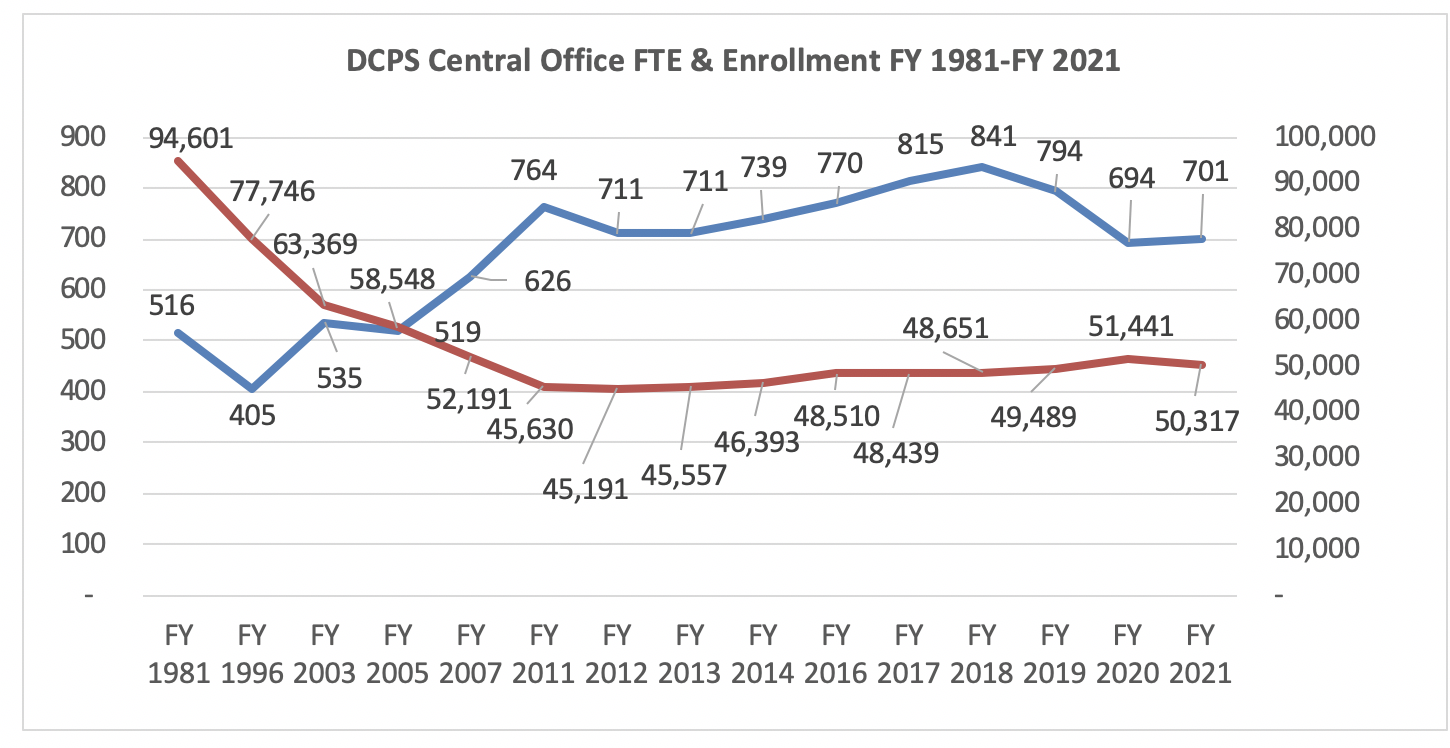
Finally, as of mid-March, 2021, we do not know the Final Initial Allocations to schools, nor how much money DCPS will have in total.  The amount in central accounts will be announced only when the Mayor releases her proposed budget in late April.  For many years I have categorized DCPS employees by a consistent set of definitions based on whether or not they serve students directly, which is what most of the public want to know when they ask about central office or “administration.”[1]  The number of central office employees has decreased a little recently but is still much higher than in years much earlier when enrollment was much higher. The number of central office full-time equivalent staff performing the same functions that DCPS now performs rose from 516 in 1981, when we had 95,000 students to 626 in 2007, when we had 52,000, and as of last month to 701 for 50,000.  They include 4 Executive Directors, 9 Chiefs, 24 Deputy Chiefs, 75 Directors, 165 Managers and 41 Analysts.  The system needs some number of these officials, and those who are good are worth a great deal.  But do we really need 35 Executive Directors, Chiefs and Deputy Chiefs?  75 Directors? 165 Managers?  Could some of these positions not be redirected to retain local school staff?

[1] The source is personnel department lists of DCPS employees, obtained by FOIA or from submissions to the D.C. Board of Education (before FY 2008) or to the DC Council (since FY 2008), based on office of employment, program codes, job title, purpose of applicable grant funding, and DCPS website descriptions.  Employees performing functions subsequently transferred or contracted out are excluded in the earlier year calculations.

Ward 1 Education Council Testimony – COW Hearing: DCPS Initial School Level Budgets FY22 – April 2, 2021

On Behalf of the Ward 1 Education Council

Committee of the Whole Public Roundtable on DCPS Initial School Level Budgets

April 2, 2021, 9:30am

Good morning Chairman and Councilmembers. My name is Alexandra Simbana, a parent of a 3rd grader at Cleveland Elementary, a member of my school’s LSAT and member of the Ward 1 Education Council. 

As always schools are in flux and in a state of uncertainty during Term 3 and into Term 4; dividing time and resources over their unknown future. A universal feeling of not knowing what you will lose and how you will still meet the needs of your students in the next year is not unusual but THIS YEAR is a burden the schools, staff and families should not need to balance, when so much Federal funding is available to help stabilize the overwhelming needs which have only worsened during the pandemic. The city must allow DCPS schools to use federal and other pandemic special funding on staff.  By not doing so, we are asking schools to cut school-based staff who already have strong relationships with students, while hiring for temporary programs which are less effective, all in the hope of makeup for the loss of school-based staff on top of the trauma caused by the pandemic.

As one community member states: “We don’t know exactly what we will lose in this budget cycle and schools try to retain staff but that comes at the cost of other resources like professional development, classroom materials, and extracurricular programming. DCPS can claim budgets are rising when functionally they are not due to increased costs.”  

While all our Ward 1 schools are unique and they have varying needs, each community has significantly varied ability to cover school priorities outside of school budget allotments. The financial costs of what is needed to supply additional personnel support is too much for ANY school PTA/PTO to cover on their own and that approach would only continue the inequities between schools who have funds and those who don’t. 

In Ward 1 four of our schools will experience a loss of funding ranging from $223k – $437K. Most of our schools are known for their high concentration of English Language Learning students within the City. The pandemic has hit their community particularly hard and all our schools anticipate a greater need to service these students. Given the populations at our schools, most will not be able to mitigate even a fraction of the losses to their school budgets to help support the students who will require more assistance when returning to class in the Fall. And yet, we hear reports of funding cuts across the City to ELL positions. Given the vulnerability of this community, it is extremely irresponsible and inequitable to remove the support they will need.  As we all have experienced in the past, once positions are removed from the school budgets they very rarely are returned the next year. 

Cardozo which is set to lose $437.1K in this budget cycle. This school which serves as a combined middle school and high school in addition to their International Academy has an 80% At-risk population. Cardozo is also a school who will more than likely see the greatest number of additional students arrive for SY21-22 because of the population and programming they offer. How can we realistically expect these schools to service their students with such high impact changes?

For all our Ward 1 schools maintaining staff positions for janitorial staff, security personnel and support staff positions will be critical in any phased in reopening plan which will require more staff coverage per smaller cohort units, ensuring adherence to safety protocols and mandatory cleaning regimes to ensure pandemic protocols are followed as more students return to in person learning in the coming months. Just as important to maintaining physical health will be to provide emotional support and resources which is why we ask that school staff be kept whole at ALL our schools. 

The school which will have significant cuts again this year is CHEC. They will lose $-265.3K in this budget cycle.For the last several years CHEC has experienced a significant reduction in their school budget. In SY 2019, they already suffered a $250k reduction in budget but come the Fall they had an additional 119 students to service. A CHEC LSAT member said: There is no mechanism to correct these budget miscalculations and again our DCPS schools, staff and students are made to pay the price [of] being under resourced. The staff reductions implications to this school will further traumatize this school community. Once these budgets are approved there will be no recourse for these schools and they will again need to service their larger school population with less resources

The CHEC budget is of great concern, because they’re losing four positions, and their funding is the lowest per pupil based on enrollment in the City.  The At-Risk funds are being designated for general education purposes.  According to the preliminary budget analysis by the Coalition for DC Public Schools and Communities, per pupil funding for “general education” varies greatly among schools.  General education is the remainder when at-risk, special education, ELL and federal funding are filtered out.  One would expect general education per pupil funding among schools with the same grade levels to be similar except for adjustments for size, since small schools have higher costs.  Yet some schools of similar size have general education per pupil funding differing by many hundreds of dollars.  This has substantial repercussions for CHEC because of its high number of at-risk, special education and ELL students.  Among DCPS high schools, CHEC consistently receives the lowest amount of discretionary funding (Specialty Funds, Stabilization Funds, Chancellor’s Budget Support, and Per Pupil Minimum Payment), can this disparity be reversed? How can the adverse impacts of these inequities be mitigated for all the Ward 1 schools whose student populations include significant ELL, special needs and homeless populations? 

There are also many questions about the criteria or method used to derive the additional stimulus funding allotments. During the education hearings DCPS was asked for this information and no response was ever provided. 

Our students are paying attention and they see how the system is not prioritizing their needs. As a student leader says, “Why do the decisions (sic) about the budget have to lead to schools having to cut staff? We all know that next year will be all about recovery. Students will need every support accessible to them to feel welcomed, feel like they belong, feel supported, [and] have someone to talk to, feel less stressed, and just recover! We can’t justify or say that the summer activities are going to be (sic) enough. We can’t cut off staff and say that you have been given the choice to add another psychiatrist, psychologist, or therapist and [make] it seem right. We can’t say that we want the best for our students when we know they need every resource [available] to have a transition as smooth and supportive as possible when we are continuing to do the opposite.”

Our school budgets must reflect our value of the work schools do, the work and learning we ask students to do academically and socially as the mechanism to become members of our community after they graduate. Unless we prioritize Federal and surplus local funds, we are merely giving lip service to the idea that education matters or that every day counts.

Thank you.  

BANCROFT: Unaffected

BRUCE MONROE: Unaffected

CLEVELAND: Losing $-228K in this budget

HD COOKE: Unaffected

MARIE REED: Unaffected

TUBMAN: Losing $-223.3K in this budget.

ADAMS MS: Unknown due to combined Oyster budget

CARDOZO: Losing $-437.1K in this budget

CHEC:Losing $-265.3K in this budget. 

BANNEKER HS: Unaffected

Ward 2 Education Council Testimony – COW Hearing: DCPS Initial School Level Budgets FY22 – April 2, 2021

Chairman and Councilmembers. I am Sandra Moscoso, treasurer of the Ward 2 Education Council and a parent of two students at School Without Walls High School. 

I am here to ask that you support funding our schools so they are able to maintain current staffing levels and to also invest more in schools hardest hit by the current crisis. I will share with you what school communities are telling us about how DCPS’ inadequate budgets will hurt their ability to serve students.

DC Public Schools is forcing schools to cut staff for the 2021-22 school year, the first year of recovery after more than one year of disrupted learning due to Covid-19. Education councils in Wards 2, 3, 4, 5, 6, 7, and 8, and ANC Commissioners and leaders initiated a petition to demand that the city maintain current staffing levels for the upcoming school year. We agreed that DC must also invest more in schools in under-resourced areas to address the disproportionate impacts of the pandemic. 

In many cases, the school-level staffing cuts cannot be explained by lower student enrollments. Schools face staff cuts for a number of reasons each year, including increases in costs.

These cuts are happening while DCPS is expecting to receive from the American Rescue Plan around $275 million (ESSER II + ESSER III) in stimulus funding for school recovery. These federal funds can be used for “activities that are necessary to maintain the operation of and continuity of services … and to employ existing staff.” While DCPS could use these federal funds for any purpose through September 2024 – including to fund staff and develop a multi-year staffing plan – DCPS instead chooses not to do so. 

The city must do better to meet the needs of all students, given that staffing cuts will be felt most heavily in schools that are already under-resourced. In addition, lack of supplemental investment in education at this critical time will exacerbate the unacceptably large gaps in learning by student race and income. We ask that you fund DCPS schools for recovery:

  • Schools need more staff, not less, to address learning needs. Schools with fewer staff cannot provide the same level of targeted supports when the academic needs of some students have increased due to the pandemic. Funds promised for summer and afterschool programs must not be considered replacements for instructional staff during regular school days.
  • Schools will need more staff to adhere to health and safety guidelines, to offer in-person learning to more students, while continuing to provide virtual options. Fewer school staff puts many schools at risk of not having adequate resources to serve all students and re-open safely.
  • Schools need additional support to address whole-child needs. Mental health support for students continues to be the most highly demanded request in the city, and the pandemic has exacerbated this need. It is particularly short-sighted and imprudent to cut existing school staff before we have a solid handle on all the mental health, socio-emotional, and academic needs that students will face as in-person learning increases and virtual learning continues to evolve.

In the citywide petition, we asked school communities to share the impact of these cuts to their schools. Here’s what we have heard from Ward 2:

  • Duke Ellington School of the Arts, which for nearly 50 years has served as the sole public arts high school in DCPS, serving a majority African American student body from all 8 wards, reports a serious under-allocation, and seeks pay parity for its teachers. The 2020-21 DCPS budget allocation for Ellington pays for just 31 of the 58 full-time, dual curriculum, faculty positions. Ellington teachers earn an average of $25,000 less than their DCPS counterparts. The school seeks an increase, commensurate with what they would rightfully expect to receive today. Doing so gives Ellington teachers the equitable salary and benefits package they are entitled to, and ensures teacher retention. (See DESA Fact Sheets)
  • Ross Elementary, a school with a 20% English Language Learner population with a mile long waitlist, is being forced to cut all their art, music, world languages and library positions to part-time.
  • At School Without Walls High School, despite DCPS forecasting zero loss in enrollment, DC’s highest-performing, nationally-ranked magnet school serving families in all eight wards must cut a teacher and educational supplies across science, art, and music. This on the heels of a year where the school sacrificed a librarian, and two other staff. For schools like Walls, DCPS should at least do no harm — maintain the status quo to serve the same number of students as in the prior year. (see LSAT and HSA letters to Chancellor)
  • Thomson Elementary, a Title 1 school with a 50 percent Hispanic population has suffered greatly due to the pandemic (i.e. food insecurity, difficulties with distance learning, and unemployment. Note the at-risk population at Thomson is much higher than reported. Many undocumented families do not register for benefits that form the basis of funding formulas). The school, which counts teacher stability and retention as a strength, is losing an ELL teacher and a first grade teacher. Cutting one of Thomson’s classroom teachers will have ripple effects for years. Thomson would like to see the budget pre-pandemic numbers reinstated for the next school year.  

I hope you can see a pattern of annual cuts and defunding of our schools. A pattern that does not change even in the face of a pandemic.

DCPS has not yet released a comprehensive plan for recovery, so we took a look at what experts outside of DCPS are saying. In one way or another, all of these recommendations focus on investing in schools, in school-day activities, in strengthening relationships between home and school. With federal funds that can be used through September 2024, we have an opportunity to do this. All we need is the political will.

We thank Councilmember Pinto for including restoring cut teacher positions, critical mental health support and funding healthy buildings in her budget priorities. While I am here speaking on behalf of Ward 2 schools, it’s important to note that families across all wards enroll their children here. Of the 876+ individuals who signed the petition so far, 80% of signatories linked to Ward 2 schools, identified their home ward as other than Ward 2. 

We hope to see support for keeping our schools whole across every Councilmember’s priorities.

In the Fall, schools should open their doors (or e-classrooms, depending on health and safety) with robust and familiar instructional staff, equitable access to technology, opportunities for students to pursue interests and build relationships, and most importantly – mental health resources to help students cope with current and ongoing stressors. 

Thank you for this opportunity to testify.

Ward 6 Public Schools Parent Organization Testimony – COW Hearing: DCPS Initial School Level Budgets FY22 – April 2, 2021

I am Valerie Jablow, Ward 6 resident and DCPS parent testifying on behalf of the Ward 6 Public Schools Parent Organization.

As you know, DCPS is forcing schools to cut staff and make impossible budget choices for the 21-22 school year, the first year of recovery after more than one year of disrupted learning due to covid.

Budget analyst Mary Levy analyzed DCPS’s initial budget allocations and found 51% of schools have lost staff positions for the 21-22 school year relative to pre-pandemic budgets. These staffing cuts cannot be explained by lower student enrollments. Even schools without budget cuts are losing staff because of increases in costs.

Local School Advisory Teams (LSATs) have been asked to choose between academic and emotional support in a time of increased, not decreased, needs.

Here’s what this looks like in a few Ward 6 DCPS schools:

Eastern High (95% Black, 67% at risk) is losing a social worker and at least one teacher

Seaton Elementary (36% Black, 38% Latino) is losing a science teacher and an ESL teacher, while the school’s immigrant population constitutes more than >60% of its student body and its English language learners 38%

Ludlow-Taylor Elementary (41% Black) is reducing its full-time librarian and science teacher to part-time

Miner Elementary (79% Black, 61% at risk) is experiencing budget cuts, including losing its librarian.

Walker-Jones Education Campus (92% Black, 81% at risk) is continuing its historical understaffing, while losing its librarian

Amidon-Bowen Elementary (79% Black, 65% at risk) is losing two full-time positions. 

To see the ramifications of this disaster budgeting, let us look at Amidon.

In recent years, Amidon-Bowen has had two full-time interventionists, for reading and math. Neither has ever been included in the school’s initial budget allocations. This year, the principal again requested two interventionists—but got funds for only one. The LSAT then made the tough choice of a part-time reading interventionist and a part-time math interventionist for next school year. This means students behind one or more grade levels will get only half the intervention time they received before the pandemic, even as some have fallen further behind during the pandemic. 

Amidon-Bowen also currently has a specials teacher who serves as a part-time PE teacher and part-time science teacher. But in its initial budget allocation, Amidon lost this full-time specials teacher. Yet, the school is adding a classroom next year, which means that this cut also decreases the number of possible specials rotations next school year. And all the cuts mean fewer school-wide supports and staff for a greater number of classes—not to mention fewer staff to address the challenges of social distancing requirements. 

And all this at a school that has not lost any enrollment for years running—and used to have full-time Spanish and science teachers.

Beyond Amidon, four other Ward 6 schools–Brent, Miner, Van Ness, and Walker-Jones–will have no librarian next year, and Ludlow-Taylor will be reducing its full-time librarian to part-time. We know that having a full-time certified library media specialist supports literacy development. What are we saying to the children who attend those schools by cutting their librarians–and in a time of trauma?

Yet, DCPS is directing federal stimulus funds for new programs or additional supports for the summer—even though paying vendors to provide services is not an adequate substitute for keeping staff who know students and their school communities and are needed now.

Worse, these DCPS budget cuts have a terrible urgency, because staff who are told their positions are no longer funded will soon find employment elsewhere. If DCPS waits until late spring to restore these positions, it may be too late to get back staff or hire the best new staffers.

And worst of all, the experiences of Ward 6 schools show explicitly who these cuts will hurt the most: Black and brown children, many of whose families have already been devastated by the pandemic.  

It doesn’t need to be this way—and you can change it.

With a $500 million surplus in 2020, our city should not be forcing LSATs to choose where and how our schools should fail our children.

Rather, DC can and should invest for recovery now. 

That means: 

—No school budget and staff cuts for SY21-22

—Investment in regular school day staff with federal stimulus funds, which can and should be used for that purpose by DCPS, which is expected to receive more than $100 million

—Targeted investment in school mental health staff, whose services are desperately needed for full pandemic recovery

—Investment in staffing to help with virtual learning at each school and to adhere to health and safety guidelines

—Creation of digital infrastructure for equitable distance learning, with a 1:1 device ratio, internet for all, and readily available tech support for all schools

—Understanding that funds for tutoring, summer school, and afterschool programming are not replacements for instructional staff in regular school days

We do not lack money to do all of this for all our schools right now. 

We only lack political will. 

In this time of great need, with achievement gaps only growing, DC needs to invest in our schools and children for recovery—not disaster. Thank you.

Upcoming Opportunities to Support DCPS School Staffing and Budgets

Dear DC School Community Members,

Thank you for your support in demanding the city maintain the current staffing levels at all DCPS schools for the upcoming school year AND increase funding in schools serving students most impacted by the pandemic.

794 community members from 97 schools across all 8 wards have shown their support. Thank you to all the school communities who have shared how their school staff will be cut, and to school communities who have signed the petition in solidarity.

The DC Council will hold a public roundtable on DCPS Initial School Level Budgets (for school year 2021-22) on Friday, April 2 @ 9:30am. Representatives from the Ward Education Councils who co-sponsored the petition have been asked to testify. We need your help.

  • Please help us get to 1000 signatures by sharing this petition with your school communities and neighborhood communities. Find the link HERE.
  • If you are able, please watch the hearing and support via Twitter using #fundDCPSschools #noDCPScuts
    • Watch the hearing live April 2 @ 9:30am (or recorded later) HERE
    • Find social media contacts for DC Council, Mayor, Chancellor, Ed Council, and Media HERE

We will send a reminder on Friday morning ahead of the hearing. Please don’t hesitate to reach out.

Thank you,

Betsy Wolf and Sandra Moscoso (please see all petition sponsors below)

Sponsors:
Ward 2 Education Council
Ward 3 Wilson Feeder Education Network
Ward 4 Education Alliance
Ward 5 Education Equity Committee
Ward 6 Public Schools Parent Organization
Ward 7 Education Council
Ward 8 Education Council

Layla Bonnot, 1A01
Christine Miller, 1A05
Judson Wood, 1A06
Jason Clock, 1A12
Lisa Gore, 3G01
Evan Yeats, 4B01
Erin Palmer, 4B02
Tiffani Nichole Johnson, 4B06
Colleen Costello, 5B05
Robb Dooling, 6A06
Dorothy Douglas, 7D03

DC Fiscal Policy Institute

W6PSPO & Friends Support of OSSE PARCC Waiver Request

Acting Superintendent Young, 

We (parents, educators and community members) strongly support the DC Office of the State Superintendent for Education (OSSE)’s request for a systemwide PARCC reading and math assessment waiver this spring 2021, and we agree with the request to suspend the calculating of new STAR ratings for SY 2020/2021.

Between February 12 and February 24, 2021, 1,225 parents, educators and community members across DC Public Schools and DC public charter schools signed on to a petition to cancel the PARCC assessment in spring, 2021. DC community members agreed “DC Needs To Prioritize Time for Social, Emotional and Academic Learning Over Time for Testing.”

Students and educators have already lost too much learning time to disruptions caused by school closures and waves of quarantines, community and family illness, economic crisis, inadequate attention to digital equity needs, and social and mental health impacts. We should be investing every minute of in-person or remote learning into making up for lost time – not adding to the time deficit.

Testing takes precious resources away from learning and other supports for students when they need them most. Testing this spring would happen over an 8-week period, deploying educators and staff away from providing learning and support services to proctoring tests and preparing and managing test logistics.

These high-stakes tests add stress to students already burdened by added, unprecedented pandemic-related stresses. We should instead be reducing stresses and supporting students’ social, emotional and mental health.

Test scores won’t be valid or available in time to help students now nor to plan for addressing learning loss this summer or next school year. Not only will tests be invalid due to variations in testing environments, mandated standardized testing does not provide educators the data needed to meet individual student learning needs in real time, which is what we need right now.

For the sake of students, we support this waiver request.

Please find attached the signatories and their comments.

Sandra Moscoso and Suzanne Wells 

on behalf of The Ward 6 Public Schools Parent Organization (W6PSPO) and the attached signatories

For Action: OSSE PARCC Waiver Requests are Open for Public Comment Through April 2, 2021

Good news! You can review OSSE’s requests for one-year waivers for PARCC testing HERE and provide comment via email to osse.assessment@dc.gov by April 2, 2021.

It’s worth noting in the Statewide Assessment Waiver Request, OSSE proposes to:

Collect and share information transparently with the public on local interim assessments as well as a spectrum of previously and newly collected data on student outcomes and experiences in lieu of statewide assessments.”

Let’s hold OSSE to this, especially as our schools need this data to develop robust plans to support students over Summer and Fall, 2021. Our schools need analytic support – we’re hoping OSSE will deliver this.

Thanks again to everyone who supported our petition to cancel PARCC this year.

Petition: Our Students and Schools Need More Funding, Not Cuts

DC Public Schools is forcing schools to cut staff for the 2021-22 school year, the first year of recovery after more than one year of disrupted learning due to Covid-19. Education councils in Wards 2, 3, 4, 5, 6, 7, and 8, and ANC Commissioners initiated this petition to demand that the city maintain the current staffing levels at all DCPS schools for the upcoming school year AND increase funding in schools serving students most impacted by the pandemic. Please consider signing this and sharing with your networks.

Sign the petition here.


To: DC Mayor Muriel Bowser, Chairman of the DC Council, Phil Mendelson, DCPS Chancellor Lewis Ferebee

From: The Education Councils of Wards 2, 3, 4, 5, 6, 7 and 8

DC Public Schools is forcing schools to cut staff for the 2021-22 school year, the first year of recovery after more than one year of disrupted learning due to Covid-19. We, as parents, teachers, and community members across DC demand that the city maintain current staffing levels for the upcoming school year to support recovery. DC must also invest more in schools in under-resourced areas to address the disproportionate impacts of Covid-19.

51% of DCPS schools lost staff positions for the 2021-22 school year in their initial budgets (and relative to pre-pandemic budgets) according to local budget expert, Mary Levy. These staffing cuts cannot be explained by lower student enrollments. Schools face staffing cuts for a number of reasons each year, including increases in staffing costs.

Meanwhile, DCPS is expecting to receive from the American Rescue Plan around $275 million in stimulus funding to support schools in recovering from the multilayered impacts of the pandemic. These federal funds can be used for “activities that are necessary to maintain the operation of and continuity of services … and to employ existing staff.” While DCPS could use these federal funds for any purpose – including to fund staff and develop a multi-year staffing plan – DCPS instead chooses not to do so. In addition, the DC government reported a $500M surplus in its own 2020 budget, reducing budget pressure for the city.

The city must do better to meet the needs of all students, given that staffing cuts will be felt most heavily in schools that are already under-resourced. In addition, lack of supplemental investment in education at this critical time will exacerbate the unacceptably large gaps in learning by student race and income. We ask that you fund DCPS schools for recovery:

  • Schools need more staff, not less, to address learning needs. Schools with fewer staff cannot provide the same level of targeted supports when the academic needs of some students have increased due to the pandemic. Funds promised for summer and afterschool programs must not be considered replacements for instructional staff during regular school days.
  • Schools will need more staff to adhere to health and safety guidelines, continue to provide virtual options, and offer in-person learning to more students. Fewer school staff puts many schools at risk of not having adequate resources to serve all students and re-open safely.
  • Schools need additional support to address whole-child needs. Mental health support for students continues to be the most highly demanded request in the city, and the pandemic has exacerbated this need. It is particularly short-sighted and imprudent to cut existing school staff before we have a solid handle on all the mental health, socio-emotional, and academic needs that students will face as in-person learning increases and virtual learning continues to evolve.

DCPS parent L.D. Parker recently said it best: “We are literally being asked to choose where to fail our children.” For the sake of students, we ask that you increase funding for DCPS school budgets NOW to maintain current staffing levels and address increased needs. Time is critical, as schools and staff are currently making employment decisions.

Sign the petition here.

Sponsors:
Ward 2 Education Council
Ward 3 Wilson Feeder Education Network
Ward 4 Education Alliance
Ward 5 Education Equity Committee
Ward 6 Public Schools Parent Organization
Ward 7 Education Council
Ward 8 Education Council

Layla Bonnot, 1A01
Christine Miller, 1A05
Judson Wood, 1A06
Jason Clock, 1A12
Lisa Gore, 3G01
Evan Yeats, 4B01
Erin Palmer, 4B02
Tiffani Nichole Johnson, 4B06
Colleen Costello, 5B05
Robb Dooling, 6A06
Dorothy Douglas, 7D03

CC:
Councilmember Charles Allen
Councilmember Anita Bonds
Councilmember Mary Cheh
Councilmember Janeese Lewis George
Councilmember Vincent Gray
Councilmember Christina Henderson
Councilmember Kenyan McDuffie
Councilmember Brianne Nadeau
Councilmember Brooke Pinto
Councilmember Elissa Silverman
Councilmember Robert White Jr.
Councilmember Trayon White Sr.