Serenity Rain Testimony – DCPS Performance Oversight Hearing – February 26, 2019

Serenity Rain

Ward 7 Resident

Parent and LSAT Chair, Anne Beers Elementary School

Testimony on the DC Council Committee of the Whole and Committee on Education

Performance Hearing on the District of Columbia Public Schools

Tuesday, February 26, 2019

John A. Wilson Building, Room 500


Thank you for the opportunity to testify today. My name is Serenity Rain, and I am a parent at Anne Beers Elementary with kids in Pre-K 3, Kindergarten and 3rd grade. I am here today to speak in support of the FoodPrints program as a parent, teacher, LSAT chair, community advocate, and trained social worker.

Two years ago, I began as the community advocate for the Beers Farm Share program and a Foodprints assistant teacher. The FoodPrints program was so compelling to me that last year, I left my job to begin a position as the Lead FoodPrints teacher at Anne Beers.

From my perspective as a parent, Anne Beers students are learning critical thinking, problem solving, team building and essential life skills in FoodPrints. This whole-child approach to education is very important to me and one of main reasons why I choose Anne Beers for my children.

From my perspective as a teacher, I’ve witnessed the impact FoodPrints has on the entire school. Everyone at Beers from the Principal to the Custodial Staff loves FoodPrints and are always eager to see what we are cooking next. We’ve got the whole school loving Kale and saying “Kale Yeah!” and being open to trying new healthy foods. Foodprints is the highlight of everyone’s of the day, and I feel like a celebrity when I push my cooking cart through the school.

From my social worker perspective, FoodPrints is healing. This is especially important at schools in which so many students are impacted by trauma, challenging childhoods, mental, physical and learning disabilities.

I’ve seen how a student experiencing stress is relaxed by digging in the soil, watering a plant, cutting vegetables, or grinding wheat berries into flour. And how students are excited they created something delicious and nutritious together! Just by participating in FoodPrints, children feel a sense of belonging, teamwork, and that they matter.

From my perspective as a community health advocate, FoodPrints and our farm share grants our school community access to fresh produce and healthy eating in a place known as a “food desert” with high rates of obesity and diabetes. Seeing students come to school eating honey buns and donuts for breakfast and having a packed lunch of processed foods and snacks is disheartening. Students are excited to try new healthy foods in FoodPrints because they are part of the process to harvest and cook the food.

Though Foodprints is amazing at our school, we face funding limitations. Currently only students preschool through 1st grade gets the full Foodprints experience. Upper grades participate on a very limited basis and students and teachers – and parents – continually ask if they will be able to participate more frequently. Limited funding is constantly looming over us and it’s a fear year to year whether or not we will be able to continue our FoodPrints program. We hope the city can invest in this program so that all our students can benefit. There is so much research out there that proves that a model like this works, and our students deserves the best we can give them!

Jennifer Mampara Testimony – DCPS Performance Oversight Hearing – February 26, 2019

Jennifer Mampara

FRESHFARM FoodPrints Program Director

Testimony on the DC Council Committee of the Whole and Committee on Education

Performance Hearing on the District of Columbia Public Schools

February 26, 2019

John A. Wilson Building, Room 500

Thank you to the Committee for holding this hearing and listening to community voices on our DC public schools.

I am Jennifer Mampara, the Director of Education at FRESHFARM and manager of the FoodPrints program. We currently partner with 13 DCPS elementary schools across the city to provide regular hands-on food, gardening, and nutrition classes throughout the school year. We have developed curriculum that is aligned with local and national science, math, ELA and health standards, as well as with the DCPS curricular scope and sequence at each grade level and local Environmental Literacy goals.

I am here today to share with the Committee our successes in our long-term partnership with DCPS that helps meet academic goals and the requirements of the DC Healthy Schools Act; provides opportunities for exciting, hands-on learning; and models new ways to engage with academic content for teachers. This has been an incredibly productive and successful partnership that began in 2009 and has resulted in FoodPrints programming that currently serves more than 4,500 DCPS students, 66% of whom are economically disadvantaged. We are reaching about 20% of the DCPS elementary school population at this time, and an additional 18 DC public schools have reached out to us requesting programming for their school communities.

This partnership has also resulted in DCPS school administrators, teachers, parents and students that express tremendous interest in sustained, academically integrated food, nutrition and environmental education at their schools. Year after year, many of our partner school principals choose to direct discretionary funds in their school budgets to contribute to the cost of FoodPrints programming for their schools. Year after year, parent teacher associations dedicate a significant portion of the funds they raise to make this programming possible.

An additional result is a unique and exciting collaboration with the DCPS school meals program in which recipes that students have been studying, cooking and eating during their FoodPrints sessions are prepared from scratch with the support of a chef coach once a week and served in our partner school cafeterias. This project began when the DCPS Food and Nutrition Services Director (Mr. Rob Jaber) noticed that when asking students what they would like to have more of in their school lunches, there were a few outlying schools with students requesting kale salad and apple beet salad instead of pizza and hamburgers. These outliers were students at FoodPrints schools, and since then, Mr. Jaber has been unwavering in his support for sustaining and growing the program.

In order to measure and communicate this success, we partner with researchers at George Mason University and Columbia University. Last spring, one of our evaluators, Dr. Katie Kerstetter, surveyed 150 DCPS administrators and teachers about the value FoodPrints programming brings to their schools and students.

The majority of respondents said that FoodPrints programming is “very important” or “important” (a 4 or 5 on a 5-point scale) in providing:

  • Academic Support
  • Family Engagement
  • Nutrition Education and School Gardens Engagement
  • Social and Emotional Learning

This is some of the feedback we have received from classroom teachers:

“FoodPrints allows my students to access our unit themes in new ways. It allows my students to see how our ELA and Math units align to real-life situations.” – Teacher, Tyler

“FoodPrints is designed to  allow students to revisit the concepts and topics from class and to see them from a different perspective.” – Teacher, Francis Stevens

“Families who don’t usually participate are given an opportunity to engage in FoodPrints and feel a part of the community,” – Teacher, Marie Reed

“Many of my students have tried and enjoyed foods they didn’t try before and/or thought they didn’t like previously… FoodPrints perfectly fits early childhood education as it’s all about trying new things and investigating possibilities.” – Teacher, Francis Stevens

“[Through FoodPrints,] students learn to have more independence and how to hold themselves accountable.” – Teacher, Kimball  

“[Through FoodPrints, students are] working collaboratively and working out a plan.” – Teacher, Tyler

“Taking risks and trying new things.” – Teacher, Peabody

“Building the self-confidence to try new things in a safe environment.” – Teacher, School Within School

This is some of the feedback from school principals:

“Our students and families really feel this is an integrated approach to learn about healthy food and nutrition, where food comes from, and how to grow your own food.” 

“It’s critical that this kind of program gets into schools across the city, regardless of the economic status of their neighborhood, and that it is sustained.“  

“{FoodPrints supports] negotiating peer relationships in managing the kitchen, the tools and the garden”

This is some of the feedback from parents:

“FoodPrints has helped create the collaborative, creative environment that fosters growth, curiosity and learning, and it is part of the reason that we continue to be such happy members of our school family.”

“FoodPrints has transformed my daughter’s perception of food and living organisms. As a volunteer, I had a wonderful experience learning to make healthy meals for my family. I can’t wait to participate again!”

“If DC can do one easy, tangible thing to foster a healthy community, supporting this program is it. It requires so little and it teaches so much. I feel incredibly fortunate that my children are getting a great early foundation in healthy living through it. I hope you not only continue to support this program, but commit to robustly expanding FoodPrints so every DC child has access to it. “

At at time when over 30 percent of our youth aged 17-24 are ineligible for military service due to obesity, and 1 in 3 children born today will develop diabetes, food education at an early age is critical. I thank DC Public Schools for supporting the long-running partnership between schools and the FRESHFARM FoodPrints program, and I encourage the Council to recognize the importance of this partnership as a strength of DCPS that deserves ongoing financial support from the city.

Rebecca Reina Testimony – DCPS Performance Oversight Hearing – February 26, 2019

Testimony of Rebecca Reina

to DC Council, Committee on Education, Performance Oversight Hearing

DC Public Schools

on 2/26/19 at 12:00 pm, John A. Wilson building, room 500


Hello, I‘m Becky Reina, Chair of the Ward 1 Education Council. Our Education Council advocates for a stronger public education system that supports all our students and families, while making sure we safeguard our by-right neighborhood schools and work for greater resources, equity, transparency, fairness, and safety across both educational sectors.

I am also the mother of 2 Cleveland Elementary School students, where I have in the past served on the PTA and LSAT. Thank you for this opportunity to provide feedback on the performance of DC Public Schools. I want to preface my critique by saying I think all DCPS employees are striving to educate and support DC students. I have been very happy with my children’s direct classroom experience and I am proud to send them to a DC Public School. My critique is focused on DCPS as an institution. I have found DCPS Central Office employees to be smart and exceptionally hardworking; yet, the negative institutional and systemic pressures on them are often insurmountable.

Sometimes, I feel like DCPS is changing for the better: the creation of the Ward 1 Education Council was warmly received by DCPS and since our formation in January, we have already had some productive conversations on how our Education Council and DCPS can work together. However, I have also been disheartened by DCPS’s sometimes opaque decision making, poor communication, and tardiness in addressing urgent problems.

The W1EdCouncil is deeply concerned that the planning leading up to and underlying justification for the announced move of Banneker HIgh School has not been discussed publicly. While the decision appears to have been made solely by Mayor Bowser, DCPS employees have struggled – often ineffectively in multiple public meetings – to address public concerns, choosing instead to silo various stakeholder communities, pitting neighbors against each other due to perceived scarcity. After looking at the proposed Educational Specification for the new Banneker building, I am concerned that the Banneker community is not being afforded the robust planning process, focused on the school’s uniques needs, that has been afforded to other DCPS application high school such as School Without Walls. Banneker not only deserves a beautiful building on time, but also deserves the attention of thoughtful planning in collaboration with its community.

I see similar deficits in the school budgets that were released last week, many weeks late, leaving very little time to engage stakeholders. Teacher raises are well deserved. They should have been properly funded to protect the buying power within school budgets. The decision to imbedded the cost of security into individual school budgets is a laudable move toward transparency, but in some cases it obfuscates large cuts to individual schools. In Ward 1, H.D. Cooke, Cleveland, and Tubman all face substantial cuts. These three schools also have some of the largest percentages of At-Risk students in Ward 1: with H.D. Cooke at 49%, Cleveland at 61%, and Tubman at 65%.   In the case of Tubman, the funding cut is initially hidden when looking at the proposed budget because the “increase” in year over year allocation is entirely swallowed by security costs, leaving a proposed deficit of over $65,000. The Comprehensive School Model of budgeting hides even more cuts, because school leaders have so few real chances to reallocate money from one category to another. If Tubman decides not to use its allocated money for the library books they don’t need, they lose $10,000; they cannot reprogram the money to other uses. Outside of Ward 1, the cuts to comprehensive high schools across the river are truly horrifying: H.D. Woodson, Anacostia, and Ballou High Schools appears to face cuts in the $100,000s according to their public allocations, perhaps even a million dollars in the case of Ballou when security costs are included. These budgets are being justified by unrealistic enrollment projections for schools that receive new students through the school year. These budget games do not serve our students. The schools facing the worst budget cuts should not be the schools with the most needs. Even the schools with large raises now need to fear that the tap dries up next year and they are faced with losing staffers they brought on only a year before. Students need stability. Budgets that swing wildly year to year, forcing teacher and staff turnover and constant programmatic changes need to stop.

I am similarly concerned that DCPS employees continue to tell the MidCity community that there are enough DCPS seats at the middle school level.  Planning for by-right, neighborhood middle and high schools feels particularly pressing for Ward 1, because of increasing evidence that our neighboring schools of MacFarland and School Without Walls at Francis Stevens will be over-enrolled in the near future, in addition to the ongoing overcrowding in the Wilson High School feeder pattern. DCPS is holding well-run community meetings on these issues, but outreach and advertising of these meetings to parents has been lacking and the data that is being presented there does not match reality. In the 2017-2018 school year, over 1,600 students were enrolled in middle school grades in the area in and surrounding the Cardozo feeder pattern, and yet DCPS says it is satisfied with the status quo, with only 147 students in middle school at Cardozo that same school year. Charter schools can and do close without warning. Also in Ward 1, 294 Cesar Chavez Prep students are now looking for places to land; DCPS is the educational sector legally required to catch them if their families so chose. DCPS needs to welcome them and generally focus greater attention on the middle grades in the middle of the city.

I will end on a bright spot: DCPS listened to advocates and allocated money for better school technology. The perfect follow up would be a comprehensive plan that supports not only laptops for testing but also continuing classroom use even during testing of a computers, laptops, tablets, headphones, and SMART boards and maintenance of all these devices. I look forward to seeing that from DCPS soon.

Thank you again for this opportunity.

Sandra Moscoso Testimony – DC Water Performance Oversight Hearing – February 26, 2019

Sandra Moscoso Testimony

Committee on Transportation & the Environment Performance Oversight Hearing:

DC Water

February 26 at 10:00AM JAWB

Good morning, Chairperson Cheh and Councilmembers. I am Sandra Moscoso, Secretary of the Capitol Hill Public Schools Parent Organization, the education council for Ward 6. I am also the parent of a 7th grader at Capitol Hill Montessori at Logan and 10th grader at School Without Walls.

First of all, I would like to thank DC Water for being a fantastic longtime partner in our flagship community events. For at least 13 years, Capitol Hill public, charter, and private schools have been coming together to celebrate Walk to School Day in October and since 2012, Bike to School Day in May. These events signal our community’s commitment to collaborating to strengthen Ward 6 schools. They also bring attention to the importance of getting students to and from school safely. To give you a sense of the events, we partner with our community foundation, D.C. Councilmembers, the Mayor and local government agencies, environment and transportation focused non-profits and businesses, national partners like the National Transportation Safety Board, the National Center for Safe Routes to School, the National Park Service, and we’ve even had my personal hero Congressman and civil rights leader John Lewis join us.

Since 2013, we have counted DC Water as a trusted partner for our events, bringing the message of conservation ethic and personal health with their reusable water bottles, filling station, and best of all, free hugs from Wendy the Water Drop. We appreciate the support for our schools, and we appreciate the reminder to the hundreds of families who celebrate with us to drink tap water and reduce consumption of plastic.

My son rows with the Capital Rowing Club Juniors team out of the Anacostia Community Boathouse. Last Saturday morning I cheered him on in an ergathon to raise funds for rowing scholarships to make the sport inclusive and more DC-area students have the chance to experience rowing and to make their own memories on the water.  In the Spring and Fall, my son and his team mates spend 5 days a week on the Anacostia River. The river plays a central role in our daily lives and you can imagine our families do a lot of thinking about the quality of the water. I applaud DC Water for initiatives like the tunnel to keep trash and toxins out of the river.

My family’s Martin Luther King Day tradition for the past 5 years has been to brave frostbite and participate in Anacostia River cleanup efforts with the Anacostia Riverkeeper and the Student Conservation Association. There’s nothing like collecting 4.5 tons of trash (bottles, metals, frozen diapers!) to help open your eyes to how we overwhelm the river.

My family has benefited from education programs like the Anacostia Riverkeeper’s tours and much like DC Water programs influence behavior, the Anacostia Riverkeeper’s education programs have influenced my family to reduce waste, and go beyond our blue recycling bin to drop off plastic film at recycling centers and food scraps at our farmer’s market. I hope DC water will make the most of the new Anacostia River headquarters and use it to showcase much needed green infrastructure like living shorelines. I am also probably the last person in DC to learn about the Clean Rivers Impervious Area Charge and the equity issues around it. I hope DC Water will prioritize working with the federal government to fix these and incentivize property owners to install green infrastructure to continue to reduce stormwater runoff in the Anacostia’s drainage.

With your support, we can hopefully look forward to more Walk to School Day hugs, and future MLK Days which do not feature frozen diapers.

Thank you for your time today.

Mary Levy Testimony – DCPS Performance Oversight Hearing – February 26, 2019

TESTIMONY BEFORE THE COMMITTEE OF THE WHOLE AND THE COMMITTEE ON EDUCATION, DISTRICT OF COLUMBIA COUNCIL

 Performance Oversight on the District of Columbia Public Schools 

Mary Levy      February 26, 2019

As an education finance lawyer, a budget and policy analyst, and a DCPS parent, I have studied DCPS data and policies for almost 40 years, including the period when both our daughters were going through DCPS, from pre-kindergarten through grade 12.  Below are summaries of some of my recent analyses, but first I want to talk about funding for DCPS local schools.

Last Thursday, DCPS released proposed local school budgets for next year.  Although schools were closed for winter break, principals and LSATs were given until Sunday to petition for changes to the many required positions and expenditures, along with another five days to make the limited choices permitted.  Parents are reporting that their schools will have to cut staff, even where enrollment has not decreased.  We have just received a spreadsheet from DCPS showing all the schools, but I have not yet had time to analyze it to assess these concerns definitively.  Nonetheless it is apparent that many schools will suffer higher pupil/staff ratios and less money for supplies and materials because increases are small, while the average staff position costs have almost all risen significantly and budget totals include substantial new sums for security costs now transferred from central accounts.

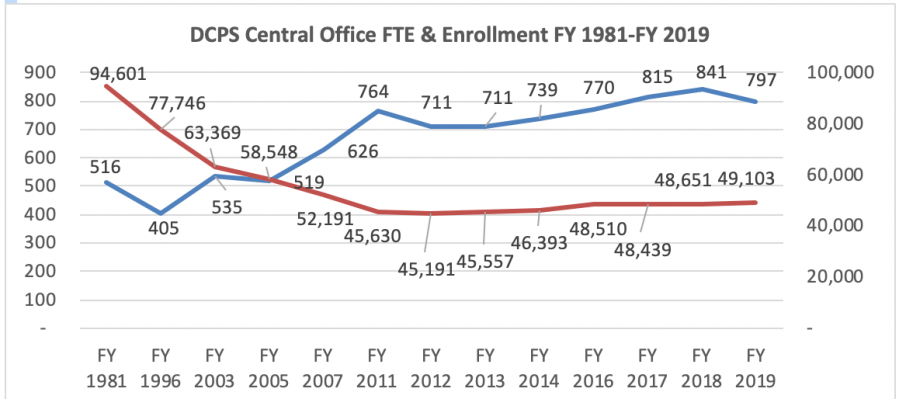
We do not yet know DCPS total budget for next year, nor where the rest of the money is going, but we do know that DCPS central offices are very expensive and much larger than they once were, and given this, we have to question whether local schools should be losing staff.

Screenshot 2019-02-26 14.31.01

For many years I have categorized DCPS employees by whether or not they serve students directly, which is what most members of the public want to know when they ask about central office or “administration.[1]”  The number of central office full-time equivalent staff performing the same functions that DCPS now performs has risen from 516 in 1981, when we had 95,000 students to 626 in 2007, when we had 52,000, to 797 this year for about 49,000.

Below are November 2019 counts of central office staff with common titles.  Certainly the system needs some number of these people.  Those who are really good are worth a great deal.  But do we really need 45 Chiefs and Deputy Chiefs?  86 Directors?  180 Program Specialists?

Title # of FTEs Title # of FTEs
Chief 14 Program Specialist 180
Deputy Chief 31 Project Manager 73
Director 86 Coordinator 144
Manager 79 Analyst 55
Specialist 84 Program Coordinator 9

According to the most recent statistics from Census Bureau fiscal reports, DCPS central office spending in FY 2016 was 10.8% of total current expenditures, compared to the U.S. average of 1.9% percent.  DCPS is spending $2,260 per pupil, which is ten times the US average of $226.[2] If central office were reduced to a more reasonable level, DCPS would not have to cut local school resources or use at-risk funds to supplant rather than supplement services for at-risk students.

What is happening is all the more painful given that we are spending more money on schools in recent years but seeing only limited academic progress.  Since 2007, the District has spent an average of 25% more per pupil in inflation adjusted dollars than in the decade before.  Yet DC schools made greater progress on the NAEP assessment in the decade before the mayoral takeover than in the ten years since. The larger NAEP score increases that used to be occurred for all subgroups—low income, black, Hispanic, and special education.  The significantly higher spending has brought many benefits, but slower improvement suggests that we need seriously to question the efficacy of recent reforms.  As to performance specifics for DCPS:

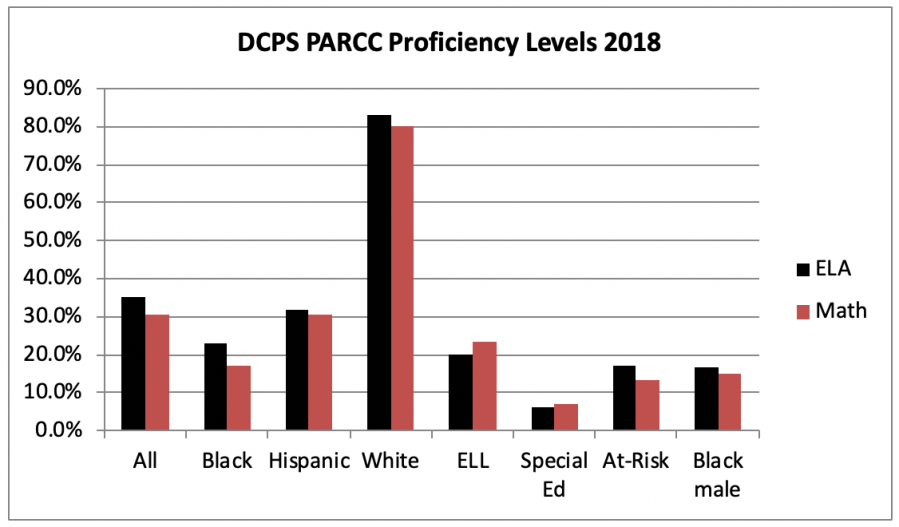
  1. Low overall achievement.  Scores on the best test available, the National Assessment of Education Progress (NAEP), have increased at about the same rate since at least 2003, but remain dismally low.  If one adjusts scores to control for the demographic changes, about two thirds of the DCPS gains since 2003 remain for 4th graders and 8th grade math students, but 8th grade reading gains almost disappear.  Comparing the adjusted scores to the big city NAEP average, DCPS 4th graders are improving faster, but remain noticeably lower.  DCPS 8th graders improved only a little more in math and not really at all in reading, and remain way below the big city average.  PARCC scores, only available for the last four years, resemble NAEP scores, and like them are inching up, but so slowly that it will take decades to reach respectable levels.
  1. The lowest achieving groups are black males, at-risk students, and special education students.  PARCC score proficiency rates are about 14% for black males and at-risk students and about 7% for special education students. In ten of twelve of our non-selective high schools only a handful of individual students perform at the “college and career ready level.”  At the current rate of improvement – about 2% annually – scores for these groups will remain pitifully low for years. Achievement gaps remain horrendous.

Screenshot 2019-02-26 14.37.37

Perhaps we could speed rates of improvement by dealing with the following:

  1. At-risk funds too often supplant rather than supplement other funds.  The at-risk funds added by the Council five years ago are now allocated at the same amount per at-risk pupil at every school, but according to my analysis, somewhere between 26% and 45% of at-risk funding in the FY 2019 school budgets supplanted base funds, in contravention of governing law.  The unclear 19% is used for mental health professionals, most if not all of whom perform special education services required by law, hence not extra services eligible for at-risk funding.  DCPS could, but does not, separate out extra services.  The level at which supplanting occurs varies enormously from school to school, and those whose funds are used this way have less, sometimes almost no extra resources dedicated to at-risk students.
  2. Local school general education funding discrepancies.  When funding for the variable special needs (special education, ELL, at risk, and Title I) is filtered out, there are variations of thousands of dollars per student unrelated to academic or other student needs.  Such discrepancies are displayed in the C4DC interactive web tool for FY 2018, http://dcpsbudget.ourdcschools.org/.  For example, two high-need middle schools with the same size enrollment differ by about $3,000 in their general education per pupil allocations as do two high schools. In addition, individual school funding goes up and down from one year to the next, frustrating the continuity of programming.  Figures for next year are currently unavailable.
  3. “Highly effective” teachers are less available to low-income students.  The schools with the highest percentage of teachers rated “highly effective” by the IMPACT system in 2017-18 were in Ward 2 (58%) and Ward 3 (54%).  The schools with the smallest percentage of “highly effective teachers” had only half as many:  Ward 5 (28%) and Ward 7 (29%).  Figures in previous years are similar.
  4. High levels of teacher turnover generally.  System-wide, almost 20% of the entire ET-15 workforce (including counselors, librarians, etc.) leaves DCPS each year.  At the school level, 25% leave each year.  Over a period of three years, 55% of teachers leave their schools and over five years, 70% leave their schools.  These rates are much higher than those of other school districts, including urban districts.  Almost half of all newly hired teachers, whether experienced or new to the profession, leave the system within two years; 75% leave within five years of their hiring.
  5. Staff instability in schools with the highest percentages of at-risk students.  In these schools one-third of the ET-15 staff leave annually, compared to 20% of teachers at schools where 20% or fewer of the students are at-risk. Over three or four years some of these schools have almost no continuity.  They also change principals more often than other schools.
  6. High principal turnover ranges in the last six years from 16% to 26%.  From last year to this year it was 20%. Research finds that principals need about five years to improve their schools’ performance, but only one-third of DCPS schools this year have principals that lasted that long.  Most schools have two or three principals in five years.
  7. Teachers and students by race/ethnicity. Since 2009-10, DCPS teachers have consistently been about 32% white and about 59% minority, with the remainder not reported.  Blacks have made up about 50% of teachers, Latinos have risen from 3% to 7%, and Asians have been 3-4%.  Student enrollment in the last six years has gone from 10% white to 15%, from 71% black to 60%, and from 15% Hispanic to 20%.
  8. DCPS enrollment increased in the last ten years, but not nearly as fast as the school-age population. DCPS is losing almost one percent of market share each year.  Attrition of grade level cohorts beginning with 1st grade dipped a little a few years ago but is now rising to earlier levels in the decade.  The biggest drop-offs occur between 4th and 5th grades (about 12%-13%) and between 5th and 6th grades (about 33%).  One bright spot is that in 28 schools in affluent and gentrifying neighborhoods, in-boundary enrollment has risen in the last ten years by 2,755 students.  These schools are thriving.  Unfortunately, others are declining.
  9. Budget transparency is lacking, as is meaningful participation in budget decision-making.  Parents and community are invited to state general preferences, but have no opportunity to affect the criteria or other specifics of budget allocation because budgets are announced only when it is too late to change them.

Parents and community have pleaded with DCPS for improvement on all these issues.  We need the Council to play its part in advancing the school system in a more constructive direction.  Our schools need critical friends.


[1] The source is lists of DCPS employees, obtained by FOIA or from submissions to the D.C. Board of Education (before FY 2008) or to the DC Council (since FY 2008), based on office of employment, program, job title, purpose of applicable grant funding, and DCPS website descriptions.  Employees performing functions subsequently transferred or contracted out are excluded in the earlier year calculations.

[2] Derived from U.S. Census Bureau, Public Education Finances:  2016, May, 2018 Tables 6, 7 and 19.  https://www.census.gov/data/tables/2016/econ/school-finances/secondary-education-finance.html.  These figures are self-reported by DCPS.

.

Goodbye CHPSPO, hello CHPSPO? Help us find a new name – please vote!

We’ve outgrown Capitol Hill and we’re long overdue for a name that reflects our work in support of Ward 6 schools and all of the students enrolled in our schools (and across the city!). Help us by voting on the suggestions submitted by our community!

Signe Nelson Testimony – Roundtable on Chancellor of DCPS Dr Ferebee Confirmation – February 12, 2019

Testimony before the Council of the District of Columbia

Committee of the Whole & Education Roundtable 0 PR 23-0061

The Chancellor of the District of Columbia Public Schools

Dr. Lewis Ferebee Confirmation Resolution of 2019, February 12, 2019

Submitted by Signe Nelson


Good afternoon, Chair-Persons and Members.

My name is Signe Nelson, 19 years an ESL teacher, currently serving in Ward 4 where I also reside.  I also sit on the WTU Executive Board. I am here to voice my own objection to the Mayor’s choice for DCPS Chancellor, Dr. Lewis Ferebee

I do not know Dr. Ferebee personally. I won’t comment on his lapse of judgement as a mandated reporter – I can’t say whether it is more or less serious than the lapse of judgement that cost Antwan Wilson his job.

Nor do I object to the nation-wide search for the best available talent and relevant track record.  In fact, in my opinion, complicity in the failed policies and practices of the Rhee/Henderson era, and the lack of demonstrated will or ability to move DCPS in a new direction, effectively disqualify the leading internal candidates.

My real concern is privatization of public education.  Funding for education is the first or second line in every state budget, including the District of Columbia.  That’s a lot of money.  We have charter schools thanks to Congress, through the District of Columbia School Reform Act of 1995, not because our citizens EVER voted to use Washington, D.C. as a laboratory for a charter school experiment.  Charter expansion got a big boost during the Rhee-Henderson years with the closure of over 40 neighborhood schools of right.  At the same time, DCPS turned over key functions to outside contractors closely allied with the charter world, and funded by pro-charter philanthropists. And we are under relentless attack by charter expansion interests masquerading as democratic, grass-roots activism, also funded by pro-charter philanthropists.  It should not really come as a surprise that the expansion of the charter sector to nearly 50% of enrollment, and the ill-conceived “reforms” of the last 12 years have led to little appreciable improvement in the educational experiences and outcomes for the overwhelming majority of our children in both sectors. On the deepest level, I believe it is all about the money.

What I am seeing here right now disturbs me, and it should disturb you, too. The Mayor hires (and the Council confirms) a deputy mayor, whose premier expertise is in charter conversion.  She backs charter advocates in SBOE elections.  Now she offers us a chancellor, who rather than turning schools around, turns them over to private operators.  It looks to me like the plan is to continue to privatize at the expense of public education, by setting the foxes to guard the hen house.  This is the same strategy the President uses to weaken Federal departments and agencies by placing them in the hands of individuals hostile to their missions.   Whose plan is this?  Who is making education policy behind the scenes? In Indianapolis it is the Mind Trust.  In L.A., it is Eli Broad’s plan. In Washington DC, is it City Bridge Education? Education Forward DC? DC Public Education Fund?  The City Fund? Walton Family Foundation?  As Deep Throat said, “Follow the money.”

So now it is on you.  If you confirm Dr. Ferebee, it will be your responsibility to monitor him closely.  Require transparency and accountability.  Defend against unelected, private interests making education policy to suit their own agenda.  Maybe he will surprise me.  Like Dr. Ferebee and Mr. Kihn,  Antwan Wilson was a Broad Fellow,  but he surprised many of us by not following a Broad agenda.  Some folks think that’s the real reason he is no longer with us.

As we go forward, keep in mind the fable of the frog and the scorpion: A scorpion asks a frog to ferry him across a swollen river.  Familiar with the scorpion’s deadly reputation, the frog refuses, but the scorpion reassures him with soothing words and an appeal to logic: “It would be against my own interests to sting you,” he reasons, “for it would bring about my own demise.” Half way across the river, the scorpion stings the frog. “Why?” gasps the frog with his last breath. “Because it is what I do.” sighs the scorpion with his.

Betsy Wolf Testimony – OSSE Performance Oversight Hearing – February 21, 2019

There are few issues in education in DC right now that are as clearly problematic at the new OSSE school report cards and 5-star school ratings. For some background, I am a parent at Amidon-Bowen, but I am also an educational researcher who cleans and analyzes student achievement data as part of my day job.

The OSSE 5-star school ratings supposedly measure school quality, or how well schools are serving their students. But my analysis – and others’ – have shown that the 5-star school ratings are more strongly determined by which kids are in the schools than what the schools actually do to help students learn. Specifically, 64% of the variation in OSSE school ratings can be explained by student demographics alone. Let that sink in for a minute. We are rating schools on the basis of student demographics more so than school effectiveness.

If pressed, OSSE would respond (as they did in their report) by saying that once you control for the various STAR metrics, there is no relationship between student poverty and the school ratings. But that is a flawed argument because the school ratings are determined on the basis of the metrics. Metrics are ratings, they are one and the same. So if metrics are biased against high-poverty schools, then so are the ratings. This is not a matter of me, a member of the public, not understanding what OSSE is doing. This is a matter of OSSE leads not understanding the statistics behind the OSSE star ratings or the methodological implications of their decisions.

What are the implications of the star ratings? First, we’re giving low ratings to schools that serve predominantly at-risk and special education children, and we’re giving high ratings to schools that serve predominantly affluent children. Even though growth factors into a school’s overall score, we are still rating schools more so on student demographics than any other factors.

Second, with these school ratings, we’re telling principals and teachers whether they are doing a good job or not on, again, which students they serve. My advice to effective teachers in high-poverty schools shouldn’t be you’re doing a great job, ignore your state agency. OSSE should be on the front lines of identifying schools that are really moving the needle and making a difference for kids.

Third, we’re telling parents to steer away from the “bad” schools, you know the schools with too many at-risk and special education students. Better stick to the schools serving affluent children by moving into an expensive neighborhood or winning the lottery for a spot in one of the most sought-after charters serving more affluent students.

Fourth, and perhaps most problematic, is that schools with consistently low ratings will be threatened with take-over or closure, without any regard for to what extent these schools are helping kids learn or how students in these schools will fare in other places.

Let’s talk about the growth metrics that OSSE uses. The median growth percentile essentially compares achievement for students who start with the same score. But whose growth are we comparing against whose each year, and does that make sense? Median growth percentiles are also problematic because they may (a) fluctuate wildly from one year to the next and (b) are also correlated with student characteristics. It gets better – the creator of median growth percentiles specifically warned that median growth percentiles should not be used to determine school quality. So why are we going against the recommendations of the statistician who created the indicator in the first place?

How should school performance be gauged instead? We have to find valid measures that capture what schools actually do. Valid measures of growth, academic offerings and enrichment, and school climate. There are plenty of experts in this field who could help us get it right. And if the federal requirements are too restrictive, we can do what many states have already done and create an independent state accountability system instead.

This is really an exasperating issue if you understand the methodological problems. If you understand the stats behind this, and you are not speaking out either internally or externally, you are complicit in propping up a school system that further disadvantages our most disadvantaged children. Let’s not wait several years to fix it or discuss the unintended negative consequences of the new star ratings.

I’ll close by sharing several quotes from the feedback sessions that OSSE hosted about the new school report cards.

– “Do we have to use the stars? Do the stars simply reflect the economic status of students? Does this concern you?”

– “The proficiency and attendance measures reward schools with fewer students in poverty. This is not fair.”

– “At-risk demographics are a strong predictor of proficiency. We should do more to desegregate schools. The accountability system needs more growth, especially for low-proficiency schools.”

– “Proficiency is weighted too highly in the accountability system. Include higher weight on growth. Otherwise, schools have an incentive to push students out of the school.”

– “80% on PARCC proficiency and growth is too high. Add measures of social and emotional learning.”

– “Can growth be weighted higher than proficiency? Especially since we know that scores are strongly correlated to income?”

– “Have you tested the model on existing schools? Why not? That would enable us to see how this correlates to poverty.”

– “Think we should measure school environment/teacher quality/other things that are important.”

– “We should back map from what data we need to provide well-rounded measure of school quality. Don’t be scared about collecting new data if it’s the right data.”

– “Where is the focus on curriculum? How is a school supposed to know it’s important if you don’t even mention it?”

– “Why don’t you have a classroom observation measure for higher grades?”

– “We should use school climate surveys from students, teachers, parents, and administrators. Why was this measure rejected?”

– “There are more than 20 school climate surveys that the federal government have deemed valid. This is available.”

– “How is attendance a measure of school environment? I think that’s insufficient.”

– “Concern about how we will ensure kids are getting a well-rounded education when there’s such a strong focus on PARCC.”

– “Has there been consideration of including measures to encourage a well-rounded education?”

– “What about sports, arts, other subjects outside math/reading? Research shows enrichment, other offerings add to success of students academically.”

– “You should consider a rating in each different component of the school’s rating – not just one set of stars.”

– “We need to address core problems affecting students (hunger, suicide, poverty, trauma), not just make minor changes in accountability system.”

– “Why doesn’t high school system include growth?”

– “Why is there no growth metric in high school?”

– “Do you have mathematicians on your staff?”

Scott Goldstein Testimony – Deputy Mayor for Education & District of Columbia Public Charter School Board – Performance Oversight – February 15, 2019

EMpowered

Performance Oversight Hearing- PCSB and Deputy Mayor for Education

Testimony of Scott Goldstein, Executive Director EmpowerEd

February 15, 2019

Good Morning Chairman Grosso and Chairman Mendelson.  My name is Scott Goldstein and I am the Executive Director of the teacher advocacy organization EmpowerEd.  We asked teachers to submit input for oversight into both PCSB and the Deputy Mayor for Education.

First, on the Deputy Mayor for Education, I want to point out that I have been very pleased by the willingness of this Deputy Mayor to listen to the community.  He has listened clearly to teacher voices and clearly integrated their thoughts on issues like the crisis in teacher turnover into his thinking and made it a priority.  He has been out in the community regularly meeting with advocates and engaging in conversations- but not just with those who we might already agree, but soliciting broad feedback from diverse voices.  We all applaud that approach- and others in the DC education community should take note.

I asked teachers what key questions they had for the Deputy Mayor.  The top four questions were these:

  1. How are schools being guided to implement the Fair Access to Schools Act, since this applies to both sectors? How will schools and principals be held accountable for following the Act? What funding is available to them to implement?
  2. How would you define a viable, matter of right public school system? How are you working to achieve it?
  3. Do you support subjecting all public schools, including charter schools, to the same basic transparency rules- including FOIA and the Open Meetings Act?
  4. Is it a priority for you to take serious action to de-segregate our schools both racially and socio-economically?

The overriding question that faces the Deputy Mayor for Education is how will we plan comprehensively for education in this city.  Teachers and parents are deeply frustrated that we continue to open and close schools at random without considering the whole picture.  Acting Chancellor Ferebee said himself in his confirmation hearing that we should not just be opening new schools, especially next to existing neighborhood schools, in places where the specific demand does not exist. What is the Deputy Mayor’s strategy and timeline for implementing a comprehensive school plan in DC?

At the Deputy Mayor’s confirmation hearing I proposed an idea I would like to re-surface and hope to work with the Deputy Mayor on in the coming weeks and months.  Much like any new building must receive an environmental impact report before being permitted, any new school should have to receive an equity report before being granted permission to open.  There is a lot we need to take into account- including neighborhood demand, over and under-enrollment at surrounding schools, programming relevancy, the impact the new school will have on both enrollment and diversity at existing schools, what plan exists for ensuring the school will be staffed by a diverse teaching staff that reflect the student population and many more factors.

To start, there are several questions teachers wanted you to put directly to Director Pearson.

  1. Do you believe there should be accountability for charter schools as a system, related to its effect on education in the city, or only accountability for individual schools?
  2. Do you support teacher collective organizing in charter schools and would you support allowing charter teacher the options to participate in the DCPS pension plan?
  3. Who are all the agencies and actors that you believe have authority over the charter sector? If you believe it to be only PCSB, where in the law do you find that interpretation?
  4. What do you plan to do about the correlation between PMF scores and the at-risk status and SPED populations of the students the school serves? Will you prioritize intentionally de-coupling those indicators in how you measure schools to ensure you are measuring HOW the school serves instead of WHO they serve?
  5. How many discussions have you had with stakeholders about ways to improve teacher retention in the past year?
  6. Do you support subjecting charter school boards to FOIA and the Open Meetings Act? Why or why not?
  7. Do you believe it’s important for your schools to recruit and retain teachers of color? If so, what do you do to collect teacher demographics, analyze them, and take action to improve.  If you’re leaving this up to LEA’s- how are you ensuring equity for all DC students, so that they can learn from adults who look like them, an incredibly important factor in their education.

We very much appreciate that PCSB has taken new steps to consolidate information that was already public into one central transparency hub on their website. That’s helpful for the public. But the overwhelming top concern we heard from teachers was this one- when the public charter school board proactively seeks input on policy- it is rarely teachers.

We know that schools with stronger family, student and teacher engagement produce stronger results- so we should do everything in our power to arm our families and educators with everything they need to be part of the discussion. If we want schools to be responsive to the needs of those they serve- we should ensure every single LEA is subject to the Open Meetings Act and the Freedom of Information Act.

Transparency is in the system’s best interest.  When stakeholders are involved in solutions on the front end, you rarely see bad headlines on the back end. A disturbing argument is often made that somehow transparency is divorced from our work to better outcomes for students.  If you believe that, you don’t genuinely believe in the power of community engagement.  Too often those in positions of leadership see transparency as oppositional. But transparency is the opposite- it’s how an organization shows it values those it serves and it’s how those in the community show loyalty to an institution they care deeply about. No one spends their free time attending a charter school board’s meeting because they don’t care about that school.  All public schools should be equally public.

We hope that both the Public Charter School Board and the Deputy Mayor for Education will listen to the voices of teachers as they make policy with recognition that there are not “adult issues” and “youth issues” and that in fact better teaching conditions are better learning conditions.  When teachers ask for policy makers to address turnover- it’s to ensure they’re students have consistency.  When we ask for transparency, it’s to ensure students are being treated equitable across our schools.  When we demand a diverse workforce, it’s because that matters to student outcomes, and when we demand diverse schools it’s because all students benefit from diversity. We look forward to working together more with teachers at the table as key stakeholders who should be engaged and respected in the policy process. Thank you!

Martin Welles Testimony – Deputy Mayor for Education & District of Columbia Public Charter School Board – Performance Oversight – February 15, 2019

Public Testimony of Martin R. Welles, Esq. For

PERFORMANCE OVERSIGHT HEARING: 

COMMITTEE ON EDUCATION & COMMITTEE OF THE WHOLE

Deputy Mayor for Education

District of Columbia Public Charter School Board

Friday, February 15, 2019

10:00 a.m., Hearing Room 120, John A. Wilson Building


Good Morning Co-Chairman Mendelson and Grosso, members of the Education Committee and Committee of the Whole.

My name is Martin Welles and I’m a parent of 3 children who attend Hardy Middle School.  My children have also attended Amidon-Bowen Elementary School and Appletree Charter School.  I am an active volunteer and serve on the Jefferson Middle School SIT (school modernization team), Amidon-Bowen and Payne Elementary LSAT teams, and on the Board of Directors of Hardy PTO as Vice-President Civic Engagement, the Board of Directors of Near Southeast Community Partners as Treasurer, and on the Board of Directors of Capitol Hill Little League as Treasurer to name just of few of my volunteer activities. I do have a full-time “day job” as well.

My comments today will be directed toward both the DME and the Charter School Board:

Deputy Mayor of Education Paul Kihn:

First of all, I would like to welcome DME Kihn to DC government and thank him for his hard work since arriving.  Many of you know that Near Southeast Community Partners (NSCP) originated the “Feed the Feeder” series – a Principals Roundtable and Networking event to strengthen our neighborhood feeder school patterns.  In DME Kihn’s first week on the job, he attended our Ward 6 Feed the Feeder event and was one of the first to arrive and last to leave.  He spent the entire night meeting and speaking with teachers and parents.  I heard many positive comments from attendees and they were impressed with his willingness to listen.  When offered the microphone to provide some words, he said he was just there to listen.  I’m not sure I would ever pass up a microphone – so I don’t know what to make of that.

On another occasion, after reviewing the facts and understanding the situation, DME Kihn honored a commitment made by the previous administration.  It was the right decision and put an end to a contentious situation.  In short, DME Kihn’s approach has been reasoned and informed.

However, I did attend another event in which DME Kihn was a panel speaker on “Equity in Education.”  His presentation and remarks were focused on the District of Columbia, but I did find the narrative conveyed to be a little off-putting.  He articulated data that pit one Ward against another.  He seemed to convey that a Ward that was showing high scores, was somehow to blame for another Ward’s low test scores.  I walked away thinking that his comments seem to suggest that a high achieving Ward, rather than being celebrated, should be punished for being successful,  I would like to see excellence celebrated and invigorated, regardless of what Ward it exists.  Making every Ward’s neighborhood schools strong and desirable should be the priority, but it should not be a zero sum game.  There is room for growth and excellence everywhere in DC.

There are several hot button issues that I will require attention in the near future:

Amidon-Bowen:  Developers are trying to get a zoning variance to build a 50-foot tall, 32-foot wide, 40 unit dormitory to house actors and interns.  The lot is restricted to 3 stories, but more importantly the want relief from property line setbacks because the lot is only 40 feet wide.  The proposed building will be right on top of the playground and become a constant source of noise complaints.  Additionally, granting a zoning variance to the developer will waive the District of Columbia’s property rights to add capacity to the thriving Amidon-Bowen school in a neighborhood where 18,000 housing units are slated for development.  The developer has submitted a bad plan, and neither the DME nor DC Council should support it.

Hardy Middle School – Science Teacher Position:

The 7th grade students at Hardy Middle School have been without a permanent science teacher for almost the entire year.  Due to a series of unfortunate events, a substitute had to come in and teach.  Even though it was doubtful the permanent teacher would return quickly, the position was encumbered and that prevented hiring a dedicated science teacher.  DCPS and the DME’s office need to figure out a way to attract a permanent “substitute” teacher, and double encumber the position.  It would be nice if the DME could step in with a special budgetary authorization to double encumber a position so that when, and if, a teacher returns, the long term substitute is not forced to leave and so that two teachers could make up for lost ground.  An offer was finally made to a full-time science teacher, but I learned yesterday that the new hire was not able to start.  This is a serious problem, not only specific to Hardy Middle School 7th grade, but likely throughout the school system.

Hardy Middle School Capacity:  Hardy received a 5 star rating and that has certainly increased the desire of families to attend Hardy.  The 3rd floor of the building contains the Fillmore Arts Center.  As Hardy continues to grow, the need for classroom space becomes greater.  It is time to start shrinking the footprint of Fillmore Arts Center at Hardy Middle School and find a new location for them.  The first step would be for the Fillmore Arts Center to vacate classrooms that are in the 6th grade hallway.  These classrooms could be used for 6th graders so that they do not have to run up and down stairs to get to their classes on time.  It is also my understanding that the number of schools busing to Fillmore has reduced due to expansion and modernization at their own schools.   Fillmore offers a great curriculum, but it is only available to relatively few students anyway, and Hardy needs the space.

Thank you DME Kihn. Thank you to the Council for listening to my comments I look forward to continuing to work with you.

DISTRICT OF COLUMBIA CHARTER SCHOOL BOARD

I’m not sure the taxpayer of the District of Columbia is getting what they bargained for with the Charter School sector.  The reason I am unsure is because Charter Schools are not subjected to the Freedom of Information Act (FOIA) or open meeting laws.  Therefore, there is not any real way to know how much of our taxpayer dollars are spent on teacher salaries, benefits, building leases, and administration.  We do not know to whom the Charter Schools are beholden, if anyone.  I would like the Charter School Board to contractually require Charter School operators, in exchange for the $100s of millions of taxpayer dollars, to hold open meetings, to operate transparently at the same level as DCPS, and to be accountable to their customers – the parents and students who attend and the taxpayers who fund their enterprise through the FOIA.

The time for reform is ripe.  Of the 17 schools that received a 5 Star rating – 12 were DCPS schools and only 5 were charters.  The promise of Charters was that through innovation and freedom from regulation, they would be able to provide superior education to our children.  With the number of Charter School closings – either through abandonment or loss of license – it is clear that promises made during the application promises were hollow.  Granted, closing a low performing Charter school may be a way to instill fear among operators, but it really has an adverse impact on families who are now left without a familiar place, a familiar teacher, or a familiar peer group.

What was a promise of niche education, has turned in to mass education.  The Charter School model has now become to replicate DCPS and all its great offerings.  The innovation and methodologies that were promised 20 years ago materialized in very few schools.  And while there are several excellence Charter Schools, I’m not sure that the bulk of the sector has lived up to the hype and expectation.

I implore this Council and the Charter School Board to adopt transparency and compliance with the FOIA and open meeting laws. It can be done on a contractual basis, it doesn’t necessarily have to be legislative.

Sincerely,
Martin R. Welles, Esq.

Parent of 3 Children at Hardy Middle School

Vice President, Hardy Middle School PTA

Member, Student Assignment and Boundary Committee

Member, Chancellor’s Parent Advisory Cabinet

Board of Directors, NSCP – Treasurer

Board of Directors, CHLL – Treasurer


LL.M. Georgetown University Law Center – Taxation

LL.M. George Washington Law School with Highest Honors – Litigation

J.D. Loyola New Orleans – International Law

M.A. Loyola New Orleans – Communications

B.A. Viterbo University

A.A. University of Wisconsin – La Crosse