Jessica Sutter Testimony – Roundtable on At-Risk Funding – February 1, 2019

February 1, 2019

Jessica Sutter

Testimony at Council Oversight Roundtable on At Risk Funding Transparency

Thank you Chairman Mendelson and Members of the DC Council for inviting public testimony today. My name is Jessica Sutter and I have the honor of representing Ward 6 on the DC State Board of Education. I am testifying here today as an individual, and not on behalf of the SBOE.

I support the goal of this bill: to help guarantee that the original purpose of the at-risk funding mechanism—promoting equity of opportunity in education—is fully realized. Increasing equity of opportunity for all young people is why so many educators decided to work in or with public schools. But we have not yet realized the goal of providing all DC children with equitable opportunities to succeed and I believe that some modifications to the bill can help us get a bit closer than we are today.

I have three requests to modify the bill as currently written.

First – there is simply a need for more funding to serve students who are identified as “at-risk.” We know this. The 2014 Adequacy Study from the Office of the Deputy Mayor for Education recommended for $3906 per student identified as “at-risk.” Our current funding is nowhere near that. In order to best serve the diverse needs of our diverse student body in Ward 6, and all across the city, we need the UPSFF to be adjusted to weight “at-risk” funding at the recommended level. This will benefit early childhood students at Amidon-Bowen ES and AppleTree PCS, it will benefit middle school students at Eliot-Hine and it will benefit young people in the alternative education programming at Kingsman Academy. All Ward 6 students – and all students District-wide – who meet the definition of being “at risk” deserve these funds as a matter of educational equity. I ask that you increase the funding to the recommended level and ensure that school leaders have the power to spend it in ways that can best serve the needs of children in their care.

Second, I’d recommend streamlining the reporting on how at-risk funds are spent. As written, the bill would require LEAs to provide reports to the Council each year that explain how each school used its at-risk funds. Rather than create an additional report, it would be great to see this information reported as part of the DC School Report Card, allowing students and families a chance to gain an understanding of schools’ budgeting priorities and spending histories. This would increase school budget and funding transparency – a matter for which parents and teachers across the city are currently advocating. DC PAVE has selected school funding and budget transparency as one of their key advocacy issues for 2019.

The ESSA Task Force of the SBOE is working with OSSE to establish how data on per pupil expenditures will be displayed on the School Report Card (starting in December 2019), the at-risk funding expenditures could, perhaps be displayed in the same section. This would streamline information for the public, especially families, and it could reduce the administrative burden on schools that are saddled with many reporting requirements to their LEA, to OSSE, the federal government, and other external partners and grantors.

Finally, adding a standardized set of terms and definitions—like a common set of expenditure categories—to the language of this bill would ensure all LEAs are reporting the same data points and pieces of information. It would also allow for easier at-a-glance understanding of how schools use these funds to promote both well-being and improved achievement among at-risk students, and better (if still limited) comparisons across schools. Common categories would allow for public transparency in considering how schools spend these funds, while also acknowledging that the kinds of expenditures that benefit students classified as “at risk” are often hard to tie directly to immediate (i.e. – within year) academic outcomes.

I thank you for your consideration of these recommendations and for allowing me time to speak today.
 

Grace Hu Testimony – Roundtable on At-Risk Funding – February 1, 2019

Grace Hu
Amidon-Bowen Elementary PTA
mailto:amidonbowendc@gmail.com
February 1, 2019

My name is Grace Hu. I serve on the PTA of Amidon-Bowen Elementary and have previously served on the Amidon-Bowen Local School Advisory Team.  On behalf of the Amidon-Bowen PTA, I would like to thank you for holding this hearing and specifically thank Councilmember Charles Allen for introducing legislation on the important topic of at-risk funding.

Earlier this week Comments on CM Allen At Risk Funding bill Jan 29 2019. Our PTA contributed to and endorses those comments. My testimony today provides additional views specific to our school community.

Chronic underfunding not an excuse to misuse at-risk funding

Amidon-Bowen Elementary, the neighborhood elementary school for Southwest DC, serves approximately 350 students, of which more than 70% have been identified as “at risk”.  Our parents notice that staffing positions are on the chopping block each year and students lack basic resources (e.g., computers to support online testing and curricula, paper, other supplies) in the classroom. We wonder how are we expected to close the achievement gap (and overcome our 2-star OSSE rating) without a serious investment of resources?

But while we believe there is a chronic underfunding of our schools, we also believe that chronic underfunding is not an excuse for the misuse of at-risk fundsAs long as at-risk funding is being used to cover budget gaps at our neediest schools while schools without at-risk funding are provided base positions and resources without this shell game (see footnote [1]) of moving around at-risk money to cover shortfalls, funds that are designed to provide equity will continue to be used to create inequity.

At-risk funds and student achievement

Although the intent of existing law is to improve student achievement among at-risk students, we currently use at-risk funding on things like social workers, psychologists, and afterschool staffing. These provide significant value to our students and families and should be available, but they are not specifically targeted to closing the achievement gap. If we want to narrow the achievement gap, we have to be more intentional about targeting instructional resources to at-risk students. Research shows that biggest bang for your buck in improving student performance is supplementing instruction, for example, providing more staffing to enable small group tutoring and smaller class sizes.

We have seen encouraging early evidence of the impact of supplemental instructional support at Amidon-Bowen. Last year was the first year that Amidon-Bowen employed both a reading specialist and a math intervention coach. The math intervention coach provides small group and intensive tutoring to roughly 30 low-performing students in grades 4 and 5. The reading specialist provides intensive tutoring to 25 low-performing students in grades 2 to 5. The initial results are promising: a higher percentage of students receiving additional math support met their middle-of-the-year growth targets compared to students who did not receive the additional support. 80% of those who met with the reading specialist met their growth goals, and average gains for “below basic” students who met with the reading specialist were higher than those of similarly low-performing students who did not receive this support.

Despite this progress, we’ve been told by DCPS to not expect these positions to be continued in future years. One of these positions was funded with at-risk funds; the other was gifted to us because we could not afford it in our budget.

If we could focus all of our at-risk funding (~$500K per year) on instructional supports with a direct tie to student achievement, we believe our school could make significant academic progress. Instead our at-risk funding is used to cover legally mandated special education (even though the majority of our at-risk population are not students in need of special education services) and other positions that should be covered under a base budget.

Lastly, transparency and other requirements related to at-risk funds should apply to all Local Education Agencies (LEAs) across both sectors to ensure all at-risk students are getting the supplemental support they need and deserve.

Thank you for the opportunity to testify.

[1] School budgets should be equally funded according to the comprehensive staffing model before at-risk funds are allocated. In Title 1, this is called “Title 1 neutral” and is guidance we follow every year. Instead, in DC it’s easy to tell which schools receive at-risk funds before they’ve been allocated. The budgets of schools with high percentages of at-risk students have holes in core staffing. DCPS then uses at-risk funds to fill these manufactured gaps. Large gaps in core staffing only exist at our schools most in need.

CHPSPO Meeting Notes – December 2018 and January 2019

Miner Elementary School – 601 15th Street, NE

January 15, 2019 – 6:30 p.m. – 8 p.m.


  1. 2019 Performance Oversight and Budget Hearings, Laura Marks and Anne Phelps
  • Budget Presentation. See presentation.
  • Important to make priorities heard by Mayor before it is transmitted to Council (March 20), as agencies are formulating their budget now. Citizen priorities are captured in decisions.
    • Email Jenny Reed jennifer.reed@dc.gov (Director, Office of Budget & Performance) , John Falcicchio john.falcicchio@dc.gov (Mayor’s Chief of Staff), (see more on slide 19).
    • Look up Mayor’s schedule (https://mayor.dc.gov/newsroom)
    • Only chairman has scope to re-fund/fund priorities. Typically, this cannot be done at committee level (committees develop recs).
    • Attend hearings: http://www.davidgrosso.org/education-committee/
    • Education-related committee changes:
      • Grosso is chair; Mendelson somewhat co-chairing. Possibly joint hearings for performance and budget – Education; DCPS, DME, OSSE, Library
    • DGS now under Robert White
  • Timing
    • Once Mayor’s budget is transmitted to Council, it will be published on https://cfo.dc.gov/ (circa March 20)
    • DCPS has slightly different budget timeline; Council does not engage in school-level budget recommendations on Operating budget. However, Council has some discretion on Capital Budget. (See slide 13)
  • Highlights
    • Of 14.6B, 8B are used locally; education is second largest allocation (18.2%),
    • Of 1.67B Capital budget, DCPS 20.9%
    • DC Public Library – many opportunities for collaboration w/ DCPS, and libraries need adequate budget support
  • Requests:

2. FoodPrints Funding, Jennifer Mampara

  • In 13 schools in all wards but ward 3. In Ward 6: Watkins, Peabody, LT, SWS, Tyler – http://freshfarm.org/foodprints.html
  • Funded by OSSE, PTAs, Federal Grants, Private Donors, Indiv School Budgets through contract by DCPS Office of School Nutrition Svcs
  • At the end of the school year, DCPS contract funds will run out, OSSE grants are for kickstarting (not ongoing) programs
  • Requesting from DC Gov, fund existing programs,
  • Letters to Mayor, DME, DCPS advocating for food education programming in schools. High demand
  • Language to include in testimony. See language.

3. Technology Advocacy, Grace Hu

4. Wilson Building Visits, Danica Petroshius

  • Early to mid Feb; refresh on CHPSPO; set agenda
    • ~10 per day + twitter amplifying
  • CHPSPO Strategic Plan
  • STAR Rating

5. Chancellor Selection, Group Discussion

6. It’s time for CHPSPO to change its name (come with ideas for names, new logo, etc.), Group Discussion. Suggestions:

  • Ward 6 Education Council
  • Ward Six Public Schools Parent Organization (WSPSPO)
  • Capital Helpers for Public Schools and Parent Organizing (CHPSPO)
  • Creative Help for Public School and Parent Organizing (CHPSPO)

Next CHPSPO Meeting: February 12, 2019

—————————————————–

Capitol Hill Montessori@Logan – 215 G Street, NE, December 18, 2018

December 18, 2018 – 6:30 p.m. – 8 p.m.

  1. Safe Passages Program, Office of the Student Advocate
  • Who is Office of the Student Advocate? See presentation
  • 50% of Ward 6 Requests for Assistance to Student Advocate are re: Safe Passage
  • Parent and Family Go To Guide. See guide.
  • Safe Passage Toolkit
  • Potomac Ave (MPD)
    • MPD Daily juvenile conference call
    • MPD Detail at L’enfant plaza
    • MPD Daily usually start at stadium and l’enfant and follow groups
    • Casual/plain clothes anti-terrorism which focus on Eastern Market and Potomac Ave
    • Fights/violence are priority; fights can turn into robberies
  • MPD Resource Officers focusing on youth advisory council ; suggestions
    • School leaders and school staff present at ‘hot points’ can be a deterrent
    • Lighting the path; stand out on the street between 3-5
    • Advocate for heads of school to join the calls
  • Next Steps: Fulcrum host DME, Office of Student Advocate, MPD, and Potomac Ave community planning around Safe Passage. Contact Tom Kavanaugh tom@fulcrumpg.com

2. LSAT Coordination, Steve Bowen, Payne LSAT

  • What is the best way to coordinate across LSAT members?
    • Mailing list
    • LSAT training in May; alongside with Council budget presentation

3. School Report Card reactions, Group Discussion – Deferred

4. CHPSPO 2019 Strategic Plan Action Items, Danica Petroshius and Suzanne Wells – Deferred

5. Is it time for CHPSPO to change its name?, Group Discussion – Deferred

Next CHPSPO Meeting: January 15, 2019

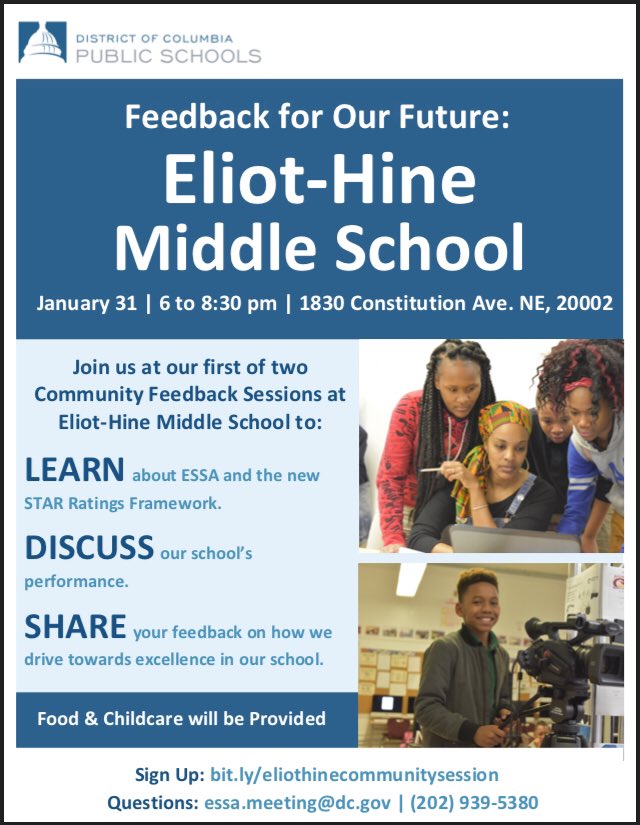
EliotHine Community Feedback Session about STAR rating – Jan 31, 6-8PM

dyh_chqw0aabklt.jpg-large

Sign Up: bit.ly/eliothinecommunitysession

Connect on DCPS Chancellor: DC Council Public Rountables and Acting Chancellor Meet and Greets

Chancellor Confirmation Public Roundtables:

DC Council’s Committee of the Whole and Education will host a series of Public Roundtables on Chancellor of DC Public Schools Resolution of Confirmation on:

  • Wednesday, January 30, 6:00pm
  • Wednesday, February 6, 6:00pm
  • Tuesday, February 12, 11:00am

Visit http://www.davidgrosso.org/education-committee/ for details and register to testify here.

Acting Chancellor Meet and Greets:

DCPS’s Acting Chancellor Ferebee will host a Ward 6 meet and greet on Friday, March 29, 8-9:30 am @ The Pretzel Bakery (257 15th St., SE – near Payne Elementary School!).

Screenshot 2019-02-25 21.18.29

2019 DC Alumnae Chapter of Delta Sigma Theta Scholarship

Please distribute this opportunity to your communities. For additional information, visit http://wdcacdst.org/wordpress/wdcac-scholarship-program/ .

2019 washington dc alumnae chapter scholarship application flyer2019 washington dc alumnae chapter scholarship application flyer

Upcoming hearings, Performance and Budget Hearing schedules – Jan-Feb 2019

Good afternoon –

The Council’s Performance Oversight and Budget Oversight schedules are now out, so I wanted to pass those along (attached) and flag a few other hearings of interest. Coming up on Friday, the Committee of the Whole and the Committee on Education will hold a hearing on the issue of At-Risk School Funding in general, and CM Allen’s At-Risk School Funding Transparency bill specifically. We’ve heard from many of you over the years about this issue – we hope you can come out to testify on Friday. Let me know if you have any questions.

Committee of the Whole & Education Public Oversight Roundtable

DATE Friday, February 01, 2019, 09:30 am
LOCATION Wilson Building Room 412 | 1350 Pennsylvania Avenue, NW, DC, 20004

· At-Risk Funding Transparency

Another date to put on your calendar is the Mayor’s Budget Engagement Forum on February 21 in Ward 6:

Mayor’s Budget Engagement Forum

February 21 | 6:30 pm

Arthur Capper Community Center | 1001 5th Street, SE

RSVP: https://2019budgetforums.eventbrite.com/

On Wednesday evening, there will be the first of three hearings on the nomination of Lewis Ferebee as DCPS Chancellor. The public is invited to testify in person or in writing at any of these three. The Feb 12 one will be the only hearing when we will hear from Mr. Ferebee. The hearing record will close on February 22 – all written testimony must be submitted before then.

Committee of the Whole & Education Public Roundtable:

DATE Wednesday, January 30, 2019, 06:00 pm
LOCATION Ron Brown Boys College Preparatory High School Gymnasium | 4800 Meade St, NE, DC, 20019

· PR23-0067, the “Chancellor of the District of Columbia Public Schools Dr. Lewis D. Ferebee Confirmation Resolution of 2019”

Committee of the Whole & Education Public Roundtable

DATE Wednesday, February 06, 2019, 06:00 pm
LOCATION Francis L. Cardozo Education Campus Cafeteria: 1200 Clifton St. NW Washington, DC 20009

· PR23-0067, the “Chancellor of the District of Columbia Public Schools Dr. Lewis D. Ferebee Confirmation Resolution of 2019”

Committee of the Whole & Education Public Roundtable

DATE Tuesday, February 12, 2019, 02:00 pm
LOCATION Wilson Building Room 412 | 1350 Pennsylvania Avenue, NW, DC, 20004

· PR23-0067, the “Chancellor of the District of Columbia Public Schools Dr. Lewis D. Ferebee Confirmation Resolution of 2019”

Hope to see you at one of these soon. Let me know if I can be of any help with anything or if you have any questions.

Best,

Laura

Laura Marks, Chief of Staff

Councilmember Charles Allen, Ward 6

Chair, Committee on the Judiciary & Public Safety

1350 Pennsylvania Avenue, NW Suite 110

Washington, DC 20004

t 202-724-8072 | m 202-262-6157

email

Connect with us: Twitter | Website | Facebook

BUDGET MARK-UP SCHEDULE.pdf

POH 2018-2019.pdf

CHPSPO Meets January 15 @ Miner Elementary

Hope everyone is enjoying the snow day! CHPSPO will meet on January 15 from 6:30 – 8 pm at Miner Elementary (601 15th St., NE). This will be our annual budget discussion, and Laura Marks, Chief of Staff for Councilmember Allen, and Anne Phelps, Budget Counsel at Office of the Budget Director, will join us for the discussion. We will also be discussing the ongoing advocacy for technology funding led by Grace Hu, the efforts to secure funding for FoodPrints, and upcoming visits to the Wilson building. We will also discuss the upcoming confirmation of the next DCPS Chancellor. Finally, we are seriously considering changing CHPSPO’s name, and everyone is invited to share ideas for a new name and logo at the meeting.

011519 chpspo agenda

Hope to see you on Tuesday.

Suzanne Wells

CHPSPO Meets tonight – Tuesday, December 18 @ Capitol Hill Montessori@Logan (215 G Street, NE)

Dear Capitol Hill Public Schools Parent Organization Members,

CHPSPO will meet on Tuesday, December 18, at Capitol Hill Montessori (215 G Street, NE). We will be joined by representatives from the Office of the Student Advocate for a discussion of the Safe Passages to Schools program. We will also be discussing promoting collaboration among the LSATs at our schools, reactions to the release of the school report cards, and the CHPSPO strategic action items for 2019.

Also, if anyone would like a Save Shaw Middle School yard sign to show your support for our neighbors in the Shaw community as they advocate for a by-right middle school, you can e-mail saveshawms to request a yard sign.

Hope to see you on Tuesday.

Suzanne Wells

121818 CHPSPO Agenda.docx

Strategic Plan Action Items 2019.docx

CHPSPO Meeting Notes – November 19, 2018

Payne Elementary School, 1445 C Street, SE
November 19, 2018, 6:30 p.m. – 8 p.m.

1. DDOT’s Safe Routes to School Program (https://ddot.dc.gov/saferoutes), Amber Gove.

Steps to getting DDoT support for traffic issues

1)    Traffic safety investigation via 311 ticketà https://311.dc.gov/

2)    Traffic calming petition – 75% of houses on block(s) need to sign à https://ddot.dc.gov/page/traffic-calming-and-traffic-safety-101 (scroll to bottom)

3)    ANC submits petition. (Reach out to traffic committee at ANC)

4)    DDoT to collect data – need to follow up to learn when the data will be collected – is it representative? (See process, per DDOT here). 

  • DDoT will give average – ask for microdata
    • Data will enable conversation, should DDoT agree action is required
    • Lamont Hinton is contact from MPD (if camera speed/tickets are warranted); only tickets at 11 miles over speed limit

Lessons:

  • Constitute a committee at PTA/SIT
    • Try to include community members outside of the school
    • Leverage ANC
    • School leadership participation is critical
    • School culture needs to be addressed, as much as infrastructure changes
  • Schools can take on own measures while safe routes plans are implemented. For example, Tyler ES uses cones to create curb extensions to calm traffic

Contacts:

Other: Daytime School Parking Zone Act may need additional advocacy


2. OSSE School Report Cards, Chloe Woodward-Magrane

New OSSE School Report Cards, featuring STAT rating will be released in December 2018

  • All data/metrics used to generate the STAR rating are listed and defined.
  • Majority of data will be coming from previous year.  Contact data, etc will come from current year

Discussion:

Q: Will data be disaggregated by program (schools like Tyler ES have 3 programs). A: No, but schools can share this data.

Q: There will likely to be 1 or 2 STAR schools in Ward 6. We’re concerned about this creating a cycle of parents not wanting to send students to schools with 1 or 2 STARS, affecting enrollment. What is message schools should give to families? A: OSSE is working w/ school leaders to know and understand own data; schools should ID bright spots when they are talking about their schools;

Q: What is OSSE doing to support schools that are rated 1 or 2? (STAR is a 1-5 point rating). What is OSSE prepared to do; how is it thinking about school improvement? Where is support for schools outside of the bottom 5% (no clear answer given by OSSE on this Q)? A: OSSE is identifying and putting forward 11M over 3 years grant available to schools in need of comprehensive support – $1M/school; schools must apply, but the amount is reserved only for the bottom 5% of schools. OSSE is working closely with LEAs to ensure grants are in alignment with school-level interventions.

Tenets of OSSE grants:

1- People: how are we supporting people/educators; leadership; training

2- Instruction; instructional practices in school, plan

3- Structures: ex: way you are organizing building (ex: academies; grade bands; supports/autonomies)-

Q: How can we move towards metrics that gauge school quality. A:  disagree that measures do not gauge quality. Examples- median growth percentile; growth proficiency; subgroups compare to subgroups (ex: students w/ disability), not to the whole population;

Next Steps: OSSE come back early next year.


3. Open Discussion with Paul Kihn, Acting Deputy Mayor of Education

DME Thematic priorities

  1. Reducing achievement gap
    • Influencing factors: 2 systems and Critical importance of by right neighborhood systems
    • Within DME office: direct influence over LEAs & Indirect influence over libraries, UDC, etc
  2. Building public confidence in public school system

Brief Presentations about current initiatives within CHPSPO community:

  1. Denise Forte: Chancellor Search – working towards a citywide meeting re: vision across all wards on what we want from school system based on equity; by right
  2. Betsy Wolf: Equitable Spending (see data analysis here and embedded below)
    • Equitable spending; ex: at-risk funding spent on special education
    • Charters: data is not available – DCPS serves more at-risk/special ed students than charters
    • Recs: California does a good job w/ funding formula; gives great bump for concentration of poverty
      •  Separate special ed from at risk/funding
      • Need policy folks to connect more closely w/ schools to see how policy plays out on the ground
  3. Suki Lucier: Advocacy for Shaw Middle School
    • Families need clear pathways for neighborhood schools and DCPS/DME need to fulfill commitments to Shaw community
  4. Grace Hu: Technology in DCPS
    • DCPS making good faith effort to inventory state of tech in schools; schools need to train staff on inventory system (by Nov 30) and inventory needs to be done by January. Push is based on need for technology for PARCC testing
    • DCPS considering a proposal to get schools to 1 to 1 ration in 4 years; year 1 for grads 3, 6, 9, year 2 for 3 6 9, year 3, 3 6 9, etc

Discussion:

Q: Chancellor; timing. A: Steering Committee delivered report to mayor and when ready, will pull together stakeholders to continue with process

Q: STAR rating; can we revisit data included in rating? A: Need to share timetable and process for revisions (ex: this rating for 3 years and work on new version over that period, etc?)

Q: Principal contracts (1 year); is DME looking into that? Need stability to ensure strong, quality leadership. A: thinking about as a matter of urgency, that we are attractive as a city

Issue: Improving environmental standards in schools; including improvements of trust and transparency in testing process: requesting parents to be allowed to observe testing.

Issue: Level playing field; moving all schools to start middle school at 6th grade, as charters which start at 5th grade is disruptive.

Q: How will DME work to build trust across ed/school related issues? A: Listening to community. (Transparency was also suggested by group)

4. Next CHPSPO Meeting:

  • December 18, 2018
  • Agenda items proposed: Safe Passages/Routes,

Upcoming Events

  • November 27 (NEW), Committee of the Whole, regular meeting to consider Bill 22-776, “District of Columbia Education Research Advisory Board and Collaborative Establishment Amendment Act of 2018”
  • November 28, DCPS Book Club, 6 pm, Dorothy Height/Benning Neighborhood Library
  • December 8, EdFEST, 11 am – 3 pm, DC Armory
  • December 12, DCPS FY20 Budget Community Forums – RSVP
    • Morning Community Forum: Wednesday, December 12 at 8:45 am at Moten Elementary School – 1565 Morris Road, SE
      Evening Community Forum: Wednesday, December 12 at 6 pm at Janney Elementary School – 4130 Albermarle Street, NW

—————