Testimony on Teacher and Principal Retention & Data Warehouse Amendment Act
October 25, 2022
Scott Goldstein, Executive Director, EmpowerEd
Good Afternoon Chairman Mendelson and Council Members. Today marks the third council hearing on teacher and principal retention in four years and the second on the Data Warehouse Amendment Act. At all of the previous hearings, dozens of educators and experts presented compelling testimony, full of specific, actionable recommendations. Yet little has been done to implement those and abet the crisis in teacher and principal turnover that is destabilizing our schools, undermining their attempts at improvement at hurting our students academically and emotionally. Not even the Data Warehouse Amendment Act- which is the very least we can do to bring more transparency to this challenge- has been moved in over two years before this council.
I’m here on behalf of the 6 year old 1st grader who lost the only stable adult in her life when her teacher resigned mid-year, on behalf of the Latina middle school student who has never been taught by a teacher that looks like her, on behalf of the high school senior with no one left to write a college recommendation for him- to implore you, council members, to do more than listen and ask tough questions. We implore you to act. The fact that in their prepared testimony OSSE singles out and complains about the burden and cost it would take to collect data on the reasons teachers leave, as if that is an unnecessary distraction from their work and not central to it, is all the reason you need not to leave it to executive agencies- still in denial of the basic facts of this crisis that every neutral observer accepted as true several years ago- to take the actions that our students and schools deserve to address this.
DC has the highest teacher turnover rate in the country, far exceeding even the urban district average. I founded EmpowerEd five years ago to tackle exactly this problem and to lift the voices of more diverse DC educators to shed light on how we can solve problems like this. You’ll hear from many of them today. I hope that it will be your intention to take detailed notes today, to ask probing questions, to compile the recommendations and the research- and then to act boldly and decisively to solve this problem. The time for waiting, nudging, pushing and prodding is over. We need this council to act.
Here’s what we know:
- DC loses an average of 25-30 % of teachers at the school level each year. The number dipped briefly during the pandemic when it was difficult to move jobs, but is rapidly rising again, with OSSE reporting 26 % turnover across the system last year.
- DC is losing more and more educators it deems effective and highly effective. According to OSSE DC retained only 80 % of effective educators city wide last year and in DCPS, 60 % of the educators who have left in the past 7 year were educators rated effective or highly effective.
- A State Board of Education survey of recently departed educators identified IMPACT as the number one reason teachers leave DCPS. Yet despite that, and despite a study they themselves commissioned where American University found the evaluation system to be racially biased, no changes have been made.
- A stunning 67 % of school leaders in DC have less than five years of experience, and the job has gotten only even more unsustainable in recent years. We can’t continue putting so much on our principals.
- We continue to have an unacceptable gap between our Latine student population and Latine educators. We also desperately need more Black male educators. Representation is critical and the research shows it has enormous effects on student learning, relationships and likelihood to graduate high school and succeed in college.
- The highest group of teacher “leavers” are teachers aged 29-39. Many of them leave as they become new parents. As one Ward 4 teacher told us: “I have a child and for most of her life I have been exhausted mentally, physically and emotionally because I typically work 65-75 hours a week (often giving up one to two full weekends days a month). She deserves better.” Educators like this one deserve flexible scheduling.
- Teachers have been working on an expired contract for the past three years, just as they did for many years prior to that on the last agreement. In the meantime, the workforce has changed drastically. A recent report from Wallet Hub designed by six accomplished scholars, the most comprehensive I have ever seen on the subject, ranked DC the third worst place to teach in the country, one of the lowest among states in salaries when adjusted for cost of living and the single highest projected teacher turnover rate. The methodology was comprehensive- accounting for everything from salaries to growth potential to student ratios to evaluation systems to commute times and even a “working mom friendliness rating”. And when taking all 24 metrics into account, DC was the third worst place to teach in the country. We can and we must do better.
These are the facts. And we have the solutions.
- Every day EmpowerEd, along with four other OSSE grantees, is working with schools directly to improve their educator wellness and retention. The work is profound and yields real results to improve educator morale, school culture and retention. We need to expand it. Yet this is funded by COVID relief money and the funding will expire at the end of this fiscal year. The council must prioritize locally funding this work.
- The nature of work has changed. Jobs are abundant and teachers are qualified to move into hundreds if not thousands of available nonprofit or education consulting and curriculum jobs widely available across the DMV where they can make more money and have more flexible hours and work/life balance. But they want to teach. To keep them, we must implement flexible scheduling. While I don’t have time to detail what this looks like during my four minutes, I hope you’ll ask for more information. These models would be a huge boon to retention and enrich student learning and experiences. But they need serious city-wide funding.
- Too many leaders have been focused on incentive based solutions. Housing incentives, loan forgiveness, sabbaticals…these are all good, and we should do them. But educators won’t stay unless we make the job itself more sustainable. Working conditions reforms- changes to evaluation, additional planning time, dramatically less testing time and more teaching time- these must come first.
- We must increase pay for our paraprofessionals- who make embarrassingly low wages and are often expected to do the same work as lead teachers if not more- and our charter school educators- ½ of whom work for schools with starting full time teaching roles that don’t pay a living wage. The council should legislate a minimum salary for full-time educators that applies across sectors.
- To ensure a strong pipeline for years to come, we also ask the council to dramatically increase funding for Grow Your Own programs, the $1.3 million pilot of which the council funded two years ago, and to prioritize low cost and excellent programs like UDC, Howard and Trinity for funding.
You’ll note in our full testimony below as well as the attached resources other key ideas and solutions which the council should explore in more depth. You’ll also see below the results of the city-wide educator survey from EmpowerEd and WTU with educators ranking the actions that would make the biggest difference. I hope you’ll ask our education leaders today exactly where they are on implementing each and every one of these ideas, but we’ve taken their word that action is around the corner for a decade now- and turnover hasn’t abetted. Our students are losing role models, learning is being interrupted, schools are being destabilized, and it’s on you to act now. Thank you.
EXTENDED TESTIMONY: Data Warehouse Amendment Act and Other Needed Actions
Two years ago I testified on the Data Warehouse Amendment Act. It was introduced three years ago. I’ll repeat some of what I testified then. As I said then, the data called for by this act is critical to identifying problems and targeting the solutions. We also strongly call on the Council to amend this legislation by adding a requirement that OSSE conduct a universal exit survey of teachers every year for teachers in both sectors and make public the results- a survey that will seek to understand the reasons teachers are leaving. This is something OSSE rejects in their prepared testimony today. OSSE not only rejects a universal exit survey, but explicitly says they only plan to release the data biannually and not annually. On top of that, they say they need until the spring each year to publish any teacher data- nearly a full year after the turnover takes place. That is beyond unacceptable.
Currently, while DCPS conducts a survey that is not routinely shared, charter schools do not have any universal exit survey. We have no consistent, yearly, city-wide data on teacher departures. You may hear arguments about data privacy. All of that can be easily solved. We decouple and de-identify data all the time. You may also hear arguments OSSE does much of this already, making a bill unnecessary. The report on the Teacher Workforce is good and improving in the past two years. But they still do not publish much of what this act calls for and there is no promise it will continue in future years. Moreover, we encourage the council to set a timeline for the publication of this data that is far sooner than a year past when the data is known. Timeliness is needed to support data-based action.
To put it simply, improvement depends on a plan, and one cannot plan without the data needed to target the right interventions and improvements. This Data Warehouse Amendment Act is an important, if obvious, step to tackling this problem and ensuring that all of our students have loving, excellent teachers and mentors that stay and grow with their schools. We hope you will quickly move to markup on this bill and approve it before the end of the council session.
As we have testified, there is so much more that the council can do to improve educator retention. Beyond those listed in my testimony above, we also urge the council to:
- Provide the funding to DCPS and OSSE to expand Community Schools (OSSE)/ Connected Schools (DCPS) & wrap around supports for students
- Create and fund a system to allow educators returning from FMLA to work a reduced schedule for a given period of time
- Require all DC-based and DC-accredited Education Preparation Provides (EPPs) to require a minimum clinical experience
- Reinstate paid COVID leave as long as isolation is required. It is simply unfair and unethical to require people to isolate at home if they test positive for COVID-19 and then require them to use their sick days. This is different from other viruses because we do not mandate isolation for others. You cannot mandate isolation and then force a teacher to use virtually all of their annual sick time for one COVID illness. This is forcing people to come to work sick. This must be rectified.
- Finally give DC educators a parking pass to easily park near their school buildings
- Implement “floating PD” hours to provide educators guaranteed time off for personalized development and growth so that they can learn from peers. Across sectors, this should be a guarantee of hours much like sick hours or paid leave.
- Work with DCPS to ensure the implementation of a comprehensive induction program for new teachers
- Urge DCPS to expand non-instructional teacher leadership roles
We also want to include on the record this recent article from WAMU on the crisis in teacher turnover and proposed solutions from DC teachers: https://wamu.org/story/22/09/28/dc-teacher-turnover/ (full text below)
As well as these resources:
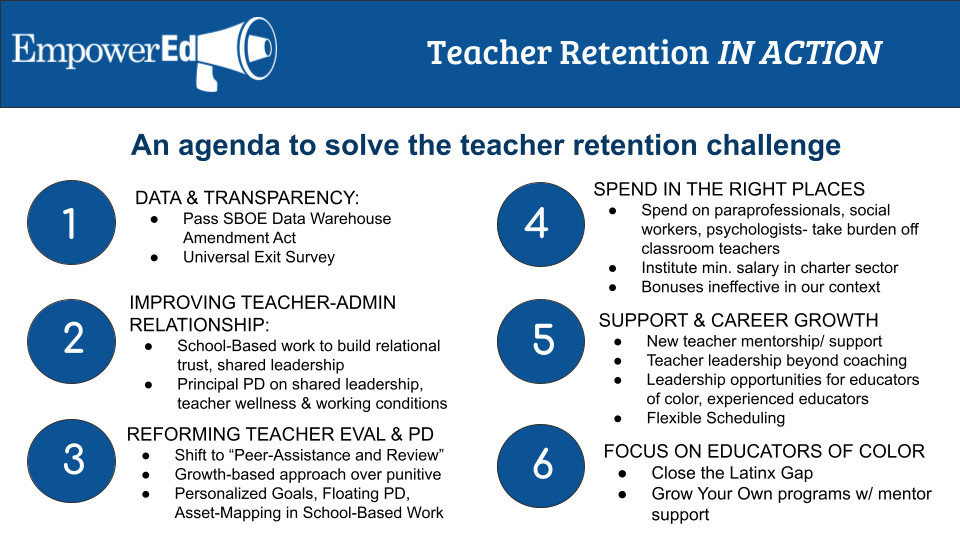
Our Teacher Retention Agenda
Video: Our Briefing on Teacher Retention in Action
EmpowerEd’s 2019 report on DC teacher turnover and retention
Research: Educators don’t leave low-income schools because of the challenges with students, but because of the types of policies imposed on these schools.
VCU Study: The effects of teacher morale on turnover
D.C. schools are losing educators. Teachers have solutions
The first days of school are finally feeling “back to normal” for English teacher Clare Berke.
Berke, who teaches at Benjamin Banneker High School in Ward 2, says her students are able to sit in small discussion groups again. With vaccines available for children six months and older, she’s no longer agonizing over strict seating charts, which kept students physically distanced and helped with contact tracing. Reduced case numbers mean that she isn’t constantly worried about pivoting to remote learning due to a sudden COVID-19 outbreak.
“My own kids, they woke up on day two, and they’re like, ‘we love school and we can’t wait to go back,’” she says. “It’s lots of joy and learning happening already.”
Humanities teacher Brittany Richardson says there is a “lot of positivity” at the Center City Public Charter School in Petworth.
“This year has so far — knock on wood — been amazing,” she says. “We’re all just relieved last year’s over and ready to start fresh.”
As grateful as teachers are for these signs of normalcy, for many D.C. teachers, normal needs to change. Since well before the pandemic, local teachers have complained of high turnover rates, brutal working hours, and an evaluation system that many describe as punitive. Not only are these problems still ongoing, the pandemic has made some of them worse.
D.C. is projected to have higher teacher turnover than the vast majority of states and some of the worst pay in the country given the cost of living, according to a WalletHub study issued earlier this week. The study ranks D.C. 48th among states in projected teacher turnover and finds it is the third worst state to teach in.
Schools are dealing with “significant vacancies” at the beginning of this school year, according to Frazier O’Leary Jr., a teacher and member of the D.C. State Board of Education representing Ward 4. He says that local teacher turnover is only getting worse and that he would be surprised if fewer than 25 percent of DCPS teachers have left their roles or quit teaching altogether since the last school year, based on conversations he’s had with educators and vacancy estimates from the city.
“This year has been precipitous, in the decline of teacher retention,” he says. “From everything that I hear from principals and teachers throughout the city, there’s been a sea change in the number of teachers who aren’t coming back.”
The State Board conducted a survey of D.C. teachers in March 2021 and found that 43.4 percent said they considered quitting teaching due to the stresses of the pandemic.
“The frustrating thing for a lot of us is we saw it coming,” says Scott Goldstein, the executive director of educators advocacy group EmpowerEd. “We’ve been saying for the last couple of years that this is going to happen, and if we don’t make the job more flexible, if we don’t focus on wellness, that we’re going to face these shortages and the students will pay the price. And here we are.”
Before the pandemic hit, D.C. schools were already experiencing high teacher turnover. A July 2021 report by the State Board of Education shows an annual teacher attrition rate of about 25 percent for six years in DCPS and charter schools — higher than the pre-pandemic national average of 16 percent. Whether COVID-19 has dramatically driven down teacher retention in D.C. is not yet clear. While retention did drop after the pandemic began, there isn’t public data yet for this year’s teacher workforce from the Office of the State Superintendent of Education (OSSE).
Not every school is necessarily feeling the weight of low staffing. Dominique Moore, a fifth grade special education teacher, says John Hayden Johnson Middle School in Ward 8 seems “pretty well-staffed” and that teachers there seem “energized” as the school year gets underway. Across the district, however, Moore says morale is waning.
“People who at this point are still teaching are really doing it for the love of teaching, for the love of kids and fostering the next generation,” Moore said. “They always expect us to do more with less.”
Brad Thompson, a world history teacher at Theodore Roosevelt High School, says last year was the most challenging school year of his tenure as a teacher. He was covering three periods on average each week, in addition to his regular teaching load.
This year — his eleventh as a teacher — is looking better thanks to some added support staff, though they’re still contending with ongoing vacancies.
“We are missing the Spanish teacher and a few other teachers and every period, a teacher has to cover that class,” he says, which eats into their prep time.
What’s probably the “biggest issue,” Thompson says, is that classes have “ballooned dramatically” in size due to staff shortages. His classes have upwards of about 30 students enrolled. Last year, he had about 22 per class.
Personnel staff at DCPS’ central office have been temporarily filling teacher vacancies across the District. Margaret Thomas, a special education teacher at Paul Laurence Dunbar High School in Ward 5, says it’s the first time her school has ever resorted to these measures. Thomas says teachers and administrators at her campus have also spent the first weeks of school scrambling to onboard new teachers and finish the hiring process for others.
Moore says several teachers across the District, including a colleague, have dealt with delays in their offer letters and onboarding in the first weeks of school, due to staffing shortages at the DCPS central office.
DCPS Chancellor Lewis Ferebee says these delays are in fact the result of a competitive hiring environment for teachers.
“Many educators received multiple offers as a new school year approached and decisions were often made later than usual, which impacted our hiring timelines,” Ferebee wrote in a statement to DCist/WAMU.
DCPS is experiencing the effects of a nationwide teacher shortage, Ferebee says. But this year, thanks to new recruitment and retainment initiatives, DCPS saw an increase in its teacher recruitment pool, according to Ferebee. The district is planning to expand its substitute teaching contracts to alleviate the strain for schools with vacancies, he says.
“This is a crisis long in the making, that parents and students are really feeling the effects of now,” Goldstein says. “The shortage that everyone is experiencing around the country is compounding a problem that was already stark in D.C.”
With COVID-19 waning, he says, now is the time for change.
“The solutions are becoming not only more clear, but more exciting.”
Reforming the teaching schedule
As much as virtual teaching was a “nightmare,” Goldstein says it gave some teachers a taste of greater flexibility, with options to spend more time with family. Thompson, for example, says he got to do a four-day teaching week, using the fifth day to create his own work schedule.
But today, Goldstein says, teachers’ schedules have mostly returned to pre-pandemic rigidity.
“The striking thing that’s happened over the past few years is that almost every other career that teachers are qualified for has gotten dramatically more flexible, and teaching has not,” Goldstein says.
Part of why Goldstein left his teaching job five years ago is that he became a father and needed a schedule that allowed for more time at home. The latest OSSE data shows that retention rates were lowest among teachers with two to five years of experience, which Goldstein says may be because some of those teachers are getting married and starting families.
He says that there are ways to make teachers’ schedules more forgiving while maintaining a five-day school week. For example, schools can make time for high school students to do vocational programming and internships during school hours while younger students can do more project-based learning, leaning on existing partnerships between schools and D.C. area nonprofits. That would give educators more free periods to lesson plan, have meetings, and work from home.
“There’s really exciting opportunities, both for students and educators,” Goldstein says. “Those take planning, and the system actually supporting the work of schools to redesign.”
Thompson says some of his colleagues work more than eight hours a day. While he’s paid by the hour, he says any work he might have to do after five that doesn’t involve interacting with students doesn’t count toward his paid overtime hours. These schedules feel even less manageable to younger teachers, who tend to have lower salaries. He says it’s also not uncommon for teachers to need another job on the side to make ends meet.
As of fiscal year 2019, the starting salary for a new DCPS teacher with a bachelor’s degree could be as low as $56,313 a year. Thompson says raising these salaries is key to retention in a city with a steep cost of living.
In his emailed statement to DCist/WAMU, Ferebee said DCPS is “proud to be one of the highest paying school districts in the country.”
Making teacher evaluations less ‘punitive’
An early 2020 survey by the State Board of Education showed that for DCPS teachers, “the primary departure driver” was the IMPACT evaluation system. Enacted in 2009 by then-DCPS Chancellor Michelle Rhee, IMPACT was one of the first evaluation systems in the country to determine a teacher’s salary and job security based on students’ standardized test scores.
The system aimed to root out — or “IMPACT out” — “ineffective” teachers, while boosting retention for “effective” teachers by paying them more — but many teachers say that’s not how it works in practice.
“IMPACT is a punitive system, rather than a supportive system,” O’Leary of the D.C. State Board of Education says.
Margaret Thomas says she’s heard many stories from teachers whose scores would vary dramatically depending on their administrators, including veteran teachers.
“It works for getting rid of teachers. But for building capacity, it’s not,” she says. “The tool has been weaponized too much.”
In response to concerns from the Washington Teachers’ Union, Chancellor Lewis Ferebee announced a review of IMPACT in 2019. As part of that review, DCPS partnered with the American University School of Education, which later published a 2021 report showing that IMPACT was prone to “racial bias,” with white teachers receiving higher evaluation scores on average than Black and Hispanic teachers.
Evaluators also observe teachers in unannounced sessions for about 30 minutes — too brief, teachers say, to fully capture all they do in a day.
Berke says she began teaching high school in D.C. fourteen years ago, when IMPACT was still new, and her first evaluation scores were “not good.”
“It was really stressful for me,” Berke says. “I thought, oh, should I quit teaching entirely? I don’t want to be in a job that I’m bad at, maybe this isn’t the thing for me.”
Berke says she was lucky to find a mentor in her department chair, who encouraged her and told her she was on the right track. But mentorship isn’t guaranteed for teachers, and Berke said being reduced to a score can be pretty demoralizing.
Most teachers — about 60 percent, as of 2021 — did feel IMPACT helped their growth to some extent, but there was wide consensus that the system needed change. Following the review, Ferebee has said he would not be getting rid of IMPACT, but would be interested in reforms.
Should it remain in place, Berke says the teachers’ union wants the evaluation to come with readily available professional development. They also want evaluators to measure student success without relying on standardized testing.
“Standardized tests can be biased,” Berke says. “They’re important for a lot of reasons, but they’re not necessarily a great indicator of what a teacher has really done for a student or for a class.”
Moore says an effective mentorship program is one of the best ways DCPS can retain teachers.
Ultimately, Goldstein says, what matters most to students is that teachers and principals they trust and have built long-term relationships with.
“School stability is the foundation of school success,” Goldstein says.
Securing a union contract
Negotiations remain at an impasse between D.C. and the Washington Teachers’ Union, which has not had a contract since 2019.
Moore says not having a contract is a “very huge issue” — in part because, for years, teachers haven’t been getting the raises that would have come in handy with inflation and the District’s increasing cost of living.
“Fire and EMS have got a new contract and a raise. The police department has gotten a new contract and a raise. Government workers have gotten a new contract and raise,” Moore says. “But the teachers are last.”
Moore says she believes this is because teachers are pushing to end mayoral control of the public education system, one of the union’s longtime priorities (the mayor has had almost full control of the city’s public school system since 2008, with only limited oversight by the SBOE).
“The teachers at DCPS, at least the teachers that I have talked to, often feel like the mayor has weaponized our contract and made it a political issue,” Moore says.
Last week Mayor Muriel Bowser signed a four-year labor contract with the principals’ union, guaranteeing principals a 12.5 percent pay increase over the life of the contract.
Without a fair contract that would secure teachers raises, Thompson says D.C. is at risk of losing even more educators.
Ferebee says DCPS has been “negotiating in good faith” to reach an agreement with the union.
“We are confident we presented the best offer and hope to come to an agreement with our teachers very soon,” he wrote.
“We’ve waited too long”
Goldstein says teachers have been putting forward solutions for years.
“We’ve waited too long,” he says. “We just need policy leaders to really seize the moment and not be afraid to tackle the problem, and listen to students and teachers and parents and families about the solutions.”
If D.C. sticks to the status quo, Thompson says teachers will continue to leave after two or three years.
“Teachers will get burned out. Young teachers will begin to get burned out. They’ll continue to get burned out.” he says.
Brittany Richardson says when she left her previous school, “there was not enough therapy in the world” for her to stay.
“The kids were coming with so much trauma and the school was not supporting them and unpacking the trauma, so the trauma got unpacked on us,” she says. “It takes a toll on you.”
Moore says teachers may be leaving, but it’s inaccurate to say D.C. is facing a “teacher shortage.”
“There are more than enough qualified people in this field,” Moore says. “It’s just they’ve gotta put some respect on our name.”
This story has been updated with a statement from DCPS Chancellor Lewis Ferebee.This story originally appeared on dcist.com.




 Ward 6 Public School Parents Organization