W6PSPO Meets Tuesday, April 9 @ Capitol Hill Montessori@Logan
The Ward 6 Public Schools Parent Organization will meet this Tuesday, April 9, from 6:30 – 8 pm at Capitol Hill Montessori@Logan (215 G Street, NE). We’ll be joined by Theodora Brown with the Ward 5 Council on Education and Eboni-Rose Thompson with the Ward 7 Education Council. They will share their ward council’s education priorities, and we’ll discuss ways we can support each other’s work. We will also discuss city-wide impacts with the proposed SY19/20 budget.
Hope to see you on Tuesday.
Suzanne Wells
Mary Levy Testimony – DC Public Schools Budget Oversight Hearing – March 29, 2019
Committee on Whole and Education
Budget Oversight Hearing of the District of Columbia Public Schools
Friday, March 29, 2019
As an education finance lawyer, a budget and policy analyst, and a DCPS parent, I have studied DCPS data and policies for almost 40 years, including the period when both our daughters were going through DCPS, from pre-kindergarten through grade 12.
For the last month, I have been studying local school budgets, first as initial budget allocations released by DCPS, then for the last week the Mayor’s budget versions. For your information, these are two different sets of numbers that cannot be matched, because of differing assumptions on teacher costs and because the definitions are largely different. A plea: Please put a stop to this! Why is DCPS keeping two different sets of books?
The initial allocations can only be described as inadequate, inequitable, un-transparent, and arbitrary. Schools are affected very differently from each other, but cuts are disproportionately concentrated East of the River, and among at-risk, minority students, those most vulnerable to the ill effects of the de-stabilization caused by big budget cuts.
- Local schools collectively have a total increase on paper of $56.2 M, but that is completely absorbed by inflationary increases in costs of staff ($26.9 M), transfer of security charges from central ($20.7 M), enrollment increase (excluding new schools, $6.0 M), and new school openings ($14.2 M), a total of $67.8 M. The deficit of $11.6 M is covered by program cuts in the schools.
- Adjusting the budgets to eliminate the reduction in buying power caused by the inflation in staff costs and the security cost transfer results in each school’s “real dollars” for next year. Some still have enough to maintain current services, but some not enough for enrollment increase, and half must cut current services including schools with no loss or even increases in enrollment.
- Altogether half the schools lost funding in real dollars. Seven schools lost over $1 M, and 6 more between $500,000 and $1 million. Nine of these are East of the River, almost all are 99-100% minority and heavily at-risk,
- The stabilization law limits dollar loss to 5% of each school’s budget this year, but doesn’t recognize inflation from staff cost increases and the new security charge. Even so, some schools have losses over 5% but no stabilization funds. Why?
- Most elementary schools whose extended year programs were eliminated lost hundreds of thousands of dollars, though program was funded by at-risk funds which they kept. Why are they losing money? Two lost almost $1 million! DCPS did not provide stabilization funds for any of them.
- When the special needs funding at each school is factored out, leaving “general education,” there is a general correlation in per pupil allocation by size, but still big differences not related to size or special needs. For example, there are pairs of schools in Wards 7 and 8, with the same enrollment, but a difference in allocations of $2,000 per pupil. Why?
- DCPS has not released information on the use of at-risk funds. Although amounts are now tracked in the Mayor’s budget, they are labeled only as “At-Risk.” Analysis of the initial allocations shows that half the funding is used for resources that are targeted to at-risk students, but the other half is in resources to which all students in all schools are entitled, meaning that they apparently supplant regular funds.
The Mayor’s budget increase in local funds is about $48 M, and that budget shows an increase in local school budgets of $50.4 M, as opposed to the $56.2 M in the DCPS version. but
As to central accounts, as opposed to local school budgets, the Mayor’s budget of a week ago provides the first data we have seen. Central accounts do include services provided directly to students, mostly in schools, including utilities, food service, special education therapists and dedicated aides, athletics, plus a host of functions that are included in teacher cost in the DCPS versions of school budgets but are clawed back into central accounts in the Mayor’s budget. These include background checks, IMPACT bonuses, extra year options, substitutes, and more.
The challenge in determining central office spending is to separate these costs out. They are included in the parts of the budget labeled “Schoolwide” and “School Support,” but these also include security operations other than school security guards, parts of downtown business services like procurement, warehouse and budget operations, school planning, and all the operations that monitor teachers and principals. Definitions are not available. In any event, from analyzing employee rosters, it is clear that central offices are bloated, with far more employees than were in DCPS when enrollment was much larger. DCPS has announced that it is cutting at least 70 central office positions, but the Mayor’s FY 2020 budget shows an increase of about 315 positions outside of local school budgets. If I can eke out an answer, I will share it.
Frank Nickerson Testimony – DC Public Schools Budget Oversight Hearing – March 29, 2019
Committee on Whole and Education
Budget Oversight Hearing of the District of Columbia Public Schools
Friday, March 29, 2019
Frank Nickerson – Member, Capitol Hill Montessori Parent Student Teacher Organization
Hello, I am Frank Nickerson, Ward 6 parent to a daughter in 2nd grade and attending Capitol Hill Montessori at Logan (CHML)
I am grateful to be here and have Councilmembers who listen to citizens.
Several years ago it was discovered that the Logan building, where CHML resides, wasn’t assessed for its qualities to determine if it needed a renovation. Most other schools were assessed in DC but not CHML. One of the main reasons? CHML is an educational campus. It has a primary, elementary, and middle school.
DCPS assessed elementary school buildings. It assessed middle school buildings. We didn’t fall in either category so we weren’t assessed. For years.
We brought this to the attention of the Council and with your championing us and your support, and your direction, the CHML building was assessed, put on the renovation schedule, and you have given us funding to renovate the school. We are extremely grateful.
We are working with DCPS and DGS now on the the building specs.
We have a problem.
Irony of ironies, I think we’ve been forgotten by DCPS and DGS again.
We’re an educational campus. A Montessori educational campus. We need DCPS and DGS to recognize this again. We can’t stick to only a regular elementary school building spec when we have middle school students. DCPS and DGS seem to forget that we have a middle school. They forget that the elementary school and middle school are both Montessori.
Middle school kids are bigger too. Physically bigger. We can’t just build this on a spec for elementary school students. Bigger middle school kids need more space for their activities. They need a full-sized gym. Not just a half gym. They can’t do much with a half-gym. They need a real auditorium to put on plays, for example. Kids can’t put on plays in a gym and give up on gym class when they are putting on a play
DC has actually hired an architectural firm with Montessori school experience. That’s good. However, we still need DCPS and DGS to agree to actually build this educational space for both Montessori elementary and middle school students and with Montessori-school type specs. They want to go by elementary school specs. We need your help.
This is a serious school. When it’s done your new building is predicted to educate 495 students. I believe this is the largest Montessori school by far in the mid-Atlantic.
CHML is a regional leader. Teachers and Montessori educators actually look to CHML. Montessori educators send newly trained Montessori teachers to CHML for practice teaching. DC can set the standard for excellent public school Montessori education. Help CHML reach new heights by doing this job right.
Rebecca Reina Testimony – DC Public Schools Budget Oversight Hearing – March 29, 2019
Committee on Whole and Education
Budget Oversight Hearing of the District of Columbia Public Schools
Friday, March 29, 2019
Hello, I‘m Becky Reina, Chair of the Ward 1 Education Council. Our Education Council is a volunteer organization that advocates for a stronger public education system that supports all our students and families, while assuring we safeguard our by-right neighborhood schools and work for greater resources, equity, transparency, fairness, and safety across both public educational sectors.
I am also the mother of 2 Cleveland Elementary School students, where I have in the past served on the PTA and LSAT. Thank you for this opportunity to provide feedback on the DC Public Schools budget.
The proposed DCPS budget for FY20 is inadequate and inequitable. Some schools are winners and some are losers. Some of the schools losing money year over year face cuts so steep that they could literally destabilize the schools; those are largely the schools that serve the highest percentages of At Risk students. Even many of the schools that are not losing money cannot adequately meet the needs of their students who have the most needs. At Risk funding continues to supplant, not supplement funding for core functions. Having spoken to many principals throughout the city, many spent a month focused almost entirely on negotiating their unreasonable initial budget allocations with Central Office and attempting to creatively fill remaining gaps. Schools use inadequate funds the best they can, making choices like cutting badly needed interventionists or hiring additional aides rather than teachers to stretch their budgets. DCPS school-based staff continue to fear discussing their seemingly now-adequate budgets out of fear that their jerry-rigged fixes will be pulled back or they will be retaliated against for speaking out.
This budget puts many of our DCPS schools in crisis.
These inadequate, inequitable budgets are formed through a broken process, which should be reformed by:
- Creating targeted stimulus funds for by-right schools to ensure every school in our feeder patterns in every part of the city remain viable – say 30 million this year across schools serving the most At Risk students, with a focus on our under-capacity comprehensive high schools like Anacostia, Ballou, and Woodson. We cannot close more schools; to help struggling schools we must invest in them. We can and should provide these schools with funding to provide full teaching staffs for a truly comprehensive curriculum, wraparound services, interventionists, and adequate extracurriculars – all the things that attract families to a school. This stimulus could increase for FY21 and if successful, could gradually decline over a period of years as programs become more self-sustaining.
- Beginning the budget process – in earnest, with actual numbers – in the fall with schools rather than weeks or days before they are due.
- Ending or drastically reforming the Comprehensive Staffing Model.
- Ending zero based budgeting, which creates wild swings from year to year.
- Taking security costs back out of local budgets. Individual schools have no control over security costs and it is inappropriate to use security costs to soften budget cuts, thereby preventing schools from receiving stabilization funds.
- Fixing enrollment projections by:
- Changing count day. October is when charter schools have their highest enrollment and DCPS schools have their lowest. The reverse is true in the spring. Many of our students are transient within the jurisdiction, with others moving into the system throughout the year. We need to move count day to the spring or aggregate two count days, fall and spring, to adequately fund our DCPS schools to match the number of students enrolled in reality.
-
- Offering seats in the lottery based on school capacity and neighborhood and system needs, not based solely on a school’s current staffing level. There is a disincentive to release more seats into the lottery, if actual enrollment increases do not result in adequate additional funding to properly staff for the increases. If we staff our schools adequately, we can than bring them up to building capacity in neighborhoods where we are not yet filling them.
- Admit that projecting enrollments is as much art as science. Project enrollment based on more than two past years and stop assuming that history is future. Neighborhoods are changing and our enrollment projections should track those changes.
Finally, I want to thank DCPS and Councilmember Grosso for your focus on technology this budget season. It’s badly needed. I hope the technology audit and systemwide plans include SMARTboards and ongoing maintenance for all types of devices. I am heartened to see DCPS listening to parents and I know we can continue this collaboration to affect larger improvements for all our students.
Thank you for this opportunity to testify.
Suzanne Wells Testimony – DC Public Schools Budget Oversight Hearing – March 29, 2019
Committee on Whole and Education
Budget Hearing
on the
District of Columbia Public Schools
Friday, March 29, 2019
Thank you for the opportunity to testify today. My name is Suzanne Wells. I am the president of the Ward 6 Public Schools Parent Organization, and the parent of an 8th grader at Eliot-Hine Middle School.
When the Office of the State Superintendent of Education (OSSE) released the school report cards in December 2018, Eliot-Hine, a Title 1 school, was rated as a one-star school, ranked in the bottom 5% of all schools in DC, and designated as a Comprehensive Support School. We learned last night that Eliot-Hine was selected to be a Connected School which will allow the school to become connected with partners and city agencies to offer a range of supports to students, families and staff. Because of its Comprehensive Support status, Eliot-Hine will be receiving some additional funding. Is the funding Eliot-Hine will receive enough? No. However, because of the school’s low enrollment, it is hard to justify funding it more.
While I don’t feel Eliot-Hine has served the current students at the school well, I am hopeful for its future. This summer the planned renovation will begin. We anticipate Principal Magrino will be back next year, and bring much needed stability and leadership to the school. Training will be provided to staff this summer to strengthen the IB program. The DCPS enrollment team is working to make in-bound families aware of opportunities within the Eastern feeder pattern, e.g., the January Eastern Feeder Fest. I firmly believe as result of all of these efforts, we will start to see more and more in-bound families choosing Eliot-Hine in the coming years.
We must ensure the same investments are happening at the schools in Wards 7 and 8 that have seen multi-year enrollment declines, and broken feeder patterns. Targeted efforts in Wards 7 and 8 to fix broken feeder patterns and provide course offerings, experiences and safe passage to and from school that students in other parts of the city have will ensure Ward 7 and 8 families have what they say they want, i.e., quality in-bound schools to choose from, and will be the fiscally responsible thing for the city to do as families are attracted back to DCPS.
To date, as a city, we have not confronted the staggeringly inefficient use of resources. Why when almost 18% of our city’s budget or close to $2 billion is spent on education are there discrepancies in offerings among our schools, and many school needs going unaddressed? Why is there going to be a cut in, e.g., school librarians or technology maintenance? I believe a key reason is we are inefficiently using our education dollars.
No one really understands the inefficient use of resources inherent in our two-sector school system, DCPS and the charter sector, that operates without any coordination. DC has truly been a leader in investing in capital improvements to our school buildings, and I commend the Council for its support for the renovations of our DCPS schools. Yet many of these renovated schools are under enrolled. Across the city we have many small and under-enrolled schools that cost more to run on a per student basis than a fully-enrolled school. There’s no better example of this than our high schools where we fund nineteen high schools (four DCPS and 15 charters) that enroll fewer than 400 students. These schools cost more to operate on a per student basis, and they don’t offer the students the educational opportunities and experiences they deserve.
Operating small and under-enrolled schools isn’t the only area where we see inefficiencies. Taxpayers pay over $3,300 for a facilities allocation for every student attending a charter school while we have thousands of empty seats in many of the beautiful DCPS school buildings our city has renovated. And, there are 11 applications before the Public Charter School Board (PCSB) this spring to open new charter schools to serve 4000 additional students while we have over 20,000 vacant seats across both sectors.
In closing, I would like to ask the Council to explain why it makes sense to open up even one new school this year when there are vacant seats in both sectors. I would also like to ask the Council to explain why it makes sense to open any new schools this spring instead of investing in strengthening the feeder patterns of our by-right school system. And, I would like ask the Council to commission a budget study that identifies the inefficiencies in our City’s two sector/choice approach so we can reduce the inefficiencies, and put our tax dollars towards supporting students.
Sandra Moscoso Testimony – DC Public Schools Budget Oversight Hearing – March 29, 2019
Committee on Whole and Education
Budget Oversight Hearing of the District of Columbia Public Schools
Friday, March 29, 2019
Good morning Chairmen and Councilmembers. I am Sandra Moscoso, a parent of students enrolled in Capitol Hill Montessori at Logan, and School Without Walls. I am also a former BASIS DC charter parent. I share this with you, because like many D.C. families, including those waking up to school lottery results today, mine is a “Cross-Sector” family.
I am happy we have become self-aware about equity in DC and commend Council for supporting legislation which begins to make funding decisions based on data and evidence. It’s time to evolve further and not let politics or fear of the well-funded education lobby stand in the way of students getting the resources they deserve.
I believe we can do this by taking a comprehensive approach to education planning – parents want this and will support you.
1.9 billion goes to fund public schools. How many students rely on public schools? How many schools are we funding? Are we making the most of limited dollars? Why is it every year, we can’t we seem to make schools whole?
I compared OSSE’s #s of overall 2019 enrollment with that of 2012.
- Our student enrollment has grown by 22%
- Our charter and DCPS school inventory has grown by 33% in that time
A study for the DME as part of the 2018 Master Facilities Plan revealed there are 22,000 vacant seats across DCPS and charter schools – that’s 20% under-utilization. 22,000 empty seats, yet here are 170 witnesses telling you our schools are underfunded.
Couldn’t we begin to resolve this by committing to take a sensible approach to planning, so that every school where students sit today is adequately funded? I think about the lack of coordination across DCPS and DCPCSB and wonder: if we owned more cars than we could maintain, our solution would not be to buy more cars.
Looking back at the DME study, I was struck by how the recommendations seemed so common sense.
- Utilize current educational space in the best ways possible
- Retain educational space for educational purposes
- Grow access to space for educational purpose
- Review enrollment policies to manage utilization
- Streamline planning processes, data collection and knowledge sharing
I go back to this study because although we are here to discuss DCPS’ operational budget, we cannot detach the teachers, staff, and materials required to educate students from the fact that we have chosen to open buildings, staff schools, and enroll students without a comprehensive strategy in mind. Without strategy and planning, we will continue to hurt our existing charter and DC public schools and will continue to underfund them.
We are in a unique position with the attention of the whole Council focused on education. It’s an opportunity to truly support every one of those 94,000 students enrolled in our schools today and sensibly, strategically plan for the 108,000 students projected to be enrolled in our schools 10 years from now.
And one more thing. School librarians are set to suffer a 10% cut across schools. School libraries are linked to improved standardized reading scores. DCPS’ literacy strategy includes in-class libraries and partnerships with DPL, yet somehow, we continue to forget the impact qualified librarians bring to a school. We went through this 6 years ago, concluded that we believed in evidence and data, and restored funding for DCPS librarians. There are a million reasons to support school libraries, but please do not take my word for it. I’ve attached a factsheet and links to a number of school library impact studies in this testimony. Please protect this funding.
Thank you for your time.
Enrollment/school inventory source: https://osse.dc.gov/enrollment
- Of school with enrollment of 131+* students, 227 DCPS+Charter in 2019, 170 schools in 2012. (*131 – the lowest enrollment in a DCPS was used as minimum enrollment cutoff for this exercise).
- ~ 94,000 students are enrolled DCPS + Charter 2019; ~76,000 enrolled in 2012.
School Librarian Impact Sources:
Betsy Wolf Testimony – DC Public Schools Budget Oversight Hearing – March 29, 2019
Committee on Whole and Education
Budget Oversight Hearing of the District of Columbia Public Schools
Friday, March 29, 2019
My name is Betsy Wolf, and I am representing Amidon-Bowen and all DCPS schools facing staffing cuts today. About this time last year, DCPS unexpectedly cut several staff from our school budget, and I started my side-job creating graphs showing how inequitable funding in this city is; I am an education researcher by day, after all. One year and hundreds of graphs later, I am still trying to understand how it is possible that in a city as rich as DC, schools are forced to cut staff from their budgets each year. Here is what I’ve learned.
DCPS has shifted costs to the school level over time
Since the reign of Michelle Rhee, DCPS has shifted costs to the school level, so while it may look like budgets increase over time, you have to account for shifting costs. Some examples include technology, social workers and psychologists, JROTC instructors, background checks, and most recently, school security funds.
Staffing costs rise faster than increases in school budget allocations
Another big problem is that costs rise faster than increases in school budget allocations, which means that some schools are faced with new staffing cuts each year. DCPS requires schools to use the average districtwide cost for a position, and the cost of each position increases annually. This is another example of why a budget “increase” may not actually be an increase in purchasing power.
Unpredictable fluctuations from year-to-year and unfunded mandates
DCPS also starts the budgeting process from scratch each year, so there may be wild fluctuations from one year to the next in a school’s budget. DCPS may also change its rules about how it allocates funds each year with no notice to schools.
There are also unfunded mandates. Schools at times are “strongly advised” or required to employ staff whose positions are not funded by the comprehensive staffing model (e.g., LEAP, sped managers). Schools must then use their extra funds (if any) to cover unfunded mandates.
Budgets are then made more complicated by additional rules, carve-outs, and supplements that may show up in one year and be taken away the next. DCPS giveth and DCPS taketh away.
Not following intent of law on stabilization funds
After the Mayor decides how money to allocate to DCPS, DCPS figures out how to make the numbers work, taking advantage of loopholes and loose interpretations of the law that says a school budget can’t be cut by more than 5% in a given year. DCPS is not able to fund schools at similar levels each year because DCPS is not guaranteed any amount in the Mayor’s budget.
Staffing cuts results in other negative ripple effects
As a result of unpredictable and inadequate school budgets, schools have less purchasing power over time and are forced to make staffing cuts. As a result of staffing cuts, there are negative ripple effects, including highly inequitable PTA funding, lack of resources like working computers, and low morale and declining enrollment in schools that can’t cover shortfalls with PTA funding. And of course declining enrollment means less money for next year, so more cuts.
DC’s school governance structures and funding formula are also to blame
But the blame cannot be placed solely on DCPS. Our city’s school governance structures and funding formula are also to blame. Which means the burden of fixing the problem isn’t just on DCPS, it’s on all of us. I’ve learned a lot from others in my journey this past year, but there are still questions I cannot answer as a member of the public.
Recommendation 1: Fund education at adequate levels recommended by study
The city commissioned an adequacy study of school funding in 2013, and the city isn’t adequately funding education, according to its own study. Why not? That seems like a relatively straight-forward fix.
Recommendation 2: Investigate root causes of staffing cuts each year
Why is it that costs rise more than school budget allocations? What are the root causes of this problem? Is it that DCPS doesn’t get enough money from the mayor’s budget to cover costs? Is it that there is inefficiency in spending in central office? DCPS separates money into three categories: school-based, school support, and central office, but school support is really an arm of central office, so is central office too large?
Recommendation 3: Investigate differences in purchasing power for DCPS versus non-governmental LEAs
A dollar in DCPS doesn’t go as far as a dollar in the charter sector. DCPS must use all of the city’s agencies and city-approved vendors. That may be desirable for the city except for there’s no recognition of this in the school funding formula that gives equal per-pupil amounts to the DCPS and charter sectors. There’s no acknowledgement that DCPS is a governmental agency that has to abide by different rules than a non-profit in the non-governmental sector.
Recommendation 4: Provide Council oversight that goes further than asking hard questions during hearings
I know these issues are complex. But we don’t we have answers to basic questions that would help guide legislation to make sure that schools are adequately funded. I’ve seen many of you ask hard questions in oversight hearings, and I appreciate that, but if that’s where the oversight stops, we have a major problem. On this note, I applaud Councilmember’s Allen recent push to make charter schools, which are public schools, also subject to FOIA.
How are we going to solve the school budget crisis without first getting down to the facts? My recommendation is to hire an independent school budget expert and start to investigate some of these issues and determine the root causes.
Cuts in staffing and other resources at the school level are costly for students
The reason we all drag ourselves to testify again and again is because the cost to students of school budget cuts is great. If you’ve ever served on an LSAT, you know just how painful the conversations around staffing cuts are. How do you choose between a reading specialist and mental health professional for students? A mental health professional and enrichment beyond math and reading for students? Don’t our students deserve both?
It is time to put our money where our mouth is and actually put students first.
W6PSPO Meeting Notes – March 19, 2019
March 19, 2019
Payne Elementary School, 1445 C Street, SE, 6:30 p.m. – 8 p.m.
- At-Risk Funding Overview – Betsy Wolf, Amidon-Bowen parent [See presentation]
- Inequity in school funding in DCPS

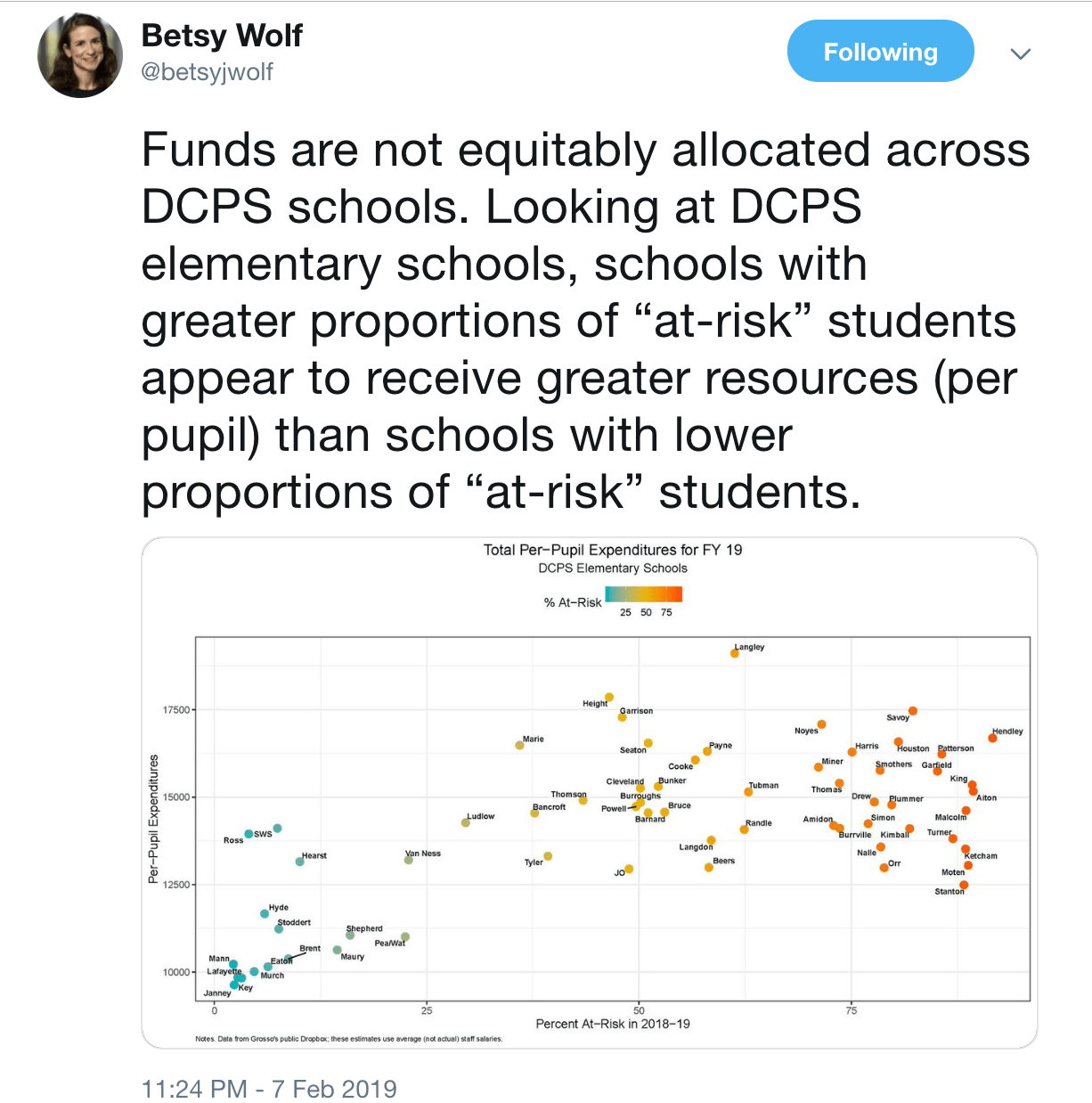
See Betsy Wolf’s At-Risk Funding Overview – https://w6pspo.org/wp-content/uploads/2019/02/at-risk-funding-and-the-achievement-gap-1.pptx - DCPS funds look like they are equitably allocated across schools in that schools serving greater % at-risk get more funds. But schools serving greater % at-risk also serve more students with IEPs. Taking out special education funding, no longer see equitable funding across schools in DCPS.
- Why not? Where is at-risk money going? It’s going to cover core general and special education positions in many cases. At-risk money is not truly supplementing the base funding.
- Achievement gaps
- DC has a large achievement gap because it has large income inequality. Nationwide, achievement gaps are the highest in places with the greatest income inequality.
- Interventions to target achievement gaps
- To target the achievement gap, you need to supplement instruction for the lowest performing students. Small-group instruction and tutoring have been shown to be the most impactful interventions in education research. But schools don’t have enough extra money to fund positions like reading specialists across the board.
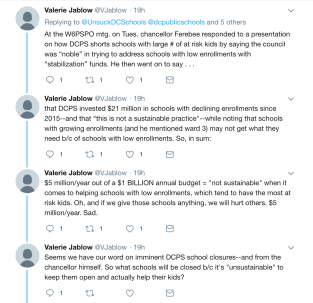
- Open discussion with Chancellor Ferebee
- Budget: trying to address decline in enrollment w/in schools in East DC vs

Community response to Chancellor Ferebee’s characterization of FY20 budget overcrowding in West DC
- Pointed to Council legislation re: stabilization to support schools in enrollment decline (cap at 5% of resources)
- Confusion remains around DCPS budget/follow the $?
- Start at per pupil allocation, then add $
- Comprehensive staffing model adds to ‘blur’
- Re: recommended interventions to target achievement gaps (like small group/reading specialist):
- School based decision today; do we create a model that is mandatory
- Influence of great teachers/school leaders is not necc equitable
- Believes in autonomy, but also in sharing with schools research-based strategies to inform their staffing and budgeting decisions.
- Cross-sector planning (W6PSPO → community members; CF: Chancellor Ferebee)
- W6PSPO: Proliferation of charters and impact on overall resources. CF: Approaching coordination carefully;
- W6PSPO: Need planning and stability w/ policy around it; Need Chancellor to be ‘cheerleader’ for DCPS
- Inequity w/in schools
- W6PSPO: Resources/visibility w/in schools are focused on early childhood families (engagement is higher from early childhood families), but schools are being judged by test scores at 4/5th grades
- Teacher Turnover
- W6PSPO: When classrooms are without a teacher for extended period of time, is there an accountability model parents can follow up with beyond the principal? (Principals are not always responsive nor give priority to staffing gaps). CF: Instructional superintendents are first point of contact.
- School Leadership:
- W6PSPO:What can the DCPS do to strengthen teacher/principal retention? CF: Exploring multi-year principal contract (today, principal contracts are renewed -or not- annually); Committed to engaging w/ WTU on IMPACT; Solve for great leadership
- W6PSPO: Principals are able to use IMPACT to evaluate and retaliate against teachers; teachers don’t have a meaningful way to give feedback on principals. CF: DCPS tracks data about whether teachers return. Understand that there are independent evaluators under IMPACT. W6PSPO: Correction – WTU did not want evaluators who didn’t know them, the school community and requested peer evaluators. Suggest DCPS pursue meaningful feedback from teachers when evaluating principal’s performance;
- Modernizations/Community Engagement:
- W6PSPO: Modernization/PACE act – suggestion to engage parents who have gone through SIT process to get a view ‘under the hood’ how policy plays out in practice.
- W6PSPO: What can we hold DCPS accountable for vis a vis lead in drinking water? CF: DGS/DCPS committed to communicating at each step of the process.
- W6PSPO: DCPS central office staff need to spend more time in the schools, understand what happens on the ground
- Open discussion with Jessica Sutter, SBOE W6
- State board voting on priorities Weds, March 20
- STAR report/dc school report card
- OSSE survey on report cards: 3 year cycle for changes, except High school growth model
- High school graduation requirements/Credit recovery
- Committees
- Teacher/leader turnover
- Teacher/leader working group
- Research
- Social studies
- Rich curriculum
- UPDATE: State Board members will meet monthly in working groups related to school visits (first Tuesday), teacher retention (third Friday), rich curriculum (fourth Monday), research (fourth Monday), and social studies (fourth Monday). These working groups will be an opportunity for members to discuss key issue and focus areas that the State Board has identified as priorities for 2019. The discussions will provide members the opportunity to share thoughts, recommendations, and next steps for the SBOE. Thank you! ~ Paul Negron, Public Affairs Specialist, SBOE
- Teacher/leader turnover
- Ward 6 DCSBOE Rep Proposed Priorities (JS = Jessica Sutter; W6PSPO → Community members)
- OSSE STAR Rating Feedback: JS: Will use OSSE Survey and SBOE surveys as starting point for community level discussions. How best to do the OSSE/STAR feedback for Ward 6? W6PSPO: Best at school level; better opportunity for collecting feedback, esp from teachers. Focus group model.
- Middle/HS paths: Ward 6 families have expressed frustration around middle and high school options. (in particular lack of strategy around dual language continuation) Middle and high schools (mostly parents from dual language programs have reached out and are dissatisfied w/ feeder options). Looking at options for bringing solutions for Tyler and Stokes communities. W6PSPO: Should start conversation with DCPS; feeders patterns would be affected.
- Advocacy Coordination Across Sectors: JS: should W6PSPO broaden advocacy efforts to also include charters? W6PSPO: overall, priorities are not necessarily always aligned. Currently, W6PSPO has hands full w/stabilizing feeder patterns, DCPS budget, technology, etc. W6PSPO always open to coordinating with charter schools when it makes sense on specific issues common to all schools. Some common areas might include standardizing grades (like grade middle schools start, e.g., 5th for charters, 6th for DCPS; SpEd student imbalance (neighborhood schools and open enrollment schools bear the brunt of SpEd-heavy communities, while charter and selective DCPS schools have low SpEd population).
4. Wilson Building Visits – Danica Petroshius –
- Friday, March 23 10AM-4PM. Danica to follow up via email to W6PSPO
5. CHPSPO’s new name → W6PSPO
CHPSPO started in 2005 as a group of Capitol Hill public school parents. Much has changed, and we now work with our neighbors in SW, Shaw and across Ward 6 to achieve common goals. We decided tonight to change our name to @W6PSPO to better reflect our values and the work we do.
— Suzanne Wells (@Sew20003M) March 20, 2019
Next CHPSPO Meeting: April 23, 2019 (Note: 4th Thursday due to spring break)
Upcoming Events
Budget Oversight Hearings – Register to testify here–> http://bit.do/educationhearings
- March 27 State Board of Education, Office of the Ombudsman for Public Education, and the Office of the Student Advocate
- March 29 DCPS (Public Witnesses Only)
- April 4 Public Charter School Board
- April 9 Office of the State Superintendent of Education
- April 25 Deputy Mayor for Education
March 25 Capitol Hill Community Foundation Spring Grants deadline
March 29 Ferebee Friday, Pretzel Bakery, 8 – 9:30 am
Visit W6PSPO on the web at http://chpspo.org
DC Council: Please Support Transparency, Stability and Success for All Public Schools, All Students
Ward 6 Public Schools Parent Organization
Please Support Transparency, Stability and Success for
All Public Schools, All Students
The Ward 6 Public Schools Parent Organization (W6PSPO) is an all-volunteer collaboration of parents, educators and community members helping to strengthen and support public schools in Ward 6. Ward 6 schools serve a diverse student population, including students from across the city. Almost 40% of students attending Ward 6 DCPS schools live in Wards 5, 7, and 8.
We believe the DC Council can play a significant role in demanding and shaping a stronger education system that supports success for every student. We ask the Council to leverage every tool in its toolkit, including adjusting budgets, demanding action by DCPS in oversight, requesting a performance-based budget, amending the School Reform Act, stopping administrative actions that have not included robust public engagement and may negatively affect communities, to implement the following recommendations.
Ensure Transparency for All
Transparency for All Schools and LEAs. Parents and students must know that they are safe and supported. We support the Public School Transparency Act and urge the Council to take swift action to pass it.
Strong Oversight. We need strong oversight over both sectors and our education system as a whole to ensure transparency so that parents and the public are never kept in the dark about proposals, decisions or the impact of decisions on students, educators and school communities.
Stabilize School System and Supports
Invest in School Improvement and Stability. Having access to a predictable, high-quality elementary to high school feeder pattern is the most important predictor of in-boundary participation rates. We continue to see the opening of new schools that don’t take into account impacts on feeder patterns [1], pull students out of their in-boundary schools, and spread our precious education dollars thin. We see regular closures of schools causing great disruption and confusion to families. We need strategies for filling under-enrolled schools, particularly middle and high schools, and meeting the needs for middle schools that take into account what communities want. And, we need to continue to build on specialized programs such as language immersion programs by providing them a feeder path that continues those specialized programs.
Invest in Teacher and Principal Retention. Excessively high teacher and principal turnover creates tremendous instability throughout the school systems. An October 3, 2018, DCSBOE report on Teacher Turnover found that “teacher turnover is higher in DC than in other comparable American cities, including New York, Chicago, and Milwaukee, and higher than the national average. The yearly teacher turnover rate, averaged over three years, across both traditional public and public charter schools is about 25 percent, compared to a national average of approximately 16 percent and an average of 19% among a selection of urban districts. In both sectors, schools with the highest percentages of at-risk students tend to suffer from the highest rates of teacher turnover.” We recommend that the Council take action on the recommendations outlined in the report:
- Create and maintain a single comprehensive and publicly available source of teacher and principal turnover data
- Require the state to work with LEAs to ensure richer data collection on teacher and principal characteristics
- Support a new, sustained research project exploring linkages between teacher and principal turnover and student success
In addition, as Chancellor Ferebee said at our recent W6PSPO meeting “Often people don’t leave jobs, they leave leaders.” We must ensure that the principal evaluation system includes effective processes for feedback from staff, students and parents. And we must be sure we are doing all we can to ensure our teachers and principals have the support they need to help all students succeed.
Develop and Follow a System-wide Master Facilities Plan. The master facilities planning by the Administration lacked authentic engagement and is unworkable as it only looks at planning for half of our students. We need a system-wide structure for planning and decision-making around school facilities for all public schools, both DCPS and Charter, including accurate projections for enrollment and vacant seats, strategies for filling under-enrolled schools, and community-responsive and community-engaged planning for new schools. System-wide plans should include coordination and strategy around opening, closing and changing the programmatic focus of schools.
Community-School Supported DC Research Collaborative: Kick off and fund the DC Research Collaborative, guided by a robust, diverse steering committee not comprised of majority mayoral appointees, that ensures safe and full sharing of data to support the work of the Collaborative, grounded in the needs of students and school improvement from the perspectives of those on the ground.
Ensure Adequate Resources and School Budgets
Educational Technology, including IT Support and Teacher Training: The DCPS technology initiative in the Mayor’s budget focuses on computer hardware and is a good first step. However, schools also need adequate IT support and teacher training to ensure that technology is used effectively. A comprehensive, multi-year plan for DCPS technology, as called for by the DCPS Student Technology Equity Act of 2019, is needed. Additionally, Council should press DCPS and OCTO on how it will support school technology for the remainder of this school year, in advance of online PARCC testing.
Adequate and Equitable Education School Budgets: Each year, costs increase faster than increases to school budgets. As a result, many schools are faced with staffing cuts each year. Schools can’t close achievement gaps and ensure college and career readiness for all with fewer and fewer resources each year. We must provide enough resources so every school has a strong base budget that builds on the previous year’s budget. In addition, at-risk funding must supplement, not supplant, other funding. Solving this challenge will likely involve increasing DCPS’s budget allocation from the Mayor as well as “looking under the hood” in DCPS central office budgeting, and at citywide costs for operating both DCPS and a charter sector. We highly recommend that Council (1) require and fund the DC Auditor to conduct a DCPS and PCSB budget audit and (2) commission a school budget expert to investigate these issues and make recommendations to mitigate unstable school budgeting and continued reductions in school staffs in the years to come.
Adequate Capital Budget for School Facilities: We must ensure that our DCPS schools that have yet to be modernized see a fast track to modernization and that we have robust funding for ongoing maintenance, repair and stabilization needs. We must also ensure safe, healthy, and modern school buildings.
- Ensure an Effective Partnership between DGS and DCPS: Currently, school buildings are not being maintained efficiently and effectively. School communities too often have to turn to Councilmembers, media and social media to turn work orders into action items. We need significant oversight that will lead to new policy or funding that will ensure DGS and DCPS can work together efficiently and effectively to quick-response action that ensures the safety and health of students and faculty at every school.
- Ensure Healthy and Safe Schools: Significant attention needs to be paid to ensure agencies are adequately protecting the health and safety of students, educators and staff in schools. We need to ensure transparency and support for lead-free schools and water and keep schools safe from other environmental hazards. We need to ensure transparency and allow the public access to observe implementation of the Water Filtration and Testing Protocol.
Support and Demand Effective Public Engagement
Effective Local School Advisory Teams (LSATs): LSATs are a critical aspect of ensuring school budgets are implemented effectively and are responsive to educator, student, and school community needs. However, LSATs are implemented unevenly and with varying degrees of success across schools. There should be significant research and oversight to understand the current state of LSATs and solutions uncovered to ensure robust engagement of LSATs across all schools.
Agency Support for Authentic Community Engagement: We need a robust conversation about how to improve community engagement in education issues involving the Mayor’s office, DME, DCPS, OSSE and the PCSB. From the lack of engagement in the Chancellor search to lack of regular engagement with communities about how to problem-solve together, DC has generally failed in engaging parents and communities in productive solutions. We believe that authentic engagement can be a critical lever in accelerating progress for students. Oversight is needed to uncover how engagement can be improved and systems put in place to ensure its effective use. Specific examples include major disconnects between agencies and those on the ground (e.g., educators and parents) on issues such as modernization, stabilization, school budgeting, school openings, strengthening feeder systems, school technology needs, etc.
[1] DCPS will open a new selective high school this year, Bard High School Early College and plans to double the capacity of Banneker Academic High School, and the PCSB is considering 11 new applications this spring that include six stand-alone middle or high schools.