Testimony of Suzanne Wells before the Council of the District of Columbia Education Committee Public Charter School Fiscal Transparency Amendment of 2015, B21-0115 October 14, 2015

Thank you for the opportunity to testify on the Public Charter School Fiscal Transparency Amendment of 2015. My name is Suzanne Wells. I am the founder of the Capitol Hill Public Schools Parent Organization, and my daughter is a fifth grader in the Tyler Elementary Spanish Immersion program.

It is important to strengthen the transparency surrounding the DC public charter schools, and this bill is a modest step in the right direction. As the Council considers comments on the bill, I strongly urge the Council to consider the recommendations included in the Transparency, Accountability, and Fiscal Responsibility for Publicly Funded Charter Schools in DC paper that was developed with input from a broad range of education stakeholders across the city.

My testimony today focuses on the lack of transparency in the siting of new public charter schools. Public charter schools generally locate their facilities in DC public schools that are determined to be surplus or in commercially-owned buildings. There is a minimal opportunity for the public to be involved when charter schools locate in surplus DC public schools. However, there is no transparency or opportunity for public input when public charter schools locate in commercially-owned buildings. There are many different reasons that a community may want or not want a school in their community, and that is why transparency on the siting of new public charter schools is so important both for the schools and for the communities.

The recent opening of Washington Global Middle School in Ward 6 provides important insights into the need for greater transparency in the siting of new public charter schools. In May 2014, the Public Charter School Board approved Washington Global’s application which said it was looking to site its new facility in Wards 4, 5, 7 or 8. Washington Global initially sought to locate in the former Gibbs School, along with Monument Academy and Community College Prep. For reasons that have never been made public, Washington Global was not included in the group of schools that were awarded the former Gibbs School. In December 2014, Washington Global Middle School announced it had leased a commercial building in Ward 6 for its new location. Because this commercial building is privately owned, there was no process for the public to provide input.

The Advisory Neighborhood Commission 6D was not consulted or informed before Washington Global leased its new facility. The Public Charter School Board approved the Ward 6 location for Washington Global even though its original application said it was planning to locate in Wards 4, 5, 7 or 8. The public was never given the opportunity to provide input on the opening of Washington Global which is now located less than 1,700 feet from Jefferson Middle School, a DC public school that has a program substantially similar to Washington Global. There is no defined process for the siting of new public charter schools.

There is no opportunity for the public to provide input when public charter schools locate in commercial buildings. I encourage the Council to consider strengthening the Public Charter School Fiscal Transparency Amendment by adding provisions that would increase public involvement and transparency when new public charter schools are sited or when existing public charter schools are expanded. Without increased transparency, we will continue to make less than optimal decisions about where our tax dollars go to support our public schools, and will do a disservice to the students attending schools in Washington, DC.

Another area where much greater transparency is needed is in regards to what happens to the facilities that once housed closed public charter schools. Approximately 40 public charter schools have closed since their charters were first approved. The facilities of these closed public charter schools were paid for with taxpayer dollars while the schools were open. The taxpayers have a right to know what happened to the facilities that formerly housed these public charter schools. If the buildings were sold, where did the proceeds from the sale go? If the facilities were being financed through revenue bond programs, who is paying the bond debt now?

In closing, there are many areas where greater public charter school transparency is needed. I strongly encourage the Council to strengthen this fiscal transparency amendment. Thank you for the opportunity to testify

Testimony of Elizabeth Bacon at the Education Committee Public Hearing on B21-0115, Public Charter School Fiscal Transparency Amendment Act of 2015

Councilmember Grosso and the Committee on Education: Thank you for holding this hearing today as a public discussion of transparency and fiscal responsibility for our public schools. This is an important, although sometimes difficult, issue that we must address to be better stewards of the $1.4 million we spend in public money on our education system annually.

In my view – as a parent with two children in DCPS schools and as a former LSAT member with experience deciphering school budgets – there is room, and need, to strengthen this bill. After seeing how tight (and often short) the capital and operating budgets are at my children’s DCPS schools, I believe we must be better stewards of our public education dollars.

As well, as a member of the education council in Ward 6 and as a member of the Coalition for DC Public Schools and Communities, I would point councilmembers to the proposals to strengthen this bill in the Coalition’s recent paper, “Transparency, Accountability, and Fiscal Responsibility for Publicly Funded Charter Schools in DC,” which contends that all of our public schools, no matter the sector, should be held to the same standards of accountability and transparency.

As I understand it, the current version of the Act, as introduced, only applies to a handful of charter schools. Examples of charters diverting millions to private contractors – as in the cases of Options and Community Academy – should speak to an imperative for greater transparency for all public charter schools, both those open now, and those that will open in the future.

As a DCPS parent, I hear how charters are supposed to spur innovation and best practices for traditional schools, but if it’s not clear how money is being spent to implement these best practices, how is it possible to authentically replicate these models and practices?

Mine is a parent’s perspective, but two particular recommendations from a recent report from the Annenberg Institute, “Public Accountability for Public Charter Schools, Standards and Policy Recommendations for Effective Oversight,” on effective oversight of public charter schools echo the conversation here today:

  • School governance should be representative and transparent.
  • Monitoring and oversight of charter schools are critical to protect the public interest.

A data warehouse – as outlined in the School Reform Act (and called for by fall 2016) – would serve to create common data points across the charter and DCPS sectors to provide intelligible and useful comparisons. This would be important to the sectors being able to learn from each other (which is in line with the goals of the cross-sector collaboration task force being formed now by the Deputy Mayor for Education); important to Council for oversight purposes; and important to LEAs and citizens in assessing how money is being spent to achieve specific results.

In the interest of stewardship of public dollars and building the strongest public education system in our city we can, I urge the Committee to use this legislation and future opportunities to strengthen fiscal transparency and accountability for our city’s education spending.

Testimony of Becky Levin – DCPS Food and Nutrition Services Program – September 30 2015

Testimony of Becky Levin, parent of Capitol Hill Montessori at Logan Student

DCPS Food and Nutrition Services Program

Council of the District of Columbia, Education Committee

September 30, 2015


Members of the DC Council, thank you for the opportunity to speak with you about food and nutrition services in D.C. Public Schools and what you can do to promote good nutrition in our school system, how to maximize the effectiveness of tax payer dollars funding school meals, and strategies to consider as DCPS moves forward to select either new vendors or a new system for producing meals in subsequent school years.


My name is Becky Levin, I am the mother of a third grader at Capitol Hill Montessori at Logan, a coordinator of the school’s Health and Wellness Club, and a Commissioner on the D.C. Healthy Youth and Schools Commission.  At Logan, we are working hard to teach our students and their families about nutrition and to promote healthy eating and living throughout our school’s activities. I’m also an advocate working on Child Nutrition Reauthorization currently pending in Congress.  I talk to a lot of school food service professionals, nutritionists, and other advocates working very hard to make school meals healthier, delicious, and appealing.  There are fantastic examples across the country that can help the District of Columbia Public Schools (DCPS) greatly improve our school meals. DCPS has had some promising initial successes. I am confident that with thoughtful consideration, such as convening hearings like today’s, and the proper oversight DCPS can once again be a leader in providing excellent and student-embraced school meals.

We all know that children, like adults, require good nutrition to power their brains so that their minds are well-fueled and they aren’t distracted by a rumbling belly.  Excellent nutrition is particularly critical for young children, as their brains are still developing. We also know that proper nutrition and exercise are essential to combat childhood obesity, adult obesity, preventable health complications and sky- rocketing health care costs. Thank you for recognizing that supporting healthy school meals efficiently addresses both public health and education issues and is a prudent and cost-effective investment. Providing the highest-quality nutrition for the districts nearly 46,000 students- about 8 million meals a year – should be a priority, especially since twenty-six percent of D.C. children are living in poverty.


School meals are a lifeline for poor students to access better health, a better learning experience, and a better future.  I want to emphasize this. Nutrition in schools should be a core focus of the public school system, and- yes- I fully recognize that there are many challenges facing DCPS.  Already, DCPS makes decisions about whether or not to open schools in bad weather, recognizing some children may not eat all day if schools are not open.  Every day that school is open is an opportunity for students to not only learn but to become healthier.

Thank you Councilman Allen- you and your staff have been very open to exploring solutions and are always willing to engage on this important subject. I’d also like to thank Councilwoman Mary Cheh and her staff for spearheading the innovative Healthy Schools Act, which is a critical first step in improving quality and standards in DCPS school meals. I’m very interested in your proposal to create a Food Policy Council and Director for D.C.  Thank you also Councilmembers Elissa Silverman and Brianne Nadeau for joining Councilmembers Allen and Cheh in the vote of disapproval for DCPS to continue the Chartwell’s contract.

I encourage Council to build on this new beginning for DCPS school food to improve student health and school meals by taking a serious look at the next critical step, selecting a responsible vendor or vendors, preferably local vendors that will provide scratch cooking, rather than the large, multi-state vendors, many of whom have proven that they are simply out to maximize profit with little regard for either quality or transparency. Ultimately, the best step would be to bring meal production and food procurement back within the public sector instead of contracting with private, for- profit vendors.  I recognize this is a very significant step, but there is clear evidence to support this transition.

School food service privatization has failed to economically manage food service and promote and maintain high quality- not just in DC but in New Jersey, New York, Pennsylvania, Connecticut, Michigan, Wisconsin and across the country. The stories are the same.  These large, multi-state food service management companies have increased deficits, decreased quality, hidden rebates, and profited at the expense of inferior nutrition for children. Despicable.

The recent $19.4 million settlement with Chartwells, regardless of whether the contractor admits fault, is a clear sign that the privatization, accountability, and procurement in D.C. government specifically is a problem. Despite repeated and continuous opportunities to hold this vendor accountable, it took a whistleblower lawsuit from outside of DCPS to begin to clean this mess up.

In order for the Healthy Schools Act to achieve its potential, the DCPS food services team needs to have experienced, professional and stable leadership.  If meal service is not produced in-house, then DCPS needs to very carefully select a trustworthy partner or partners as vendors and carefully manage the contract.  It’s also essential that there be transparency, accountability, and sustained high quality in all meals and snacks.  Oversight from Council is needed here. Problems with food services procurement, contract review, cost overruns, and quality has been a problem for too long.  Council should also require and direct DCPS to improve outreach to and coordinate with parents, students and teachers to improve satisfaction, reduce waste, and increase participation.  It’s my understanding that participation rates have dropped significantly, but the data is not readily available or transparent.  Ambitions new goals should be set to increase participation.  Participation data should be publically available and reported to Council in a standardized format broken out by individual school and with a comparison to participation numbers when they were at a peak.

Food waste is a problem, because many students do not like the food being served, a big change from a few years ago.  I encourage DCPS to work together with students, parents and DCPS faculty to make meals more engaging and appealing.  A few suggestions include forming an advisory board of students and faculty, holding a contest for new meal entries similar to what the First Lady Michelle Obama has successfully accomplished with Let’s Move, holding townhall meetings for input, and having food services representatives attend PTSO meetings to provide updates on changes and field questions.  A survey is a fine beginning, but it’s important to create and sustain a dialogue rather than quickly disseminating a one-time gauge of satisfaction.

Food waste, however, is a byproduct of meals, even with high meal satisfaction. But there’s a better way to handle it than just pitching out food.  Composting was supposed to be provided, but it’s no longer happening at our school. This should be a requirement throughout the school system.  There are also some very simple, common sense approaches to reducing plate waste.  Give students more time to eat lunch.  An extra 10 minutes would be helpful.  Schedule lunch before recess instead of afterward.  Studies indicate that students eat more after recess.  And I know that noise is an enormous issue in our school and many others.  Noise abatement is important, so that the environment is conducive to eating.

Schools around the country are crafting more innovative and economical ways to produce healthy meals and increase meal participation.  Successes are popping up in Boulder, CO, in Memphis, TN and locally in Baltimore, MD.  Let’s learn from their successes. Overall, 87 percent of large school districts across the country run food services in-house and schools systems are successfully moving away from food service management companies, and looking at innovative ways to cook from scratch, centralize meal production, purchase local fruits and vegetables, and introduce children to healthier foods that taste great.

Our bottom line should be what is best for kids. Clearly that’s high quality food that is fresh, minimally processed, seasonal and local, free of antibiotics and additives, lower in sugar, with lots of fruits, vegetables, and whole grains. If we don’t invest in this now, then we will be paying for it later in increased healthcare costs.  I look forward to hearing about Council’s plans to further improve school meals and hopefully seeing changes for the better.

I’d also like to add that children will eat healthy foods, including vegetables.  Our school’s Health and Wellness Club has introduced children to many foods they may have never have eaten before- fruit smoothies, Brussels sprouts, butternut squash, persimmons, pecans, black beans, plain yogurt, salsa, baked chips, and homemade hot chocolate with much less sugar than in mixes.  I’ve watched the same students make gagging faces at the sight of a squash and then stand in line with twenty other kids for seconds on butternut squash soup.  And we ran out of roasted Brussels sprouts, because the children were eating them like candy.  Many of these kids- and parents, too- had never eaten these foods or thought they didn’t like them. But when parents and kids tried these foods- which were local, seasonal, fresh, and cooked properly- they loved them!


Tasty school meals can achieve the same success. Healthy school meals serve an essential role to promote health, wellness, and to introduce new and tasty, healthy foods.  Ideally, the DCPS school breakfast, lunch, supper and snack menus can serve as a guide for parents to model and create healthy meals.  But we need a willing, responsible partner, effective leadership, and strong oversight that places high quality food service and health as the top priorities.  I urge you to reject empty promises from large, for-profit vendors; provide consistent oversight and accountability; ensure that DCPS is prepared to greatly improve oversight and accountability; and engage parents and students in the process in order to do what’s best for the children and taxpayers of the District of Columbia.

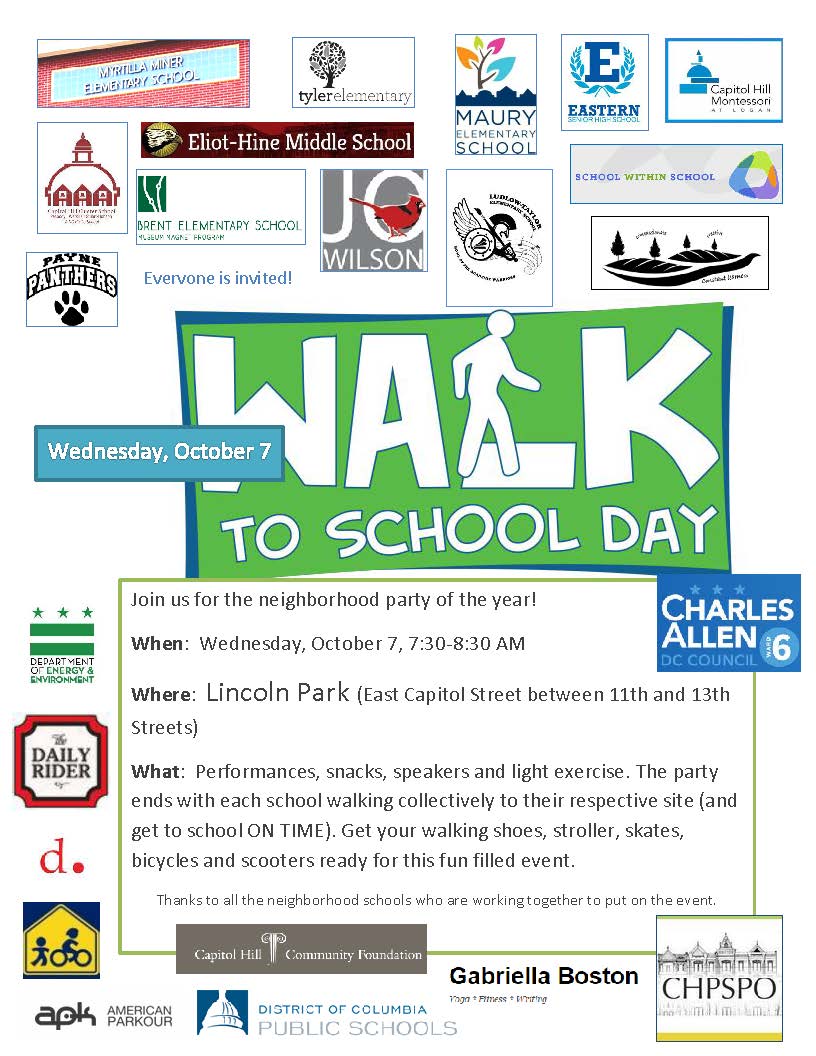
Walk to School Day is Wednesday, October 7 – register your school and join us!

Walk to School Day is Wednesday, October 7!

Join us at Lincoln Park, 7:30-8:30 AM for our annual early morning party with snacks, school performances, active transportation and education supporters, and this year – parkour and yoga!

Register your school here, to get swag for your school from DDoT’s safe routes program (and to show your support for keeping our routes to school safe for our families).

WalkToSchoolDay2015_Poster

CHPSPO Meeting Notes – September 15, 2015

Capitol Hill Public Schools Parent Organization
Stuart Hobson Middle School

September 15, 2015

1) Discussion about CHPSPO’s nomination to the Cross-Sector Task Force

  • Issues we think are important for the Task Force to address
    • Planning: # of seats, site selection, curriculum
    • Grade alignment (consistency around at grades are included in middle school)
    • Financial transparency
    • Long-term à amend the existing laws
    • Ways to foster stability throughout the school system
    • Ways to foster collaboration not competition
  • Discussion with people interested in serving on Task Force
    • Caryn Ernst (Capitol Hill Cluster School parent and former PTA president) and Sandra Moscoso (Capitol Hill Montessori at Logan & former LSAT Chair/BASISDC parent)
  • Voting on CHPSPO’s nomination
    • Caryn Ernst was selected to receive the CHPSPO nomination.

2) Discussion about educationdc.net blog, Valerie Jablow; http://educationdc.net/

  • Follow the blog via email, disseminate it into your communities and reach out to Valerie to contribute posts

3) Upcoming DC Council Education Committee hearings and events. Laura Marks

  • Visit here for calendar of Education Committee hearing dates in September and October 2015 and instructions for submitting testimony
  • Public School Food and Nutrition Services Programs and School Food and Nutrition Services Contract Requirement Act of 2015 – public roundtable. Wednesday, September 30, 2015, 10:00 a.m., Hearing Room 412 http://bit.ly/1KrvZx0
  • Early Learning Quality Improvement Network Amendment Act of 2015 and Higher Education Licensure Commission Amendment Act of 2015. Thursday, October 1, 2015, 10:00 a.m., Hearing Room 412 http://bit.ly/1WyW0nw
  • Public Charter School Fiscal Transparency Amendment Act of 2015. Wednesday, October 14, 2015, 1:00 p.m., Hearing Room 120 http://bit.ly/1NATvuJ

4) CHPSPO visits to Wilson Building, Ivan Frishberg.

In process of scheduling group visits with councilmembers on education committee.

5) DCPS Library Resourcing. Peter MacPherson.

  • Proposal to advocate for adequately resourcing DCPS libraries (recommended is 20 volumes/student, which is not currently the case at many schools). Idea is to apply the $13.7 million settlement from Chartwells towards funding volumes in schools without adequate collections.
  • Surveys were distributed to CHPSPO librarians to collect information about individual school collections. Please return completed surveys to Suzanne Wells.

6) Walk-to-School Day Planning, George Blackmon

  • Wednesday, October 7, 7:30-8:30 AM @ Lincoln Park
  • Schools are encouraged to hold their own events, if the distance to/from Lincoln Park is inconvenient.
  • Speakers; draft agenda:
    • 7:30: Arrival/Snacks and American Parkour Academy demos
    • 7:45: Ward 6 CM Charles Allen welcomes everyone
      • NOTE: Charles give a shout out to Mark Toorock and Matt Caraballo from American Parkour Academy (they won’t speak, but will be leading demos on the park).
    • 7:48: Maury ES Cheerleaders perform
    • 7:53 Miriam Kenyon, director of health and physical education at District of Columbia Public Schools (DCPS)
    • 7:56: Tommy Wells, Director of the District Department of the Environment
    • 7:59: JO Wilson ES Cheerleaders perform
    • 8:04: Fitness celebrity Gabriella Boston leads yoga stretch
    • 8:10: Charles Allen sends everyone off to school

7) American Parkour, Mark Toorock and Matt Caraballo info@americanparkour.com

Next CHPSPO Meeting:  October 20, 2015

Upcoming Events

September 30 Education Committee hearing on DCPS Food & Nutrition Services Program, 10AM

September 30  DCPS State of Schools with Chancellor Henderson, Dunbar HS, 7-9 PM

October 4        Brent Fall Festival

October 7        Walk-to-School Day (register your school at www.walkbiketoschool.org)

October 8        Jefferson Academy vs Stuart Hobson (6-8 PM @ Coolidge HS)

October 10      Capitol Hill Cluster School PTA Renovators Tour Fundraiser

October 17      Capitol Hill Community Foundation’s A Literary Feast (http://www.aliteraryfeast.org/)

October 21      Education Committee hearing on issues facing youth

October 24      Capitol Hill Montessori at Logan’s Haunted Harvest, 6-9PM

October 24      Maury Elementary’s Fall Festival

October 24      Tyler Elementary’s Harvest Festival, 11AM-3PM

November 8    JO Wilson’s Taste of H (http://www.tasteofh.org/)

CHPSPO meeting September 15 at Stuart Hobson

Dear Capitol Hill Public Schools Parent Organization members,

CHPSPO will meet on Tuesday, September 15, at 6:30 p.m. at Stuart Hobson, 410 E St., NE, Room 108.

We will be discussing the Cross-sector task force being organized by the Deputy Mayor for Education, and identifying one person we want to nominate to represent CHPSPO. We will also be discussing Walk-to-School Day (it looks like a bunch of our schools still need to register at http://www.walkbiketoschool.org), and upcoming visits to the Wilson Building.

Attached are the draft reports being prepared by OSSE to communicate the results of the PARCC test. Gwen Rubenstein at OSSE shared this current version of the report, and you should contact her, if you have additional comments.

Finally, please check out the new education blog created by CHPSPO member Valerie Jablow. Everyone is invited to contribute to this blog by writing about education issues important to you.

Hope to see you on Tuesday.

Suzanne Wells

091515 CHPSPO Agenda.docx

OSSE_ELA_Gr5_Graph.pdf

Join the DC education conversation with educationdc!

Join the DC education conversation!

New blog, educationdc (http://educationdc.net/), by DC parent and education advocate, Valerie Jablow, “is a public platform for all issues in DC public education, including research, ideas, and movements within public education in general and in DC in particular.”

The DC community is invited to read, share, engage, and contribute.

Start by discovering where all the 4th graders have gone

CHPSPO Meeting Notes – July 21, 2015

Capitol Hill Public Schools Parent Organization

Maury Elementary

July 21, 2015

OSSE Draft Parent Reports

Gwen Rubinstein with OSSE, and Steve Cartwright, a contractor for OSSE, shared drafts of reports being designed for parents to help them understand their child’s test results under the new Partnership for Assessment for Readiness for College and Careers (PARCC) tests.  Ms. Rubinstein explained the test results from school year 2014/2015 will not be available till the fall of 2015.  There were many comments about the draft report including:

  • Because it is anticipated test scores will drop under PARCC when compared with the DC CAS, some explanation about the differences in the two test results is needed;
  • The range for the test scores is between 500 and 580, and it is not clear why the scores are in this range as opposed to 0 to 80, for example;
  • It was suggested that the words describing the level of understanding, e.g., moderate understanding, be more prominent rather than performance level, e.g., Level 3, and the overall score, e.g., 556 which have little meaning to parents;
  • The term “distinguished” understanding is likely not to be understood;
  • When it says “David is growing slower than other students at the same level of prior achievement,” is this a comparison within the individual school or a system-wide comparison, or a comparison across states?
  • The term LEA is not familiar to most parents; and it isn’t clear what it means on the draft report
  • The comparisons between the overall score that is on a scale of 500 to 580 and the English Language Arts Scoring Categories (reading is out of 60 and writing is out of 40) is confusing;
  • Under the questions to ask your child’s teacher there are a series of suggestions related to what the parent can do to support the child’s learning. Equally important to know is what support is being provided by the school to help the child obtain a proficient or above level;
  • Under the section that describes what the child needs to improve his knowledge and skills, some of the language is likely not familiar to parents, e.g., “…writing prompts.”

We invited Ms. Rubinstein to come back to the September CHPSPO meeting to share the revised reports.

Faith Hubbard, State Board of Education (SBOE) Student Advocate

Ms. Hubbard explained her position is a newly legislated role that was created in the Student and Parent Empowerment Act.  While the position is within the SBOE, it is independent of the SBOE.  Ms. Hubbard sees the role as open-ended right now.  The role is designed to look out for multiple interests of families, and work to help families navigate the system.  Ms. Hubbard sees her role including being a resource for individual parents.

Ms. Hubbard described two projects she is actively working on and/or exploring:

  1. Providing parent leadership and advocacy training. This program has been successful in Connecticut (http://www.cga.ct.gov/coc/plti.htm), and has worked well in other cities.
  2. Creating a website with information on the District’s school governance structure, and a broad array of education resources.

Ms. Hubbard also described how the Ward 5 Education Council operates (Ms. Hubbard was the president of the Ward 5 Education Council prior to her appointment as the Student Advocate.  The Ward 5 Education Council was established in 1985, and Ms. Hubbard got involved in the Council a few years ago.  The Ward 5 Education Council has a president, 1st VP, 2nd VP, 3rd VP, Treasurer and Secretary.

Visits to City Councilmembers at the Wilson Building

Ivan Frishberg discussed scheduling another round of visits to the Wilson building to meet with City Councilmembers.  We discussed continuing a focus on school modernizations.  There was support for scheduling the meetings in September.

Walk-to-School Day, October 7

The following people volunteered to help plan Walk-to-School Day:

  • Danica Petroshius – Lincoln Park permit
  • Suzanne Wells – Capitol Hill Community Foundation mini-grant
  • Erin Roth and George Blackmon – bag donations
  • Shahna Gooneratne – DC Water (bottles and Wendy the Water Drop)
  • Beth Bacon and Sandra Moscoso – Line up speakers
  • George has already confirmed the Maury cheerleaders will perform
  • All schools are encouraged to register at www.walkbiketoschool.org

CHPSPO Meeting – July 21 at Maury ES

CHPSPO will meet on Tuesday, July 21, at 6:30 p.m. at Maury Elementary (1250 Constitution Ave., NE).

We will be joined by Gwen Rubinstein from OSSE who will be sharing draft parent reports, and Faith Hubbard who is the new Student Advocate with the State Board of Education.

Attached is the list of the PTA presidents and each school’s CHPSPO representative. Please send me any updates you have to your school’s contacts. Thanks!

Suzanne Wells

072115 CHPSPO Agenda.docx

CHPSPO School Year 2015 2016 Representatives.docx

Notes from Ward 6 Speaks – A Community Forum on Language Immersion Programs

Ward 6 Speaks

A Community Forum on Language Immersion Programs

June 11, 2015

Tyler Elementary School

1001 G St., SE, Washington, DC


Ward 6 Speaks was sponsored by the DC Language Immersion Project (www.dcimmersion.org) and the Capitol Hill Public Schools Parent Organization (www.CHPSPO.org). The goals of the evening were for the attendees to leave knowing more about language immersion programs than they knew before coming to the forum, and for them to be able to use what they learn to have further conversations about language immersion programs in Ward 6.

Principal of Tyler Elementary, Mitchell Brunson, welcomed the audience to Tyler and to the evening’s program.

There was a showing of the video Lead with Languages.

Vanessa Bertelli, co-founder of the DC Language Immersion Project, introduced the panelists.

Dr. Robert Slater, Co-Director of American Councils Rsearch Center at American Councils for International Education

Dr. Slater discussed a major, federally-funded study on language immersion programs that is on students in Portland, OR.  This study is looking at the relationship between language immersion programs and academic performance in students in grades K through 8th.  Currently the study is in its third year.  The Portland study is important because most studies to date on language immersion programs have looked at a group of students who self-select for language immersion programs.  There is a random assignment of students into the language immersion programs in Portland, and therefore, the Portland study eliminates selection bias.  In Portland, 4,500 students are in language immersion programs, and 45% of the students are eligible for free and reduced lunch.


Research to date has shown cognitive benefits from being in language immersion programs, and the studies suggest language immersion programs have the potential to close the achievement gaps.  Individuals with the ability to speak two or more languages are generally higher academic achievers and have higher earning powers.

The Portland study is looking at student achievement in math, reading, attendance, and retention.  To date, the Portland study is showing positive effects in reading in grades 4 and 6; positive attendance effects in grades 1, 5, and 7.  To date, there have not been positive effects shown for math.  In Portland, families in language immersion programs tend to stay in the school district beyond 1st grade.

Language immersion programs are not panaceas for education.  It takes hard work, including a focus on teacher development.  It is a potentially powerful tool when done right.  It is important to be careful about expansion.  Starting a lot of language immersion programs without the proper support will likely not result in intended benefits.

Pearl You, Washington Yu Ying Public Charter School

Ms. You discussed the highlights, challenges, and next steps facing Yu Ying.  Yu Ying has been in existence for seven years.  It is an International Bacaulaureate school.  39% of the students are African American, 38% White, 6% Hispanic, and 3% Chinese.  The school generally scores in the top 10 on the DC Comprehensive Assessment Test (DC CAS) among all the charter schools.

Yu Ying has a Chinese Literacy Program.  They work in writing, guided reading, listen to reading, read to self, and work hard.

Yu Ying provides home resource support, and a parent portal to help families who don’t speak Chinese at home.

Teacher training consists of 1) pre-service/practicums, internships, student learning; 2) novice/mentor program; and 3) in-service.

Challenges include teacher recruitment, training and retention.  Teachers coming from China have litter experience working with American students or the American pedagogy.  They have been successful hiring students from NYC and University of Maryland.

Sara Arranz and Mieya Timmons, Cleveland Elementary School

Sara discussed the student population at Cleveland Elementary.  51% of the students are at-risk, and 66% of the students are black and 29% Hispanic.

Sara teaches “in” Spanish.  You must respect the “silent” period when children are learning the language.  The second language must be embedded in the content.  There must be a commitment and resources.  The children need a lot of exposure to the second language.  There is a lot of repetition.  You have to simplify the instruction.  They use a project-based approach with a lot of visuals and manipulations.

Where is the magic?  There is a tremendous amount of power in the community of parents, teachers, administrators and students working together.  The data are showing better performance.  Use a data wall, individual plan of work, and blended learning model.

Mieya spoke about the support for families that is provided at Cleveland.

Jimell Sanders, co-founder of DC Immersion Project

Ms. Sanders lives in Ward 7 in the Deanwood community, and is in-bounds for Houston Elementary.   She has a 21-month old child.

The DC Immersion Project wants to help ensure all Wards have the option of language immersion programs.  She suggested getting in contact with other parents to find out if they are interested.  It is imperative that the principal be supportive.  You also need to educate teachers at the school.  It is a process; there must be multiple conversations in the community.  Talk with prospective and current parents in the community.  Language immersion programs take money.  The DC area has so many resources, e.g., organizations that could help support language immersion programs.  Ms. Sanders said it has taken about 18 months to begin the language immersion program at Houston Elementary.

Katarina Brito, DCPS Bilingual Program Developer, Language Acquisition Division

Bilingual language immersion programs were originally intended to serve English language learners, and getting them to learn English was the goal.

Bilingual instruction benefits all students.  DCPS has made great strides in language immersion offerings.  In 2003, there was one dual-language immersion program in DCPS with 400 students in grades pre-K to 6th.  In 2015 there are nine dual language programs serving 3000 students in grades preK-3 to 11th grade.

DCPS has also committed to Foreign Language in Elementary School (FLES) where all students are exposed to one or more classes a week in another language.

DCPS has formed an Office of Global Education.

Soon there will be a focused middle school, McFarland, and high school, Roosevelt.  DCPS is starting a Seal of Bi-literacy for student who graduate with proficiency in a second language.

DCPS is exploring ways to bringing sustainable and carefully designed dual language programs to underserved communities.

DCPS is encouraging school leaders and communities to explore dual language; there need to be whole school community conversations.

DCPS has put in place a Dual Language Application.  It is a multi-year process.

Io Ken, 4th grade student at Tyler Elementary’s Spanish Immersion Program

Hola.  Me llamo Io y soy una estudiante en la escuela Tyler en la clase de cuarto grado.

Tengo una pregunta para ustedes.  Cuales son los beneficios de aprender un segundo idioma?

Voy a empezar con mis razones.

Primero, aprendiendo un segundo idioma puedo tener conversaciones con personas que no hablan mi idioma nativo.

Segundo, aprendiendo otro idioma como el español es mas fácil aprender un otro idioma similar.

Tercero, si sabes muchas idiomas puedes ir a otros países y hablar el idioma.  Por ejemplo, mi familia y yo vamos a viajar a Chile para seis meses.

Cuarto, saber otros idiomas puede ayudar con su confidencia.  Mi amiga Amina dice “aunque no lo dices supercorrecto, hay personas que no pueden decir “uno””!

Cinco, para muchas personas es “cool”!

Mas importante que todo, investigaciones científicas dicen que aprender un segundo idioma puede ayudar tu cerebro a ser mejor, mas rapido.

Yo no estoy aquí para disfrutar la atención, sino para asegurarme que todos niños en nuestro país puedan tener las mismas oportunidades y posibilidades que yo tengo en la programa de inmersión.  Un segundo idioma te ayuda a comprender ideas en una manera mejor.  Así que podemos ser como niños en muchísimos otros países del mundo que ya aprenden dos idiomas o mas.


(English Translation)

Hello.  My name is Io, and I am a student at Tyler Elementary in the 4th grade.
I asked myself a question, and maybe a question all of you could ask yourself.  What are the benefits of students learning another language?  Let me start with my reasons.

First, learning a second language can help you converse with people who don’t speak your native language.

Second, learning a second language, such as Spanish, can help you learn other similar languages.

Third, if you know multiple languages you can travel to other countries and speak the language.  For example, my family and I are moving to Chile for six months.

Fourth, learning other languages can boost you confidence.  My best friend Amina says, “Even if you mess up, some people can’t even say uno.”

Fifth, socially it’s cool.

But the most important reasons is that research shows learning a second language can help you organize your mind and process things better and faster.

I am here not for the attention, but to make sure that every kid can have the opportunities and possibilities I have in the dual-language program.  A second language helps you understand concepts better.  And we will be like kids all over the world that learn at least two languages.