DC Council Education Committee Budget Hearing – Testimony by Elizabeth Bacon, Watkins ES

Good morning. I’m Elizabeth Bacon, a parent at Watkins Elementary School. I serve on the Capitol Hill Cluster School PTA leadership and on the LSAT, and I’ve spent many hours investigating our school budget.

The Cluster School is a Pre-K3 through 8th grade school with 1,300 students at three campuses (Peabody Early Childhood, Watkins Elementary, and Stuart-Hobson Middle School) — with steady enrollment, strong test scores, healthy vertical integration, and students from all over the city.

Per Pupil Funding Minimum (PPFM) Allocation

Over the years, we’ve dealt with funding fluctuations because of enrollment changes and the budgeting premise that there should be a minimum “per pupil spend.” This year, we were fortunate — Watkins received a welcome extra lump sum of $379,000 in order to meet the per pupil funding minimum (PPFM) floor.

This extra funding was meaningful: it allows us to more adequately staff our school of more than 500 students. But because this extra funding is an accounting loophole in the staffing formula for large schools, we worry that we will not be able to count on it next year. What will happen if the DCPS staffing model changes, and the “floor” changes? That means we could again lose staffing: our instructional aides, our counselor and a technology coordinator.  DCPS would say that’s just the way the funding “floor” worked out. But there shouldn’t be so much variance from year to year in funding floors and staffing models. It makes it hard for schools to maintain continuity in programs and staff.

We are also concerned how this bump to reach the “floor” is going to many schools with fewer needs. For example, Deal Middle School received a $2 million lump sum to reach the floor — that’s an extra $1679 per student. What a boon a sum even half that size would have been for Stuart-Hobson Middle School.


Middle School Projected Enrollment FARM (SY 2013-14) Per student amount from the PPFF minimum “bump” in FY15 Level of studentperformance
Deal MS 1310 21% $1679 per student Reward
Stuart-Hobson MS 424 57% $0 per student Rising
Hardy 400 55% $0 per student Rising
Jefferson 307 99% $0 per student Reward
Eliot-Hine 275 99% $0 per student Rising

Of the 5 DCPS elementary schools receiving the PPFM in FY15, Watkins has by far the highest number of FARM-eligible students and the second to lowest per pupil funding minimum allocation. Of these 5 schools, Watkins is the only school on the list that is below “reward” in student performance, which is another indicator of need.


Elementary School Projected Enrollment FARM (SY 2013-14) PPFF minimum in FY15 Level of studentperformance
Lafayette ES 700 7% $883,418 Reward
Murch ES 680 9% $722,699 Reward
Janney ES 672 4% $864,355 Reward
Eaton ES 477 17% $131,565 Reward
Watkins ES 523 38% $379,176 Rising

At-risk Student Funding & Additional Investment

I followed with great interest the passage of the Fair Funding Act, the Adequacy Study commissioned by the Deputy Mayor of Education, the Chancellor’s top goal to improve middle schools, and the Chancellor’s direction to LSATs to plan for a 10% increase in funding.

Come budget time, I and my fellow education advocates were anticipating additional money to support our school, particularly our at-risk students and middle schools. But in the Cluster School budget, I saw:

  • No allocation to our school marked for at-risk kids and no specific data breakdown for our at-risk students population, according to the categories in the Fair Funding Act
  • No direction to our administration or LSAT to determine how to spend additional funds to really make an impact for the kids who need the most support
  • No sign of additional investment for our middle school beyond  $100,000 extra for “socio-emotional support” (As an aside, an example of real investment would be support specialized programs at each of the Ward 6 middle schools, as DCPS agreed to four years ago — in the Ward 6 Middle Schools Plan — but has yet not funded.)
  • The PWP Student Satisfaction allotment included in the top-line of the budget — which seemed somewhat disingenuous given that money was already spoken for and had came with many strings attached
  • No significant increase in overall funding, as the Chancellor had all but promised

Where exactly is the additional $44 million in support for at-risk kids? Is most of it going to the lowest 40 performing schools? To other “Chancellor’s initiatives”? To the PWP Student Satisfaction allocations?

Where is the explicit investment in our middle schools, as one of the top goals of this budget cycle? To extended day for some middle schools? To socio-emotional support?

Parents and the public deserve answers to these questions from DCPS in a transparent and upfront accounting.

Investment & Continuity

If we really believe in the potential of our public schools — and if we are committed to their success — we need investment and we need continuity in funding. We need investments in our programs and staff and continuity in those investments — not less-than-predictable fluctuations year to year. And we need investments in our fully utilized school buildings — especially not to be asked to wait another year for modern facilities at Watkins Elementary.

——————————

Testimony of

Elizabeth Bacon

Capitol Hill Cluster School PTA and LSAT Representative 

Education Budget Oversight Hearing

Thursday, April 17, 2014  10:00 a.m.

John A. Wilson Building, Room 500
DC Council Education Committee Budget Hearing – Testimony by Kevin White, Watkins ES

Good morning.  My name is Kevin White.  I will have a 4th grader and a 1st grader at Watkins next year.  Ms. Reese’s testimony has very clearly outlined many of the physical needs at Watkins.   There are many more, such as an original out of date elevator (out of operations for the last month), an exterior façade which doesn’t keep rain out of classrooms, an undersized kitchen that can’t efficiently serve our children lunch in the time available, and the complications around sharing space with a co-located DPR recreation center (when the school is already overcrowded).

I could go on, but my testimony today will focus on some global questions with respect to the funding proposals advanced in Mayor Gray’s 6-year CIP budget proposal.

Where is the unbiased planning and rational implementation for school modernizations?

Why does the Mayor propose re-opening Spingarn High School with a commitment of $31 million in FY15 when the school was just closed in 2013?    Why is opening another high school a budget priority when there are several newly renovated DCPS high schools which are under enrolled and under capacity? Why is Spingarn a priority over a fully-enrolled and over crowded elementary school?

Why does the Mayor prioritize additional capital improvements totaling $58 million for five elementary schools[i] that have already received enhanced phase 1 modernizations as recently as 2012 and 2013 when schools like Watkins[ii] do not meet current building code standards?  Sure, temporary buildings are not ideal, but they are in far better condition than the 52-year old Watkins building.  So why must Watkins continue to wait for initial stabilizing investments while others get multiple investments in less than three years?

The Mayor’s budget proposal invests nearly $17m for Goding over a 5-year period starting in FY15.  This eclipses the total proposed investment at Watkins over the same period and includes a second phase 1 modernization for Goding, which already received a phase 1 modernization in 2005 and additional improvements just last year.  It should also be noted that the Goding building isn’t even at 100% capacity.  What does this building really require in the near term that could possibly trump the substandard and unsafe conditions at Watkins that have yet to be addressed?

I urge the District government to begin making rational decisions about school modernization based on observable and quantifiable building conditions.

Let’s not confuse the feel-good nature of supporting again and again the sought-after schools with doing the right thing –

✓  correcting deplorable conditions of buildings in the worst shape prior to making supplementary investments at schools that have already been stabilized.

Let’s not confuse the desire to be responsive to well-coordinated, and sophisticated advocacy efforts with doing the right thing –

✓  responding to the well-documented needs of the most decrepit buildings first and in a deliberate, rational, and equitable manner.

Watkins can’t wait another 2 years for its phase 1 modernization.  Thank you for your consideration.

————————–

[i]

School Enhanced Phase 1 Completed Proposed FY 15 Capital Improvement Program Addition
Hearst Elementary 2012 / 2013 $14,500,000 Yes
Mann Elementary 2012 / 2013 $5,500,000 Yes
Powell Elementary 2012 $9,909,000 Yes
Shepherd Elementary 2013 $8,167,000 Yes
Lafayette Elementary 2013 $20,341,000 Yes
  TOTAL $58,417,000  
Watkins Elementary Not applicable. $0 Needed, but unknown if DC Government will make the commitment


[ii] Murch and Garrison come to mind as other schools whose initial investments have been bumped back while other schools have enjoyed multiple years of supplemental investments.  However, Murch and Garrison appear to be set to be very well cared for in the next three years.  Murch is proposed to receive $40.3 million between FY15 – FY17.  Garrison is proposed to receive $38,000 between FY 15 – FY17.  During the same period, Watkins will receive just $14.2 million in capital investments.

——————————

Testimony of

Kevin White

Parent at Watkins Elementary

Education Budget Oversight Hearing

Thursday, April 17, 2014  10:00 a.m.

John A. Wilson Building, Room 500
DC Council Education Committee Budget Hearing – Testimony by Bernetta Reese, Watkins ES

Good morning.  My name is Bernetta Reese and I am here to represent 540 students at Watkins Elementary.  I have 2 students in the first and third grade at the school. As a parent and representative of my school community, I want to say to you today that I am disappointed that Mayor Gray’s budget has pushed Watkins modernization back to Fiscal Year 2016 which means it has been moved back three times in the last four budget cycles.  Watkins can no longer wait for modernization.  Our school has many issues that need to be addressed.


In the 2008 DCPS Master Facility Plan for Watkins, 7 of the 10 major building systems as were marked as “Poor” or “Unsatisfactory.”  The school does not meet current building code standards and physical deficiencies are well-documented in the report.  The fire alarm system is non-compliant and the building does not have a sprinkler system.  This is especially concerning given that last year, there were two gas leaks at the school and the building had to be evacuated.  This is an urgent matter that affects the learning environment and safety of our children.


In addition, Watkins building temperature is such that students have had to wear winter coats with hoods depending on where they are in the building. During the week of DCCAS, air conditioning was needed but it was not available – making the learning and testing environment more difficult for our students.


The DCPS Education Specification for Watkins reveals that 85% of our classrooms are too small which means our school is overcrowded.  Our multipurpose room/cafeteria is less than half the size it should be for a combined use room.  Because of this, indoor recess is held in a 1200 square foot room converted from classroom space.  This space is just 36% of the size that it should be.

We appreciate the effort by this Committee last year to secure funding for new windows to be installed this summer.  But it’s not enough and Watkins cannot be ignored for another 2 years. We are in dire need for phase 1 of the modernization to begin to provide our children with a healthy and safer school.  Thank you for your time.

——————————

Testimony of

Bernetta Reese

Parent at Watkins Elementary

Education Budget Oversight Hearing

Thursday, April 17, 2014  10:00 a.m.

John A. Wilson Building, Room 500
DC Council Education Committee Budget Hearing – Testimony by Suzanna Dennis, Payne ES

Good morning.  My name is Suzanna Dennis, and I have a daughter in the PK-3 program at Daniel A. Payne Elementary School on Capitol Hill.  Before I begin, I want to thank the Council, Mayor & DCPS for their time and continued support this year.


1. Overview

In the past year I have had an overwhelmingly positive experience as a parent at Payne Elementary.  The teachers, administration, and Principal are fully committed to providing a healthy learning environment.


As you know, Payne fills a unique need on Capitol Hill.  It currently serves 272 students, and enrollment is projected to grow.  Payne is known for its strong leadership; its high quality early childhood curriculum; its program integrating children with hearing impairments with hearing students; its special education services, including a program for children with emotional behavioral disabilities; and as the neighborhood school for children from the DC General Families Shelter.


There is growing PTA, as well as a committed group of prospective parents, neighbors and business owners allied to support the school through the Friends of Payne.  We’re continuing to grow that support through various initiatives, including expanding the school garden program this spring.


2. Budget

As you know, the school has been planning for Phase I of its long-needed and anticipated modernization this summer.  In February/March we had a great showing of school and broader community support to make sure Payne’s renovation goes ahead as planned.  Earlier this month the Mayor’s office submitted to the Council a reprogramming that meets two important goals.  First, it substantially increases Payne’s total capital budget by approximately thirty percent.  Second, it accelerates the renovation schedule by allocating all of the capital dollars in FY14, presumably with the expectation that the whole project will be completed this fiscal year between June and August.  It is my understanding that this new budget fully meets the school’s modernization needs.


Payne now has the exciting challenge of planning an $18 million renovation for all three Phases in the next two months, and executing that plan over the summer.  I remain hopeful that officials will be able to plan for and expend the entire $18 million budget prior to the end of this fiscal year.  Given the ambitious timing and size of the reprogramming, this will be a challenge, but a welcome one given the long standing and extensive capital renovation needs at Payne Elementary.


The Payne community stands committed to providing whatever planning and other support is needed to ensure that the project is completed on schedule.  We ask that the Council, through its oversight role, assist us in this effort.

Payne’s proposed operating budget for 2015 is $3.851 million.  This amount will pay for teachers—including early childhood and special education—the school’s leadership and administrative support, after school and library programs, and facility costs.


3. Closing

I am proud to send my daughter to Payne Elementary.  As a parent, a member of the PTSA, and the Friends of Payne, I look forward to working with the Council to support the great efforts already underway.  These efforts will build on Payne’s historic legacy to make Payne one of Capitol Hill’s most sought after schools.  Much needed improvements to the facility will make a big difference in the academic experience of its students and in the overall success of the school.


Since Payne serves some of the city’s most vulnerable elementary students, the Council’s continued dedication to improving neighborhood safety and community services–such as the families’ shelter–will also help bolster children’s learning experience at Payne.


I want to thank the Council again for their time and their continuing support of Payne Elementary.   We look forward to keeping this Committee apprised of our efforts, including the progress with the modernization.


———-

Testimony before DC Council Committee on Education, Budget Hearing

Suzanna Dennis/Payne Elementary

4/17/2014


CHPSPO Meeting April 23

Dear Capitol Hill Public School Parent Organization members,

CHPSPO will not meet on the third Tuesday of April because of Spring break. Our next meeting will be Wednesday, April 23 (note that we will not meet on April 22 as previously planned due to a hearing the Public Charter School Board is holding on April 22). The meeting will be from 6:30 p.m. – 8 p.m.

The Mayor’s Fiscal Year 15 DCPS budget was released on Thursday. Here is a link to the budget:
http://cfo.dc.gov/sites/default/files/dc/sites/ocfo/publication/attachments/ga_dcps_chapter_2015.pdf

The City Council is holding a hearing on the budget on April 17. If you are in town, and want to testify, the hearing will start at 10 a.m. in room 500 at the Wilson building. Contact Jamaal Jordan at jjordan or call 724-8061.

Mayor’s Budget Townhall

Monday, April 21, 6:30-8:30 PM

Capitol Hill Montessori @ Logan, 215 G St., NE

http://budget.dc.gov/community-meetings

—————————–

Boundary Review

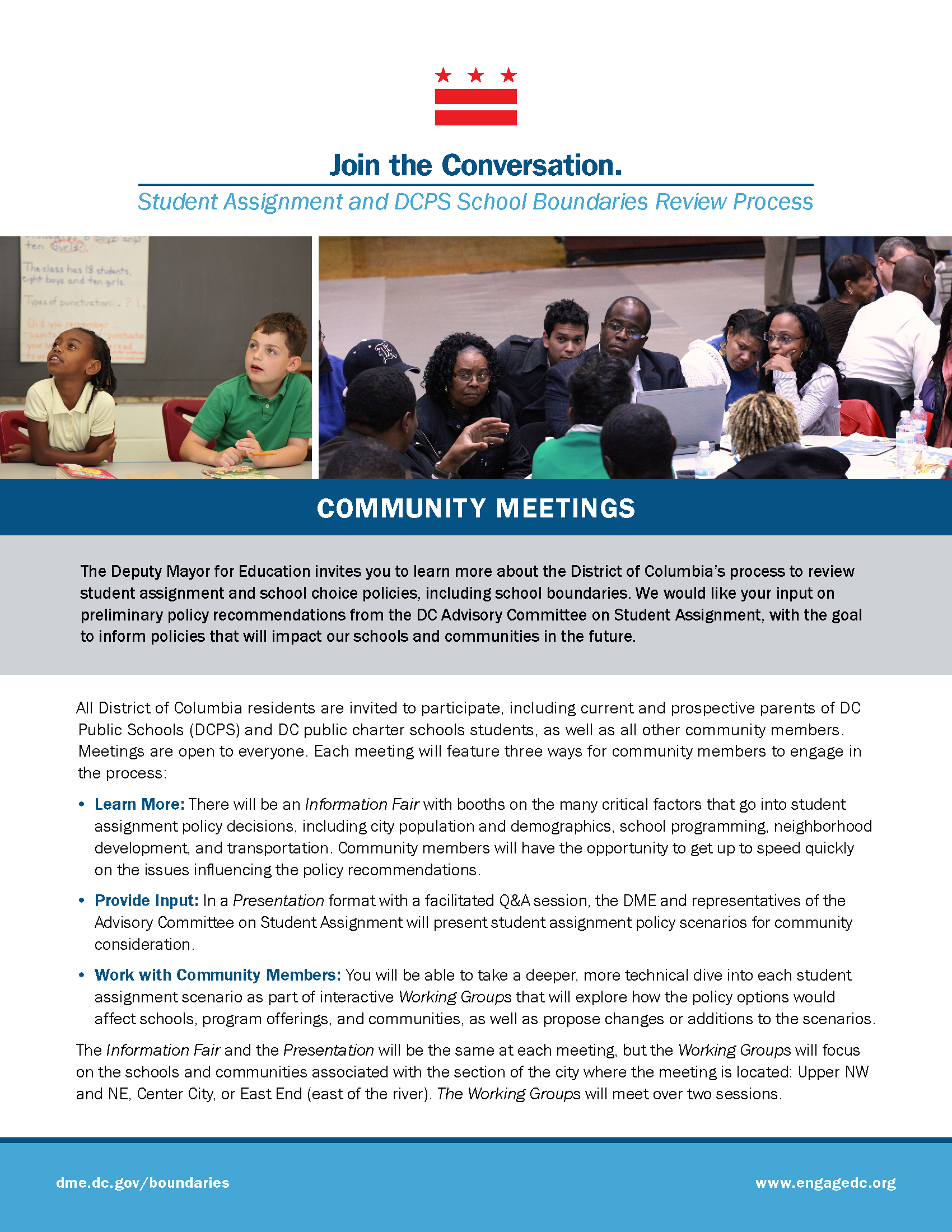
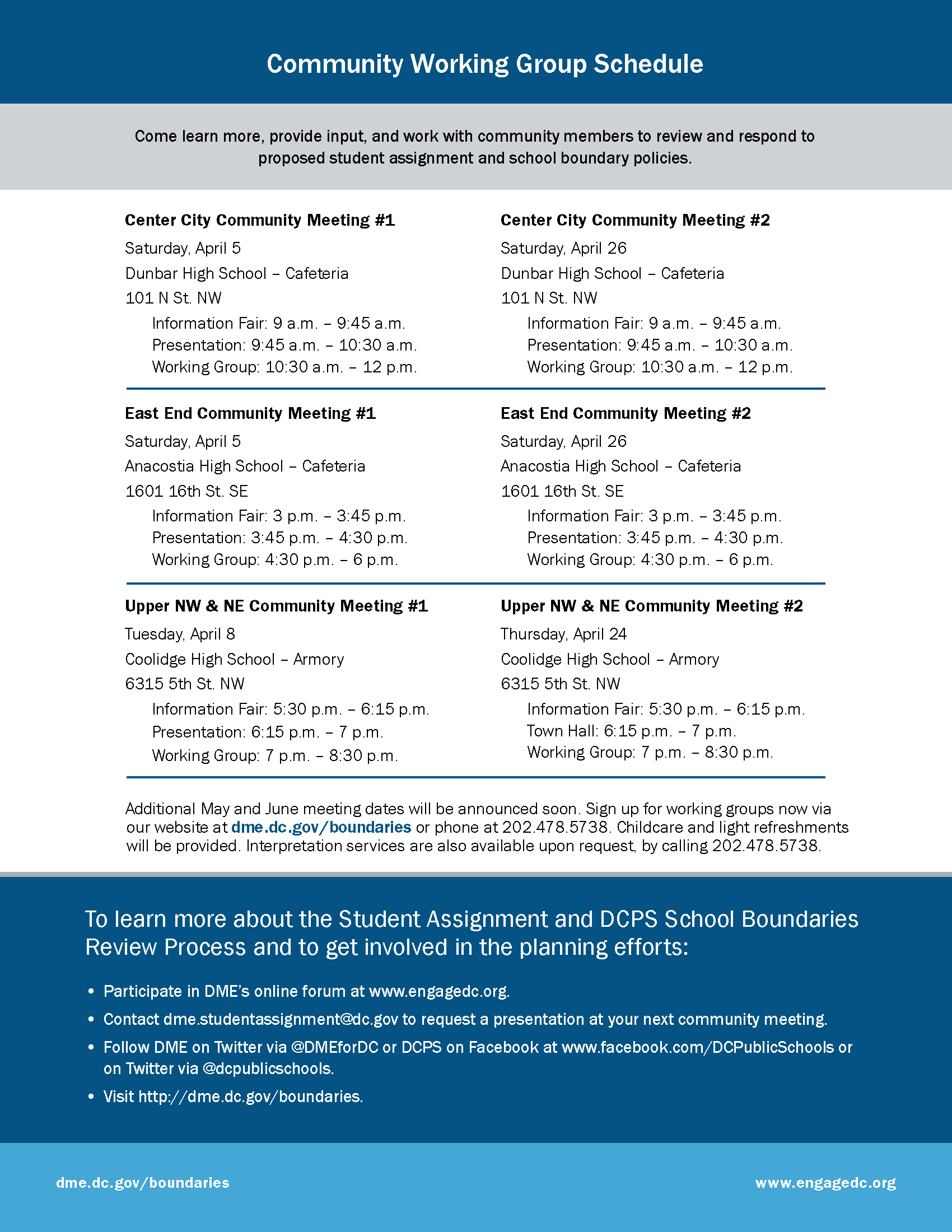
Most of you received robo calls about the upcoming community meetings being held on the school boundaries and feeder patterns. These are important meetings to make your voices heard. There will be community meetings this Saturday at Dunbar and Saturday, April 26, also at Dunbar.

Center City Community Meeting #1
Saturday, April 5
Dunbar High School – Cafeteria
101 N St. NW
Information Fair: 9 a.m. – 9:45 a.m.
Presentation: 9:45 a.m. – 10:30 a.m.
Working Group: 10:30 a.m. – 12 p.m.

Center City Community Meeting #2
Saturday, April 26
Dunbar High School – Cafeteria
101 N St. NW

Information Fair: 9 a.m. – 9:45 a.m.
Presentation: 9:45 a.m. – 10:30 a.m.

Working Group: 10:30 a.m. – 12 p.m.

Visit http://dme.dc.gov/boundaries for more information.

Suzanne Wells

Initial Reactions to DME Boundary Review – Policy Examples and Draft Boundary Changes

DME released DRAFT EXAMPLES of policies (not final) for review and feedback from community and working groups. Here’s a compilation of initial reactions on Twitter: https://storify.com/CHPSPO/dme-boundary-review-policy-examples-open-houses-an

DME Boundary Review Open House Dates and Locations

Community Working Groups Flyer - English_Page_1

Community Working Groups Flyer - English_Page_2

Bike to School Day is May 7 – have you registered your school?

BTSD_2inch_ColorHealth and Wellness teams, Safe Routes to School committees, and cycling enthusiasts, have you registered your school for Bike to School Day?

The big day is Wednesday, May 7. Register your school here (for goodies from DC’s Department of Transportation) and plan your event or help plan a joint school event at Lincoln Park!

How can you help? Easy!

  • Reach out to your favorite bike-friendly group or business to solicit healthy breakfast snacks for kids, coffee for adults, reusable bags to distribute goodies at the Lincoln Park pit stop (Vigilante Coffee, Pound, Port City Java, Whole Foods, Georgetown Sports, Medstar Georgetown, DC Water, The Daily Rider, Bicycle Space, and Clif Kids have all supported us in the past)
  • Write a small grant request (from Capitol Hill Community Foundation, who always generously support us) to fund snack purchase and National Parks and Rec permit
  • Bring folding tables to Lincoln Park to set up give aways, snacks
  • Reach out to your favorite bike-friendly group, personality, local celebrity to say a few encouraging words at the event, and to help launch bike trains to school (Gabriella Boston, Capitol Hill Martial Arts & Fitness Academy, Eazy 8/Kathy Pugh, CM Tommy Wells, the Long-Short Walk, National Center for Safe Routes to School, and DC’s Dept of Transportation have supported us in the past)
  • Score useful swag for the kiddos (reflectors, bells, water bottles) to hand out
  • Arrange for local safety groups like MPD, DCFD to participate
  • Coordinate and lead bike trains to your schools
  • MOST IMPORTANTLY – get the word out to your school communities, local media and community groups to make sure they participate, and join in the fun!

Contact us at chpspo at gmail dot com to volunteer.

Brush up on your bike safety skills and sure you and your family attend Kidical Mass DC’s ABCs of Family Biking on May 3, 11-2 @ Capitol Hill Montessori at Logan (215 G Street, NE).

Lottery results are in: Are you considering Payne ES for your child?

If yes, then please join the Friends of Payne, including current Payne parents, for an informal meeting on April 19:

  • What: an opportunity to hear from current Payne parents about their kids’ experiences at the school, including with the early childhood Tools of the Mind program.
  • Who: all prospective Payne parents are welcome!
  • Where: at the home of a member of Friends of Payne at 15th and A Streets, SE. For more details and to RSVP, please contact Amy Mauro at friendsofpayne@gmail.com.
  • When: April 19 at 10 a.m.


Mayoral Candidate Responses to Citywide Education survey – #DCISION14

CHPSPO was proud to work with other education advocacy groups in the city to develop a questionnaire for the mayoral candidates focused on education issues.  Candidates Muriel Bowser, Jack Evans, Andy Shallal and Tommy Wells submitted the following responses to the questionnaire. Read the responses here.